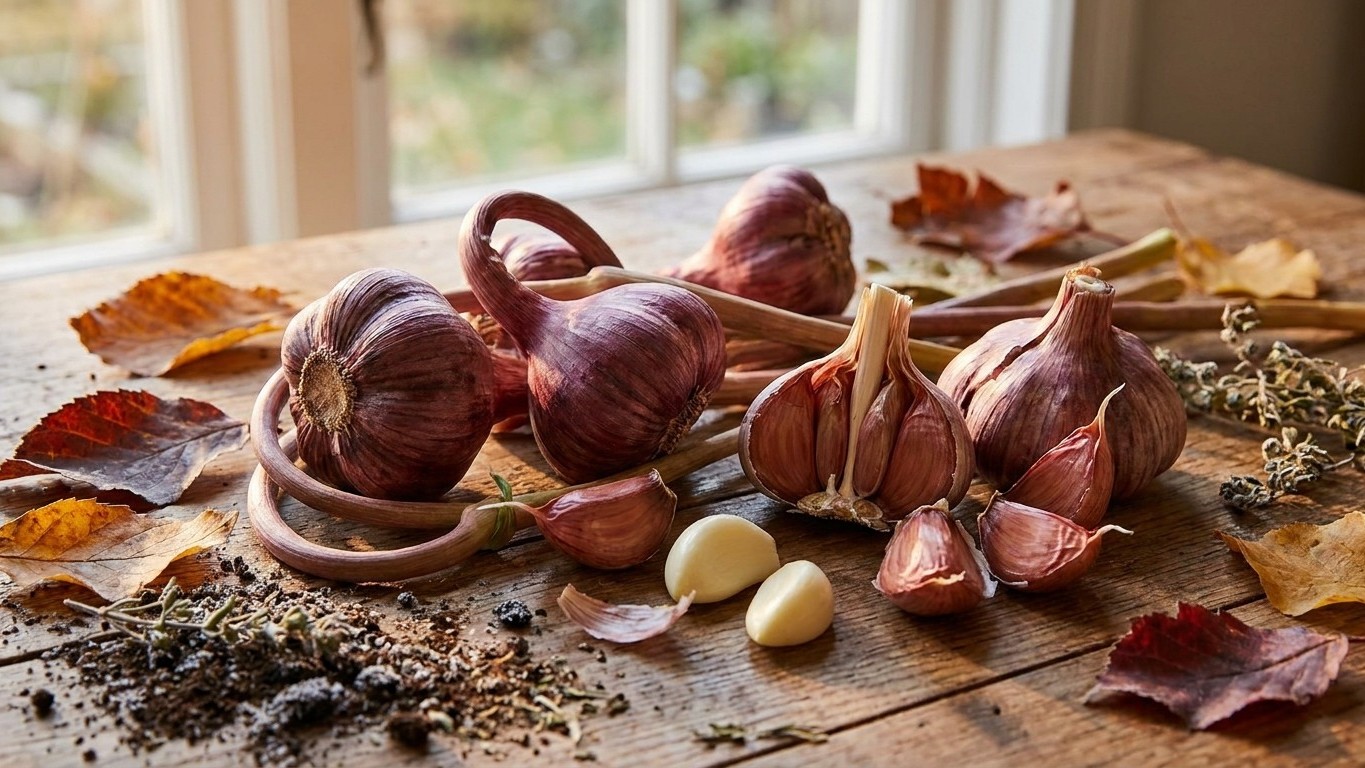

Russian Red garlic is a rocambole hardneck, the type that only makes true, well-divided heads after a real winter chill. Plant the cloves in fall, four to six weeks before the ground freezes solid, so roots take hold before the cold sets in. Skip that chill, or plant too late, and you’ll lift a single round bulb instead of a head of cloves.
What Russian Red actually is

Russian Red belongs to the rocambole group, one of the five recognized botanical types of garlic (the others being Porcelain, Purple Stripe, Artichoke and Silverskin). Rocambole is always hardneck: it sends up a rigid central stalk, called a scape, that curls before it’s cut.
On flavor, the catalog description is blunt: “If a flavor-forward garlic is your jam, then this heirloom will suit you very well.” That’s a stronger claim than most catalogs make about their milder softneck lines, and it lines up with what rocambole types are generally known for among growers who compare varieties side by side.
In the kitchen, expect four to twelve cloves per head. They peel easily, which is one of rocambole’s real selling points over the fussier, papery-skinned softnecks. The tradeoff is storage life: Russian Red keeps only three to four months at room temperature, well short of what a Silverskin or Artichoke type will give you. The practical advice that follows from that number is simple: eat this one first, and don’t count on it lasting through winter.
There are no published disease or pest resistances for this variety. That’s not a red flag by itself, since a lot of heirloom garlic lines were never formally tested for resistance codes, but it does mean you shouldn’t plant Russian Red expecting it to shrug off a fusarium or nematode problem that’s already in your soil.
Will it get the cold it needs where you are
This is where most garlic advice falls apart, because it treats the whole country as one climate. Garlic clove division depends on vernalization, a sustained stretch of cold weather after planting that triggers the single clove to split into a multi-clove head. Skip that cold exposure and the plant just makes one round, undivided bulb, sometimes called a “round” by growers, which is edible but not what you planted for.
Hardneck types like Russian Red are the ones bred and selected in places where that cold arrives reliably and lasts. Regions with long, cold winters give this variety exactly what it wants without any help from the grower.
Where the cold comes easily, where it’s marginal, and where it doesn’t come at all
| Region type | Examples | Cold exposure for Russian Red |
|---|---|---|
| Cold winter | Upper Midwest, Northern New England, Rocky Mountain interior | Comfortable. Winters run long and cold enough that vernalization happens without any intervention. |
| Moderate winter | Mid-Atlantic, Ohio Valley, Pacific Northwest interior | Marginal. Most years deliver enough cold, but a mild winter can shortchange the crop. |
| Warm winter | Deep South, coastal California, low-desert Southwest | Not enough on its own. Winters rarely stay cold long enough for reliable clove division. |
In that warm-winter column, growers have two real options, not one flat “don’t bother.” The first is to refrigerate the seed cloves before planting, typically for several weeks in a home refrigerator, to simulate the cold the ground won’t provide. This is standard practice for gardeners in Florida, coastal Georgia and similar zones who still want to grow hardneck types. The second option is more honest: plant a variety bred for a lower cold requirement instead, usually a softneck type, and save Russian Red for a colder year or a colder friend’s garden. Neither choice is a failure. They’re just different tools for different thermometers.
If you’re in that moderate-winter middle ground, don’t assume you’re safe just because you got a hard frost or two. An unusually mild winter can leave heads under-divided even in places that normally deliver enough cold. Mulching heavily can help hold moisture and moderate soil temperature swings, but it won’t manufacture cold that never arrived. Watching your actual winter, not just your zone map, is the more reliable habit.
When to put the cloves in
Garlic is a fall-planted, summer-harvested crop, and Russian Red follows that same calendar, but the exact window shifts by region because it’s anchored to the first fall frost, not to a fixed date on a calendar.
In cold-winter regions, growers generally plant four to six weeks before the ground is expected to freeze hard. That gives the clove enough time to root without pushing much green top growth before winter locks in. Too early, and you get lush foliage that gets damaged by hard freezes; too late, and roots don’t establish before the soil hardens.
In mild-winter regions, the planting window stretches later into fall, sometimes into early winter in places where the ground never truly freezes. The goal is the same, root development first, top growth held back, but the calendar tolerance is looser because there’s no hard freeze deadline forcing the issue.
In warm-winter regions where refrigeration is doing the vernalization’s job, planting often happens later still, timed so the chilled cloves go into soil that’s cool but workable, generally in the depths of winter rather than early fall.
It’s worth saying plainly: regional guides don’t agree with each other on exact windows, and that’s not sloppiness, it’s because “first fall frost” itself varies by years even within the same county. The clove doesn’t care what the calendar says. It cares whether the soil is cool enough to root in without freezing solid around it within the next few weeks.
Hardneck or softneck: what this one asks of you
Russian Red is hardneck, and that habit comes with a specific set of chores and tradeoffs, not just a stiff stalk in the middle of the plant.
Every hardneck sends up a scape in early summer, a curling flower stalk that needs to be cut off before it fully straightens. Left uncut, the scape pulls energy away from bulb development, and the head ends up smaller at harvest. Cutting it isn’t optional maintenance, it’s part of growing hardneck garlic well, and the scapes themselves are edible, often stir-fried or used like a mild garlic-scallion hybrid in the kitchen.
In exchange for that extra step, hardneck types like Russian Red give you fewer cloves per head, but each one is noticeably larger than what you’d get from a softneck. They peel more easily too, which matters if you cook with garlic often enough that peeling time actually adds up over a season. The tradeoff on the other side is storage: hardnecks in general, and Russian Red specifically at three to four months, don’t keep as long as softnecks, which can hold six months or more in the right conditions.
That pairing isn’t a coincidence. Hardneck varieties evolved for and were selected in places with long, cold winters, the same places where Russian Red gets its vernalization easily. Softnecks, bred more for mild-winter regions, trade some flavor intensity and clove size for a longer pantry life. If you’re gardening somewhere with real winters, Russian Red’s habit matches your climate. If you’re not, the storage math is one more reason to weigh the refrigeration option against just planting a softneck instead.
Growing and curing it without losing the crop
Plant cloves pointed end up, about two inches deep and six inches apart, in rows spaced roughly a foot apart. Deeper planting in cold-winter regions offers a bit more insulation against freeze-thaw heaving over winter.
Mulch matters more here than it does for a spring-planted vegetable, because this crop sits in the ground through freezing weather for months before it ever puts on visible growth. A layer of straw or shredded leaves, several inches deep, helps buffer soil temperature swings and holds moisture through winter dry spells, then gets pulled back or thinned in spring as shoots emerge.
Watering matters at both ends of the season. Keep the bed consistently moist through spring bulb development, then stop watering entirely two to three weeks before you expect to harvest. Wet soil at harvest time is the fastest way to end up with heads that rot in storage instead of curing properly.
The signal that it’s time to lift the crop is foliage: when the lower third to half of the leaves have yellowed and died back but the upper leaves are still green, the bulbs are generally mature. Pulling too early gives you undersized heads with underdeveloped wrappers; waiting too long risks the cloves splitting apart in the ground, which ruins their keeping quality even before storage starts.
Curing is the step growers most often shortchange, and it’s the one that determines whether that three-to-four month storage window gets used fully or wasted. Cure whole, unwashed heads in a warm, dry, shaded spot with good airflow for two to three weeks, until the outer wrappers are papery and the necks are fully dry. Skip curing or rush it, and Russian Red’s already-short shelf life gets even shorter.
Common questions
Can I grow Russian Red garlic in a warm-winter climate?
Not reliably without help. Winters in the Deep South, coastal California and the low-desert Southwest generally don’t stay cold long enough for the clove to divide properly. Refrigerating the seed cloves for several weeks before planting can substitute for that missing chill.
How long does Russian Red garlic actually keep?
About three to four months at room temperature, shorter than most softneck types. It’s meant to be one of the first garlics you use up each season, not the one you save for winter.
Do I have to cut the scapes?
Yes, if you want full-sized bulbs. Russian Red is hardneck, and every hardneck sends up a scape that draws energy away from the bulb if left to grow out. Cutting it also gives you an edible bonus crop in early summer.
Is Russian Red resistant to common garlic diseases?
No resistances are published for this variety. That doesn’t mean it’s fragile, but it does mean you shouldn’t plant it into soil with a known fusarium or nematode history expecting it to power through.