
Susanville is a softneck Artichoke garlic, the type with cloves layered like a real artichoke heart and a mild flavor that catalogs describe as gentler than the sharper Rocambole and Porcelain types. It stores longer than almost any other garlic, often eight months or more in a cool pantry. Because Artichoke types need less winter chill than hardneck garlic to split a clove into a full head, the first thing to check before planting is whether your own winter clears even that lighter bar, using climate data for your nearest weather station.
What Susanville actually is

Susanville belongs to the Artichoke group, one of the family names gardeners use to sort garlic alongside Porcelain, Rocambole, Purple Stripe and Silverskin. Like every Artichoke type it is a softneck garlic, meaning it never sends up the central flower stalk, the scape, that hardneck garlic does, and its bulb wraps cloves in two or three overlapping layers the way an artichoke wraps its leaves. The flavor is mild and slightly sweet raw, mellowing further when cooked, offering a true garlic taste that contrasts with the sharper, more layered bite of a Rocambole or Purple Stripe such as Persian Star Garlic. That mildness, paired with a thick and tight outer wrapper, is a large part of why Artichoke types dominate the produce aisle: they ship and handle better than thinner-skinned hardnecks ever do.
The other trait worth knowing before you plant is storage life. Susanville, like most Artichoke garlic, is among the longest-keeping types available, commonly cited at eight to twelve months in a cool, dry, dark space, well past what a Porcelain or Rocambole bulb manages before it softens or sprouts. If the goal is a braid that lasts from one harvest to the start of the next planting season, an Artichoke type is built for that job in a way a hardneck simply is not. For a full side-by-side of how the five garlic families compare on flavor, clove count and keeping quality, the Garlic Varieties guide breaks all of them down together.
What Susanville tastes like, and what to do with it
The flavor on record for Susanville is mild but true garlic taste, the kind that reads as garlic first and heat second. That places it in the gentler end of an already gentle group, since Artichoke types as a whole trade the layered punch of a Rocambole or a Purple Stripe for something rounder and easier to eat raw. Nothing beyond “mild but true” is published for Susanville specifically, so treat any claim of a signature aftertaste, sweetness, or heat level as guesswork rather than fact.
The mechanism to plan around is what heat does to garlic. Raw cloves carry the most bite because the compounds responsible for sharpness are volatile and reactive; they break down with exposure to heat, and the longer or hotter the cooking, the more that edge disappears into plain sweetness. A whole head roasted low and slow will taste sweet almost regardless of what variety went into the oven, which means roasting is the wrong test for a mild garlic like this one — it flattens the very trait that makes Susanville worth growing. To actually taste what the catalogs describe, use it raw or barely cooked: crushed into a vinaigrette, stirred into softened butter, finished over a dish rather than sautéed into the base of one.
For cooking that does involve heat, keep it short. A quick sauté or a minute at the end of a stir-fry will soften the rawness without erasing the garlic flavor entirely, which suits a variety whose whole appeal is that clean, moderate taste rather than sharpness or complexity. Save long braises, confit, and whole-head roasting for a hardneck with more flavor to spare — with Susanville, that treatment mostly just wastes a mild garlic on a technique built for hiding heat, not showcasing balance.
Will it get the cold it needs where you are
Garlic clove division runs on vernalization: a sustained stretch of weather below roughly 40°F after planting, about six weeks of it by the standard growers use, that signals the clove to split into a multi-clove head instead of growing into one round, undivided bulb. Artichoke types like Susanville ask for less of that cold than a Porcelain or Rocambole bred for northern winters, which is exactly why it markets as the mild-winter choice. But less is not none, and several of the country’s mildest-winter regions still fall short even of Susanville’s lighter requirement.
Where the cold falls short
Los Angeles, the reference station for California, logs essentially none of the six weeks below 40°F that garlic wants, a gap the underlying climate data flags outright as risky. The same shortfall shows up at the reference stations for Texas (Houston), Louisiana (New Orleans), Florida (Jacksonville), Arizona (Phoenix) and Hawaii (Honolulu). In every one of those places, a clove planted and left to nature’s own chill will most likely size up into a single rounded bulb rather than divide into a head. Louisiana and Texas and Florida growers who plant anyway, generally setting cloves out from early to mid autumn for a harvest the following August, need to refrigerate the cloves before planting, typically for the weeks of chill the local winter will not supply, essentially manufacturing the missing cold in a crisper drawer. The other route is to drop down to an even lower-chill Silverskin type, since Susanville is already the milder end of the softneck spectrum and there is limited room to go lower within the Artichoke group itself.
Where the cold is not the problem
At the opposite extreme, Prince Edward Island, referenced from Charlottetown, clears the cold requirement comfortably but only logs around 1,569 accumulated degree-days across the season, a total the data calls just barely enough, meaning an early cultivar and a plastic mulch to trap extra heat change the outcome more than the chill does. Push further north and the cold stops being any kind of constraint at all: Anchorage, the reference station for Alaska, logs about 917 degree-days for the year, Whitehorse for Yukon logs around 600, and Yellowknife for Northwest Territories around 905, all flagged as short on cumulative warmth rather than short on cold, which means a greenhouse or high tunnel does more good there than any amount of extra chilling. In territory this cold, a hardneck bred for real winters, such as Duganski Garlic, is often the more sensible pick anyway, since Susanville’s low-chill trait is wasted where cold is already the one thing in abundant supply.
| Location | Cold below 40°F after planting | Verdict | What changes the outcome |
|---|---|---|---|
| Los Angeles, California | About 0 of the 6 weeks needed | Risky | Refrigerate cloves before planting |
| Houston, Texas | About 0 of the 6 weeks needed | Risky | Refrigerate cloves, or drop to a lower-chill Silverskin type |
| Phoenix, Arizona | About 0 of the 6 weeks needed | Risky | Refrigerate cloves before planting |
| Charlottetown, PEI | Cold requirement met | Comfortable, tight on season heat | Early cultivar plus plastic mulch |
| Anchorage, Alaska | Cold requirement met, with room to spare | Comfortable, heat-limited | Greenhouse or high tunnel |
When to put the cloves in
Garlic goes into the ground in fall and comes out the following summer, and the planting window is set backward from the first fall frost, not from a fixed calendar date, because the target is roots established before the ground freezes hard without much leafy top growth showing above the soil line. Push planting too early and the plant wastes energy on top growth that winter kills back anyway. Wait too long and the clove never roots in before the soil locks up, which weakens the whole crop before it starts.
How the window shifts by climate
The order runs opposite to what a lot of new gardeners expect. In mild-winter regions where the ground barely freezes, cloves generally go in later relative to the First Frost, since there is little risk of the soil sealing up before roots form. Louisiana growers, working from the New Orleans reference station, typically set cloves out late November into mid December for a harvest around late August, and Texas growers around Houston run a similar window from early into late November with garlic ready by early August. Florida gardeners near Jacksonville follow much the same early-to-late November window with an early August harvest. Compare that to the far end of the spectrum: PEI plantings out of Charlottetown go in around late September for a harvest as early as June, and Alaska plantings near Anchorage go in even earlier, around the start of September, for bulbs ready by mid May.
State and county extension services do not agree on exact windows even within similar climates, and that disagreement is worth taking at face value rather than smoothing over. Check your state land-grant extension office for the planting range built around your own area’s frost data before committing a bed.
Hardneck or softneck: what this one asks of you
Susanville is a softneck, so it never produces a scape, unlike hardneck types such as Duganski Garlic or Persian Star Garlic, which push up a curling flower stalk each early summer that has to be cut off so the plant’s energy goes into the bulb instead of the stalk. Skipping that scape means one less task on the calendar, but it also means a bulb built differently.
What the softneck habit changes at harvest
Softneck bulbs like Susanville carry more cloves, generally smaller and less uniform in size, arranged in overlapping layers, compared to the fewer, larger, easier-peeling cloves a hardneck bulb produces in a single ring around a central woody stem. Susanville’s cloves are more work to peel because of that layering and the papery skin between them, but the trade is worth it at storage time: softneck garlic is the type braided for the pantry precisely because it holds for months longer than a hardneck bulb will.
Tie that back to climate and the picture gets simpler. Hardneck varieties like Duganski are bred for winters that hit hard and stay cold for months, and they perform best exactly where that kind of winter is guaranteed. Softneck Artichoke types like Susanville are built for winters that dip into chilling range without turning severe, the mild-but-present cold of the warmest supermarket-style growing zones.
Growing and curing it without losing the crop
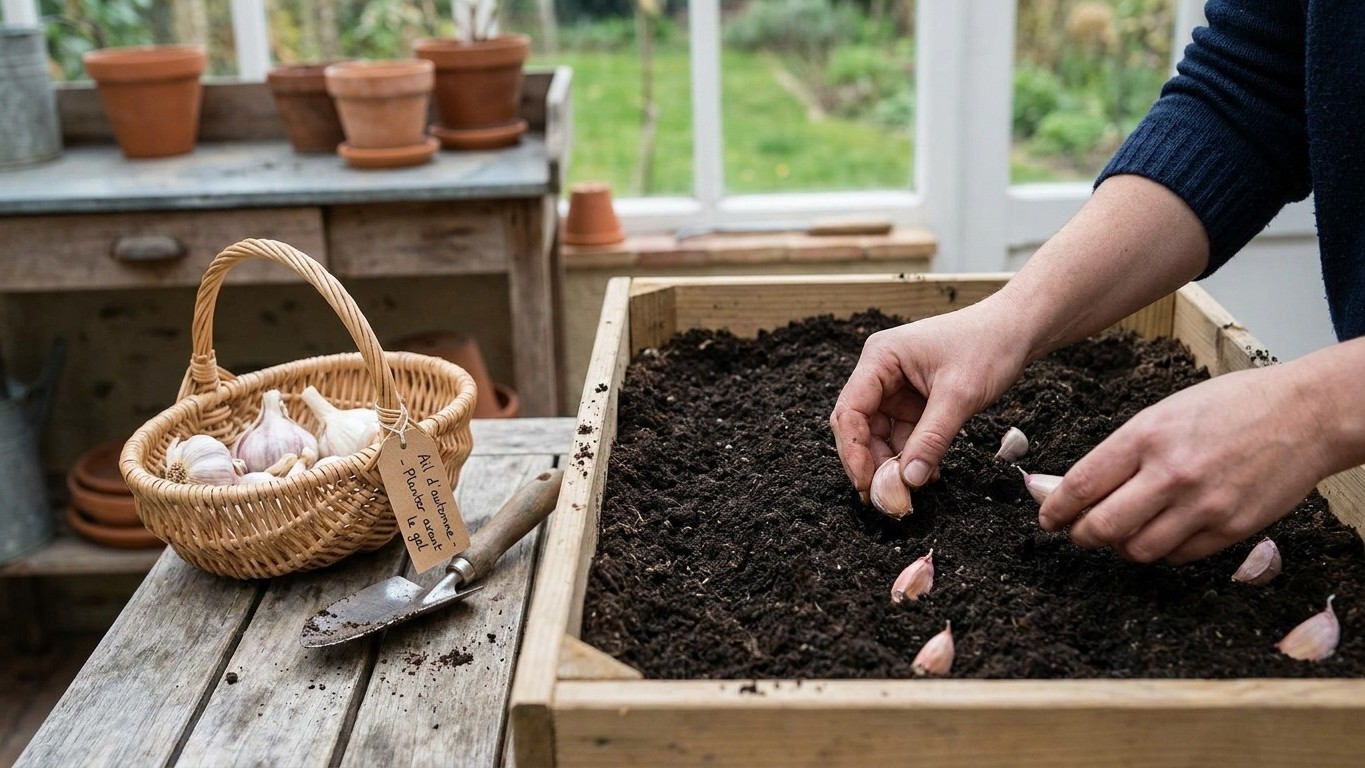
Plant cloves pointed end up, generally about two inches deep and four to six inches apart in rows spaced a foot or so apart, in a bed that drains well over winter since sitting water rots cloves before they root.
Mulch, watering and knowing when to stop
A layer of straw mulch after planting matters more for an overwintered crop than for almost anything else in the garden, because it buffers the freeze-thaw swings that can heave a rooted clove partway out of the soil before it has anchored, while still letting the same cold that drives vernalization reach the clove underneath. Water through spring as the plant bulks up, then taper off as the lower leaves start to yellow and dry back, since wet soil late in the season encourages the wrapper to stain and split rather than cure cleanly.
Garlic tells you it is ready when roughly half the leaves have died back while the rest are still green. Dig one test bulb before pulling the whole bed to confirm the cloves are well defined and the outer wrapper is still intact rather than already splitting.
Curing without ruining the harvest
The classic mistake with garlic is not the growing, it is lifting late or curing badly, and either one can cost the entire crop once it is in storage rather than in the ground. Brush soil off gently without washing the bulbs, then hang or lay the whole plants, tops still attached, in a shaded, airy spot with good air movement for a few weeks until the necks tighten and papery skins form fully around each bulb. Only then trim the roots and tops and move bulbs to long-term storage. A bulb cured too fast in direct sun or too slow in damp, still air molds from the inside before you ever notice from the outside.
Common questions
Can I plant Susanville garlic in spring instead of fall?
Not with good results. Spring planting skips most of the cold period a clove needs to divide, and even a low-chill Artichoke type generally comes up as a small, undivided bulb rather than a full head when planted that late.
What actually happens if I skip refrigeration in a warm climate?
You still get a garlic bulb, just not a head of cloves. The plant grows and forms a single round bulb with no internal divisions, which is edible but useless for replanting and a poor use of a full season of bed space.
Can I plant grocery store garlic instead of buying Susanville seed stock?
You can, but grocery garlic is often treated to slow sprouting and is rarely labeled by variety, so you have no way to know its actual chill requirement or disease history. Certified seed stock costs more per clove but comes disease-tested and correctly named.
How do I know if my winter gives enough cold without buying a weather station?
Check your state or county extension office’s published climate normals, or the nearest NOAA weather station data, for the count of weeks that typically stay below 40°F after your usual planting date. A basic outdoor thermometer log kept through one winter will also tell you plenty for future seasons.