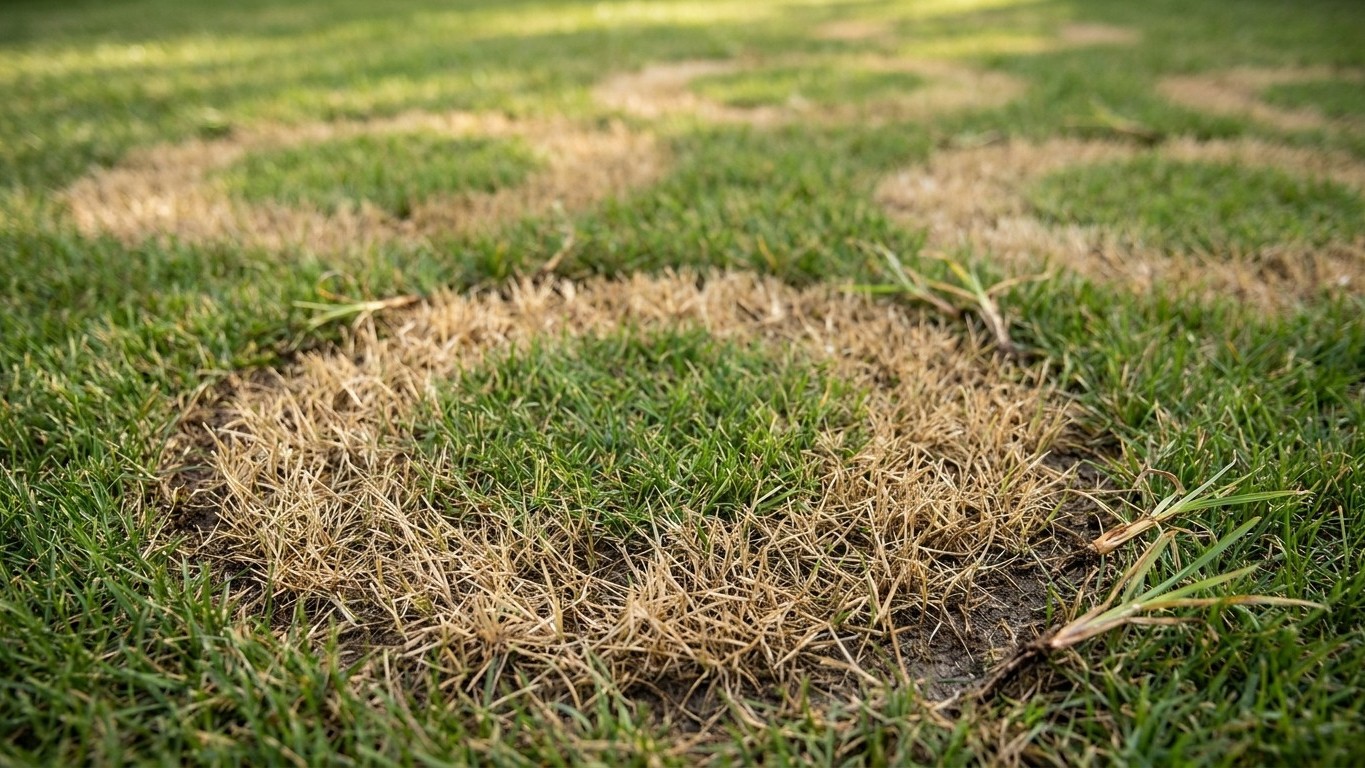

Necrotic Ring Spot is a soil-borne fungal disease that attacks the roots and crowns of certain cool-season lawn grasses, leaving behind rings of dead turf with a tuft of green grass surviving in the center, the classic “frog-eye” look. It comes back in the same spots year after year because the fungus lives in the soil and thatch long after the visible damage fades, waiting for the next stretch of stressful weather.
What you are looking at
The giveaway is the shape, not just the color. Look for circles or partial arcs of dead or straw-colored grass ranging from a few inches to several feet across, with a patch of healthy green grass sitting inside the ring like a bullseye. That center tuft survives because it’s shielded by the surrounding dead turf or simply hasn’t been colonized yet by the advancing edge of the fungus. Rings rarely appear alone; most lawns show several scattered across the yard, sometimes merging into larger irregular patches where two circles overlap.
Pull a few blades from the dead edge of a ring and look closely. Individual leaves show no distinct lesion or spot the way some fungal diseases do; instead, whole blades and tillers turn a dull tan to reddish-brown and die from the crown outward. That’s an important detail, because diseases that leave visible spots or bands on individual blades are usually something else entirely.
The confirming step is below ground, not above it. Dig up a plug from the dead zone, roots and all, and check the root system. Healthy turfgrass roots are white to cream-colored and fibrous. Roots affected by this disease turn dark brown to black, become brittle, and often snap off cleanly when tugged rather than pulling free with resistance. Crowns at the base of the plant may show the same dark discoloration. If the roots look normal and white, the ring pattern you’re seeing likely has a different cause, since the root rot is what actually kills the grass, the visible ring is just the aboveground evidence.
Rings tend to expand slowly, growing a few inches outward each year as the fungus spreads through the soil in a widening circle. A homeowner who remembers “that same spot was smaller last summer” is describing this disease almost perfectly.
What it is not
The single most common lawn complaint that gets misdiagnosed as a lawn disease is simple drought stress, and the fix there is a garden hose, not a fungicide. Drought-stressed turf browns out in irregular patches that follow the sprinkler pattern or slope of the yard, not tidy circles, and the grass blades fold or roll lengthwise before they die, a stress response you won’t see with ring diseases.
Dog urine spots get blamed on disease constantly. The distinguishing feature is a dead center surrounded by a ring of dark green, overly lush grass, the opposite arrangement from Necrotic Ring Spot’s green center and dead outer ring. Urine spots also appear overnight in specific, repeated locations near where a dog frequents the yard, not scattered randomly.
Grub damage is another frequent mix-up, especially in late summer and fall. The test here is physical: grass killed by grubs feeding on roots pulls up like loose carpet with almost no resistance, because the roots have simply been eaten away. Turf killed by Necrotic Ring Spot’s fungal rot still has roots attached, just blackened and brittle ones, and doesn’t peel back the same way.
Fairy ring, a different fungal issue entirely, produces rings too, but they’re usually accompanied by mushrooms or a distinct band of dark green stimulated growth, sometimes with no dead grass at all. If your circles come with mushroom caps popping up after rain, you’re likely dealing with fairy ring, not this disease.
And plain old summer dormancy deserves a mention here: an entire lawn going uniformly tan-brown during a hot, dry stretch, with no ring pattern anywhere, is usually just the grass protecting itself. That turf typically greens back up within a couple weeks once rain or irrigation returns, no diagnosis needed.
The conditions that bring it on
This disease targets cool-season lawns specifically. Kentucky bluegrass is the grass most consistently affected, and it hits hard enough in bluegrass lawns that some turf researchers still refer to the disease by an older name tied specifically to that species. Fine fescues and, less commonly, perennial ryegrass can also show symptoms. Warm-Season lawns, Bermuda, zoysia, St. Augustine, are not the hosts for this particular fungus; a Southern lawn with ring-shaped dead patches is dealing with a different pathogen or a different problem altogether.
The infection itself often takes hold during cool, wet periods of spring or fall when soil temperatures sit in a moderate range, but the visible damage, the actual dead rings, tends to show up later, when the weakened root system can no longer support the plant through a stretch of heat and dry weather. That’s why homeowners often notice these rings appearing in early summer or again in late summer, right as temperatures climb and rainfall drops off, even though the fungal infection may have been quietly working underground for weeks before that.
Compacted soil makes the problem worse, because a shallow, restricted root system has even less capacity to cope once the fungus starts damaging what roots exist. Lawns established on subdivision lots where topsoil was stripped and construction fill left in its place are particularly prone, since compacted fill soils force roots to stay shallow regardless of disease pressure.
Thatch buildup, that spongy layer of dead organic matter between the soil and the green blades, gives the fungus a place to persist between seasons and can shelter the disease from cultural controls. Lawns mowed too short for their species, or pushed hard with nitrogen fertilizer right before a heat wave, also show more severe symptoms, since both practices add stress on top of an already compromised root system.
What to do now
Honest answer first: most lawns with this disease recover substantially once the weather shifts and irrigation resumes, without any chemical treatment at all. The green center of each ring survived for a reason, and turf grass has a genuine capacity to fill back in from the edges as roots regenerate during cooler, wetter weeks in fall. Patience, consistent watering, and time solve a large share of these cases.
Fungicides exist for this disease, but they work as prevention, applied before symptoms appear based on soil Temperature and known disease history in that lawn, not as a rescue for rings that are already dead. Spraying a fungicide onto grass that’s already turned brown is spending money on a problem the product can no longer fix; the roots are already dead, and no fungicide brings dead tissue back to life. The active ingredients effective against this fungus generally require multiple, precisely timed applications and are more commonly handled by licensed lawn care applicators than sold in a form practical for casual homeowner use, so weigh that cost against a strategy of overseeding and patience before committing to a chemical program.
What actually helps right now is easing stress on the lawn: raise the mower deck if it’s been cutting low, water deeply but less frequently rather than a daily light sprinkle, and avoid a heavy nitrogen application until the weather cools. Overseeding the dead rings in early fall with a resistant grass, tall fescue is more tolerant of this fungus than bluegrass, gives those bare patches a better shot at filling in permanently rather than reopening the same wound next summer.
Preventing it next season
Prevention here is mostly a set of habits, not a product purchase. Watering deeply and infrequently, aiming to wet the soil several inches down rather than misting the surface daily, encourages roots to grow deeper and gives the plant more reserve to draw on when the fungus attacks. Watering in the early morning rather than evening matters too, since grass blades that stay wet overnight give fungal diseases more hours to establish.
Nitrogen timing plays a bigger role than most homeowners expect. A heavy spring nitrogen application pushes fast, soft top growth right as the fungus is quietly infecting roots below, leaving the plant with more foliage than its damaged root system can support once summer heat arrives. Shifting the bulk of nitrogen feeding to late summer and fall, when cool-season grasses are naturally building root mass, supports recovery instead of working against it.
Mowing height is a simple, free adjustment. Keeping bluegrass and fine fescue lawns at the taller end of their recommended range, rather than scalping them for a tidy look, keeps more leaf surface available for the plant to feed itself and shades the soil surface, moderating the temperature swings that stress roots.
- Aerate compacted soil at least once a year to open up root pathways and break up the thatch layer where the fungus persists
- Dethatch if the thatch layer has built up past about half an inch
- Improve drainage in low spots that stay soggy after rain
- Overseed thin or dead areas with a more tolerant grass variety each fall
None of these steps guarantee the disease won’t return, since the fungus can persist in soil for years regardless of management. But a lawn with deep roots, moderate nitrogen, and good airflow around the crowns handles an infection with far less visible damage than one running on shallow roots and a spring nitrogen binge.
Common questions
Will Necrotic Ring Spot kill my whole lawn?
No. The disease damages roots in scattered ring-shaped patches rather than spreading uniformly across a yard, and most of the surrounding turf keeps functioning normally even in a bad year.
Can I just reseed over the dead rings and be done with it?
Reseeding helps fill the dead patches, but the fungus remains in the soil, so choosing a more tolerant grass like tall fescue for the overseed gives longer-lasting results than reseeding with the same susceptible variety.
Does this disease affect warm-season lawns like Bermuda or zoysia?
No, the fungus behind this particular disease targets cool-season grasses such as Kentucky bluegrass and fine fescue. Ring-shaped dead patches in a warm-season lawn point to a different cause.
How long do the rings stay visible each year?
That varies by lawn and weather, but many affected lawns show visible improvement within a few weeks once temperatures cool and consistent moisture returns, particularly if overseeding and reduced mowing stress are part of the recovery plan.