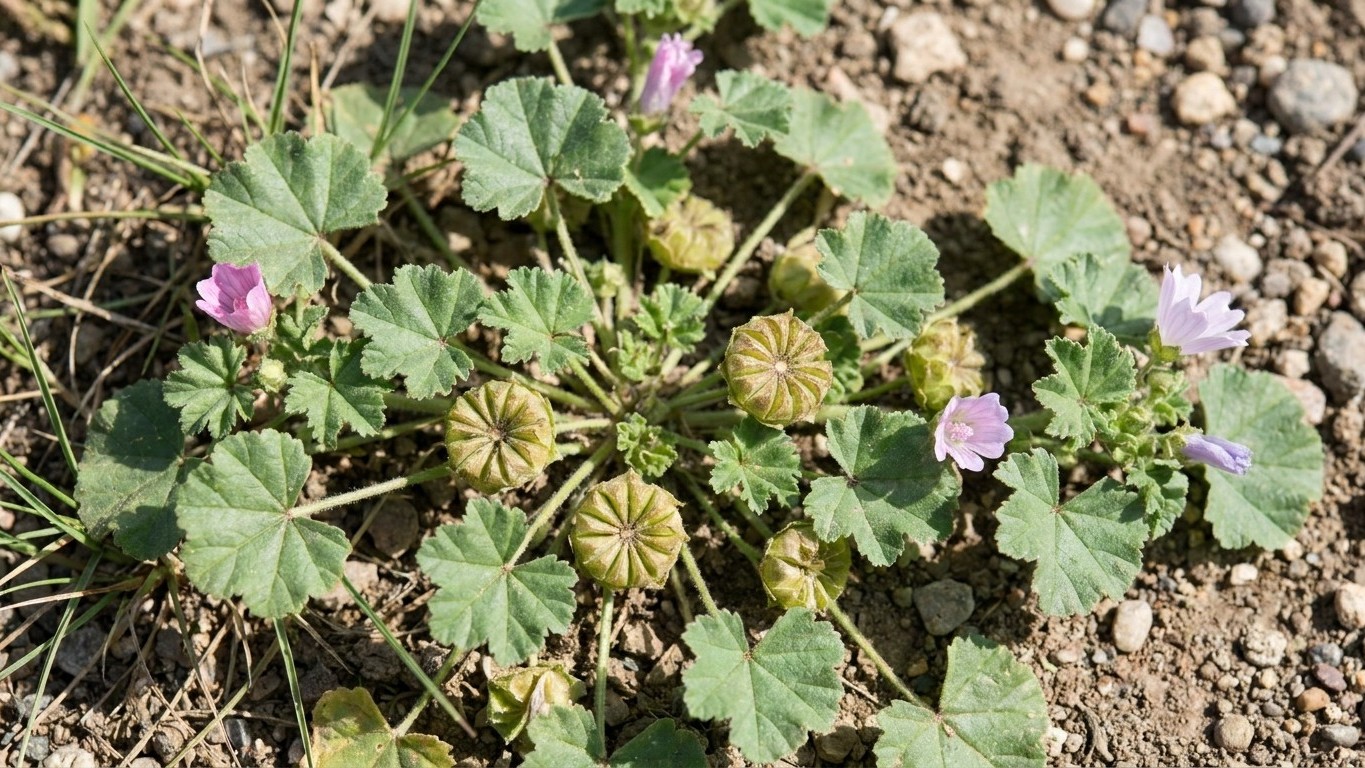

Common Mallow is the low, sprawling weed with round, scalloped leaves and flat, ridged seed pods that look like tiny wheels of cheese, which is why old-timers just call it cheeseweed. It roots from a thick taproot that survives shallow pulling, favors compacted or thin turf, and is best stopped before it flowers rather than fought after.
How to be sure that is what you have

Common mallow (Malva neglecta) grows as a rosette first, low and flat against the ground, with round leaves that have five to seven shallow lobes and softly scalloped edges, each leaf sitting on its own long stalk. Give it open space and it sprawls into stems that can creep along the soil or lift to a foot or two, especially in a garden bed or along a fence line where nothing is mowing it back.
It shows up wherever soil has been disturbed or packed down: sidewalk cracks, gravel driveways, thin lawn edges, and bare patches left by foot traffic. Small pink to pale lavender flowers with five notched petals appear from spring through fall, and behind each flower a flattened, segmented seed pod forms. That pod is the giveaway. Split it open or just look closely and you’ll see wedge-shaped sections arranged in a ring, the “cheese wheel” that gives the plant its nickname. In winter, the plant often survives as a low rosette, greening back up as soon as temperatures rise rather than dying outright.
Two plants get mistaken for it. Ground ivy (creeping Charlie) also has rounded, scalloped leaves and grows low along the ground, but its stems are square in cross-section because it’s a mint, and it roots at every node as it creeps, something mallow’s stems don’t do. Violets share the low rosette habit and rounded leaf shape, but their leaves are heart-shaped rather than lobed, and they produce a single flower on a bare stalk rather than mallow’s clustered blooms and wheel-shaped pods. When in doubt, find a seed pod. Nothing else in the lawn looks quite like it.
Why it is in your lawn
A weed like this doesn’t show up at random. Common mallow’s taproot can push down further than most turfgrass roots, which means it can pull water and nutrients from soil layers that compacted or poor lawns can’t offer their grass. Where soil has been packed down by mowers, foot traffic, or parked vehicles, grass roots stay shallow and struggle, but mallow’s taproot barely notices.
Mowing too short plays a role too. A lawn scalped down to an inch or less opens up bare soil between grass plants, and mallow’s flat rosette is built to take advantage of exactly that kind of gap, it hugs the ground low enough to dodge the mower blade entirely while spreading outward. Thin turf from drought stress, shade, or old age has the same effect: fewer grass plants means more open ground for a rosette weed to claim.
Cool-season lawns (fescue, bluegrass, ryegrass) tend to thin out from summer heat stress or shallow, frequent watering that never lets roots go deep. Warm-season lawns (bermuda, zoysia, St. Augustine) thin out from winter dormancy damage, mower scalping in spring green-up, or shade encroachment. Either way, the underlying condition is the same story: wherever turf density drops, mallow has room to move in. Fixing the compaction or mowing habit does more long-term work than any spray.
The window that decides everything
Timing splits into two very different strategies. A pre-emergent herbicide works by stopping seeds from germinating in the first place, so it has to go down before the seeds sprout, not after. A post-emergent treats the plant once it’s already growing, and it’s far less effective once mallow has built that deep taproot and started flowering.
The trick with pre-emergents isn’t a calendar date, it’s a soil temperature trigger, and dates on a calendar don’t track that reliably across a country as wide as this one. Clemson Cooperative Extension’s HGIC 1219 factsheet times pre-emergent applications for spring-germinating weeds to the bloom of forsythia and flowering dogwood, because those shrubs bloom in response to the same soil-warming trend that triggers weed seed germination. That bloom event might happen in February in the Gulf South and not until April or May in the upper Midwest or New England, weeks apart depending on where you live.
Because common mallow often behaves as a winter annual or biennial, seeds can germinate in fall as well as spring, which means a single spring application misses fall-germinating plants entirely. Watching your own yard, or a neighbor’s forsythia hedge, tells you more than a printed date ever will. If you want the deeper regional breakdown of when these windows open and close where you garden, check your region’s weed-timing calendar before you buy anything.
Post-emergent treatment, by contrast, works best while mallow is young and actively growing, before it flowers and sets seed. Once seed pods have formed, spraying does nothing to stop the next generation already dropped into the soil.
Getting rid of it
Pulling by hand works, but only if you get the whole taproot. Common mallow’s root is thick, fleshy, and prone to snapping off partway down, and any decent-sized fragment left in the ground can send up a new rosette within weeks. Pulling after a good rain, when soil is loose, makes a full extraction far more likely than yanking on dry, compacted ground. A dedicated taproot weeding tool, the kind sold for dandelions, gives better leverage than fingers alone.
For chemical control, broadleaf herbicides built around 2,4-D, dicamba, or MCPP (mecoprop) will kill actively growing mallow without harming most cool-season and warm-season turfgrasses when used according to label directions, since these actives target broadleaf plants and largely spare grasses. They work best on young plants and often need a repeat application because of that taproot’s ability to resprout from any surviving tissue.
Glyphosate will also kill mallow, but it kills turfgrass just as readily, so it only makes sense as a spot treatment on bare soil, gravel, or driveway cracks, never sprayed over a lawn you want to keep. Dicamba in particular can move through soil to injure the roots of nearby trees and ornamental shrubs, so keep it away from anything with roots extending under the treated area. Several of these active ingredients carry use restrictions in individual states, including limits tied to drift and runoff concerns, so check your state’s list of registered products before buying rather than assuming a product sold at a big-box store nationwide is legal to use everywhere. A home grower can generally still buy 2,4-D and MCPP combination products off the shelf; dicamba availability varies more by state and by product formulation.
Keeping it out
Thick, dense turf is the one control that keeps working after the herbicide wears off, because it closes the bare soil gaps mallow needs to establish a new rosette. Mowing height matters more than most people think: cool-season grasses like fescue and bluegrass hold density best mowed at 3 to 3.5 inches, while warm-season grasses like bermuda and zoysia are managed shorter, but even they suffer when scalped below their species’ recommended range. Taller grass shades the soil surface, and mallow seeds need light to germinate well.
Feeding on the right schedule for your grass type builds the root and leaf density that crowds weeds out. Cool-season lawns respond best to fall feeding, which builds root reserves heading into winter. Warm-season lawns take their main feeding in late spring through summer, during active growth, since feeding them in fall while they’re heading into dormancy does little good and can even invite disease.
Overseeding thin spots closes the gaps before mallow finds them. For cool-season lawns, fall overseeding lines up with naturally cooler, wetter conditions that favor seed germination. For warm-season lawns, late spring into early summer, once soil has warmed, is the better overseeding window. Either way, the goal is the same: leave mallow no bare ground to land on.
Common questions
Is common mallow poisonous to pets or livestock?
Mallow is generally considered non-toxic and has even been used as a foraged edible in some traditions, but any weed sprayed with herbicide should be kept off-limits to grazing animals and pets until the treated area has fully dried and any label-specified waiting period has passed.
Will one herbicide application get rid of it for good?
Rarely. The taproot and the plant’s ability to germinate in both fall and spring mean most lawns need a follow-up treatment or a second season of consistent turf-thickening work before mallow stops reappearing.
Does common mallow mean my soil is bad?
It’s more accurate to say it means your soil is compacted or your turf is thin in that specific spot, not that the whole yard’s soil chemistry is off. Aerating compacted areas addresses the root cause more directly than a soil test for nutrients would.
Can I compost pulled mallow plants?
Only if the pods haven’t matured to the point of dropping seed, and only in a compost pile that reaches a sustained hot temperature. Cooler home compost piles often don’t kill weed seeds reliably, so bagging seed-bearing plants for disposal is the safer choice.