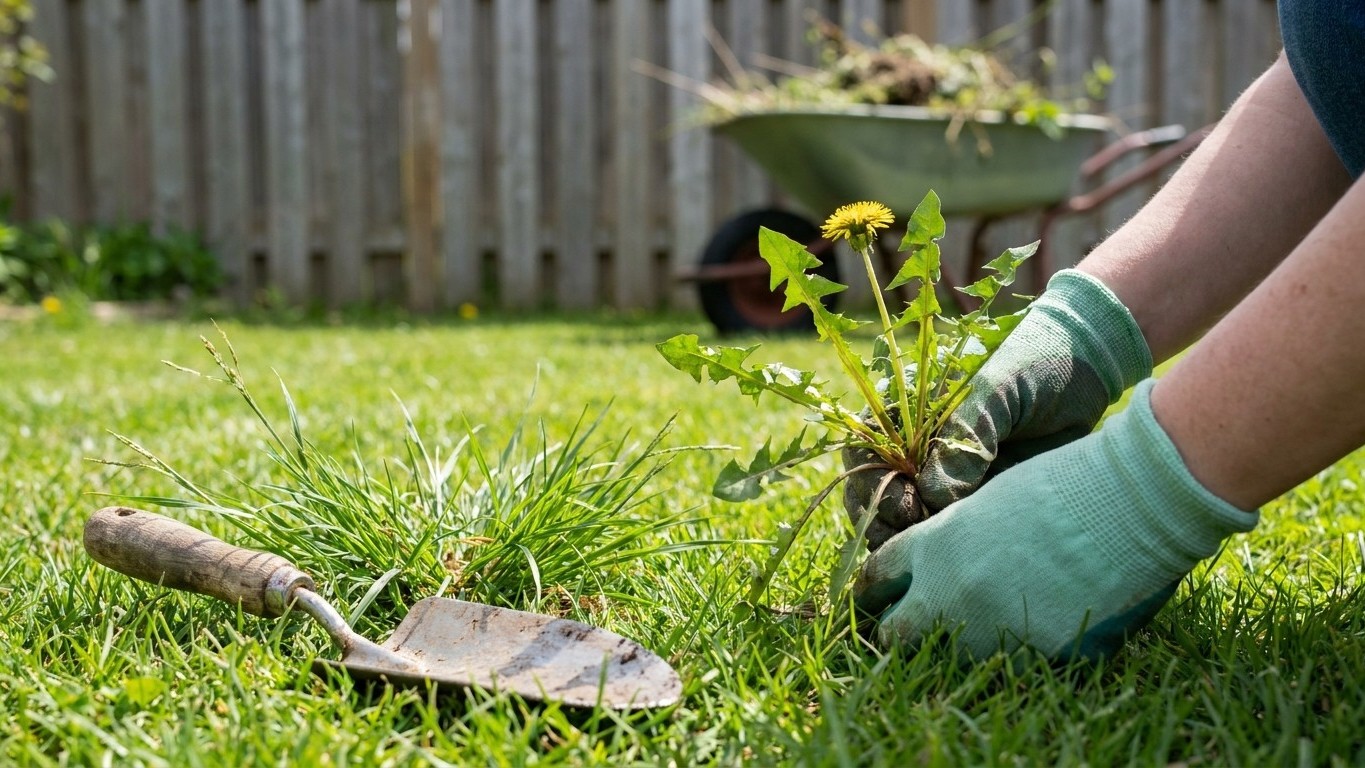

A lawn weed is any plant growing in the turf that you didn’t plant, and that includes off-type grass as often as it includes a broadleaf plant like a Dandelion lawn patch, a White Clover lawn patch, a Broadleaf Plantain lawn patch, a Spotted Spurge lawn patch, a low mat of Chickweed lawn weed, a creeping, vining patch of Creeping Charlie lawn weed, a sprawling rosette of Common Mallow, or a square-stemmed patch of Henbit lawn weed. The tell isn’t color, since both weeds and dormant turf can look brown or pale at the wrong time of year. Look at leaf shape, growth habit and how the patch responds to your regular mowing height before you spray anything. Pull a small plug from the patch and compare its root and leaf structure to the grass around it. That five-minute check keeps you from killing turf you actually want.
Why this matters
Spray the wrong target and you won’t know it for weeks. A broadleaf herbicide applied to a grassy weed like a Crabgrass lawn patch, a Quackgrass lawn patch, a Nutsedge lawn patch, an Annual Bluegrass lawn patch, or a look-alike patch of Goosegrass: The White Centre That Tells It From Crabgrass does nothing but waste product and time, and by the time you notice the grassy weed is still there, it has already set seed for next year’s crop. Spray a nonselective product on a patch you assumed was dead weed and it turns out to be dormant Bermudagrass or Zoysiagrass, and you’ve killed turf that would have greened up on its own once the season turned.
The most common mistake is treating turf color as a diagnosis. Warm-season grasses such as Bermudagrass and Zoysiagrass go straw-brown in winter dormancy and green up again once soil warms, while cool-season grasses like Kentucky bluegrass and tall fescue can bleach out in a summer drought and still be alive at the crown. Neither is dead, and neither is a weed. A patch that looks wrong compared to the rest of the lawn deserves a closer look before it gets a spray.
The second cost is drift and off-target damage, which doesn’t show up the day you spray. Broadleaf herbicides move through soil and air more than most homeowners expect, and a misapplication near a garden bed or a young tree shows its damage only in the next flush of new growth. If the whole lawn looks thin rather than one isolated patch, the cause is often something other than a weed problem, commonly a soil pH that needs correcting before anything else helps, which is worth checking against Liming a Lawn: Only After the Test Says So before reaching for a sprayer.
When to do it
Weed identification works best when the turf and the weed are both actively growing, because that’s when leaf shape, flower structure and growth habit are easiest to tell apart. For a lawn built on cool-season species such as Kentucky bluegrass, perennial ryegrass, fine fescues or tall fescue, that active window falls in spring and again in fall, according to Penn State Extension’s Lawn Establishment guide. For a lawn built on a warm-season species such as Bermudagrass, Zoysiagrass, St. Augustinegrass or centipedegrass, the active window is the opposite: mid to late summer, per Clemson Cooperative Extension’s HGIC 1214.
Weeds run on their own separate clock but tend to track whichever season is warming. Cool-season weeds like chickweed and creeping Charlie push hardest in the same spring and fall stretch that cool-season turf is growing, which makes them easier to spot against green grass. Warm-season weeds like crabgrass and spurge show up as the ground warms, right when warm-season turf is breaking dormancy, and they can be mistaken for the turf itself if you’re not looking closely at leaf shape.
Check your lawn’s general care calendar for your own grass species before assuming a timing rule written for a warm-season lawn applies to a cool-season one. A tall fescue lawn and a Bermudagrass lawn are never on the same weed schedule, and treating them as if they were is one of the more common identification mistakes homeowners make.
How to do it

Rule out an off-type grass patch first
Start by ruling out the simplest explanation: an off-type grass patch, not a weed at all. Lawns seeded from a blend, or lawns that have picked up a stray patch of a neighbor’s grass by rhizome or stolon, will show a color or texture difference that has nothing to do with weeds. If the pattern of thinning looks more like a disease than a spreading plant, compare it against Lawn Diseases: Telling Them From Watering Mistakes before you assume weed pressure at all. Before spraying, run through a short checklist:
- Does the patch respond differently to mowing at your usual height, staying shorter or taller than the rest?
- Does the leaf blade width, color or growth angle match the surrounding turf?
- Is the patch spreading by seed head, or by runners that root at each node?
- Does it hold color through the same stretch of the season as the rest of the lawn?
Mowing height alone answers a lot of that question. Cool-season fine fescues are mowed at 2.5 to 3.5 inches, and Kentucky bluegrass and perennial ryegrass at 2 to 3 inches, according to Penn State Extension. Warm-season species run shorter across the board, per Clemson Cooperative Extension’s HGIC 1214: Bermudagrass at 0.75 to 1.5 inches, Zoysiagrass at 0.75 to 2 inches, and St. Augustinegrass at 2.5 to 4 inches. A patch that keeps scalping or growing long-legged at your regular deck height is behaving like a different species, not a weed and not a disease.
| Species | Mow height | Shade tolerance | Drought tolerance | Wear tolerance |
|---|---|---|---|---|
| Kentucky Bluegrass | 2-3 in | Fair | Fair | Good |
| Tall Fescue | 2.5-3.5 in | Good | Fair | Fair |
| Fine Fescues | 2.5-3.5 in | Excellent | Good | Poor |
| Bermudagrass | 0.75-1.5 in | Very poor | Excellent | Excellent |
| Zoysiagrass | 0.75-2 in | Excellent | Good | Very good |
| St. Augustinegrass | 2.5-4 in | Excellent | Good | Fair |
Figures for the cool-season species come from Penn State Extension’s Lawn Establishment guide. Figures for the warm-season species come from Clemson Cooperative Extension’s HGIC 1214, Selecting a Lawn Grass. If the patch you’re worried about matches one of these profiles more closely than it matches a weed’s description below, it’s grass, not something to spray.
Dandelion

A dandelion grows as a low rosette of jagged, toothed leaves close to the ground, with no true stem until it flowers. The flower is a single bright yellow disc on a hollow stalk, followed by the familiar puffball of wind-blown seed. The taproot runs deep, which is why pulling by hand rarely gets all of it.
Crabgrass

Crabgrass spreads flat against the ground from a central point, with stems that branch out low and root wherever they touch soil, giving each plant a spoked, star-shaped outline. The blades run a lighter, yellowish green than most turfgrass and often take on a purplish tinge as the plant matures late in the season.
White Clover

White clover shows three rounded leaflets per stem, usually with a faint pale crescent near the base of each one, and creeps along the ground on stems that root at every node. Its flower is a small round white to pale pink puff, held just above the leaf canopy.
Broadleaf Plantain

Broadleaf plantain forms a flat rosette of wide, oval leaves with prominent parallel ribs running lengthwise. The leaves lie close to the ground and can survive close mowing, which is part of why it persists in lawns that are cut short. A narrow, leafless flower spike rises from the center when it seeds.
Common Chickweed

Common chickweed forms a low, sprawling mat of small, smooth oval leaves set in opposite pairs along thin stems. The flowers are tiny and white, with petals so deeply notched that each one looks like two, giving a ten-petaled appearance on what is actually a five-petaled flower.
Creeping Charlie (Ground Ivy)

Creeping Charlie runs along the ground on square stems that root at each node, carrying rounded, scalloped leaves that give off a minty smell when crushed. In spring it produces small, funnel-shaped purple-blue flowers, and it tends to thrive in the damp, shaded spots where turf is already thin.
What goes wrong
The most common failure is spraying a broadleaf herbicide on a grassy weed, or the reverse. Crabgrass, nutsedge and other grass-like weeds don’t respond to the same chemistry that knocks down dandelion or clover, and a homeowner who sprays the wrong class of product often doesn’t find out until the treated area looks exactly the same three weeks later, while the actual target has gone to seed in the meantime.
A second failure is treating dormant turf as a dead weed patch and digging it out. Both cool-season and warm-season grasses go brown under stress, cool-season turf in a summer drought and warm-season turf every winter, and neither is dead. Ripping out a dormant patch of Zoysiagrass or Bermudagrass because it looked like a weed leaves a bare spot that fills in with whatever weed seed was waiting in the soil, which is a worse outcome than the one being avoided.
A third is timing the spray to the wrong grass’s calendar. Herbicide labels and extension guidance are built around when the target weed and the surrounding turf are both actively growing. Applying a product built for warm-season timing onto a cool-season lawn, or the reverse, either damages turf that isn’t ready for it or misses the weed at a growth stage where the chemical has no effect. The tell shows up two to three weeks out, as a spotty, patchy kill instead of a clean one, or turf that yellows in bands that follow the spray pattern.
Drift onto ornamental beds or vegetable gardens is easy to miss on the day of application and obvious only once the next flush of new growth comes in twisted or stunted.
How this changes across the country
A cool-season grower dealing with a lawn of Kentucky bluegrass, perennial ryegrass or tall fescue is watching for weeds that move in during the same spring and fall growth windows the turf uses, and mowing at the 2 to 3.5 inch range Penn State Extension recommends for those species keeps enough leaf canopy to shade out a fair amount of weed seed before it germinates.
A warm-season grower in a state like South Carolina, working with Bermudagrass, centipedegrass, St. Augustinegrass or Zoysiagrass, follows the opposite calendar. Turf growth and weed pressure both build through the warm months, and mowing heights run much lower, from Bermudagrass at 0.75 to 1.5 inches up to St. Augustinegrass at 2.5 to 4 inches, according to Clemson Cooperative Extension’s HGIC 1214. Mowing a warm-season lawn at a cool-season height, or the reverse, opens up bare soil that weeds fill first.
The transition zone, the band of the country where summers are hot enough to stress cool-season turf but winters are cold enough to kill warm-season turf outright, is where identification gets hardest. A lawn there might carry tall fescue as the base species with patches of Zoysiagrass or Bermudagrass that crept in from a neighboring yard, and each of those grasses carries its own mowing height, shade tolerance and drought tolerance, listed side by side in the table above. Sorting out which patch is which grass, and which patch is an actual weed, takes the same leaf-and-root check described earlier, just applied more often because more species are competing for the same square foot of soil.
For species-specific mowing and feeding windows beyond identification, Clemson’s maintenance calendars, HGIC 1215 through 1219, cover centipedegrass, Bermudagrass, Zoysiagrass, St. Augustinegrass and tall fescue individually, and any general lawn care routine should start from Lawn Care basics for the species actually in the ground.
Two Weeds Worth a Closer Look
Most lawn weeds fall into a handful of familiar patterns, but a couple of them deserve their own page because the usual advice does not quite fit. If your grass has gone thin and you are suddenly seeing small purple-pink flowers scattered low to the ground, you are probably not dealing with a random invader but with henbit, a winter annual that moves in specifically where turf coverage has dropped enough to let light hit bare soil. The bloom is really a symptom of a thinning lawn more than a problem on its own, which changes how you should respond to it.
Then there is the weed people love to hate: the wild violet. It looks harmless, even pretty, but it spreads through tough rhizomes and produces seed from flowers that self-pollinate without ever opening, so a plant can keep reproducing long after you thought you had stopped it from blooming. That combination makes it one of the hardest lawn weeds to actually get rid of, and worth understanding before you try.
Common questions
Is it a weed or just a different grass that got mixed in?
Pull a small plug and look at the root and leaf shape. A weed will have a root structure and leaf pattern that doesn’t match turfgrass at all, while an off-type grass patch will simply respond differently to your mowing height, as described in the checklist above.
Why did my weed come back green a week after I sprayed it?
Either the product didn’t match the weed type, the weed was actually dormant turf that was never going to die, or the spray hit the plant at a growth stage where it had little effect. Check the label against the specific weed you identified rather than assuming any lawn herbicide handles everything.
Do I need to identify the weed before buying a herbicide?
Yes. Broadleaf herbicides, grassy weed controls and sedge-specific products are different chemistries aimed at different plant structures, and using the wrong one wastes the application and gives the actual weed more time to spread or set seed.
Can I just pull weeds instead of spraying?
It depends on the root type. Taproot weeds like dandelion often regrow from a broken root left in the soil, while spreading weeds like white clover or creeping Charlie need repeated pulling because every node along the stem can root again on its own.