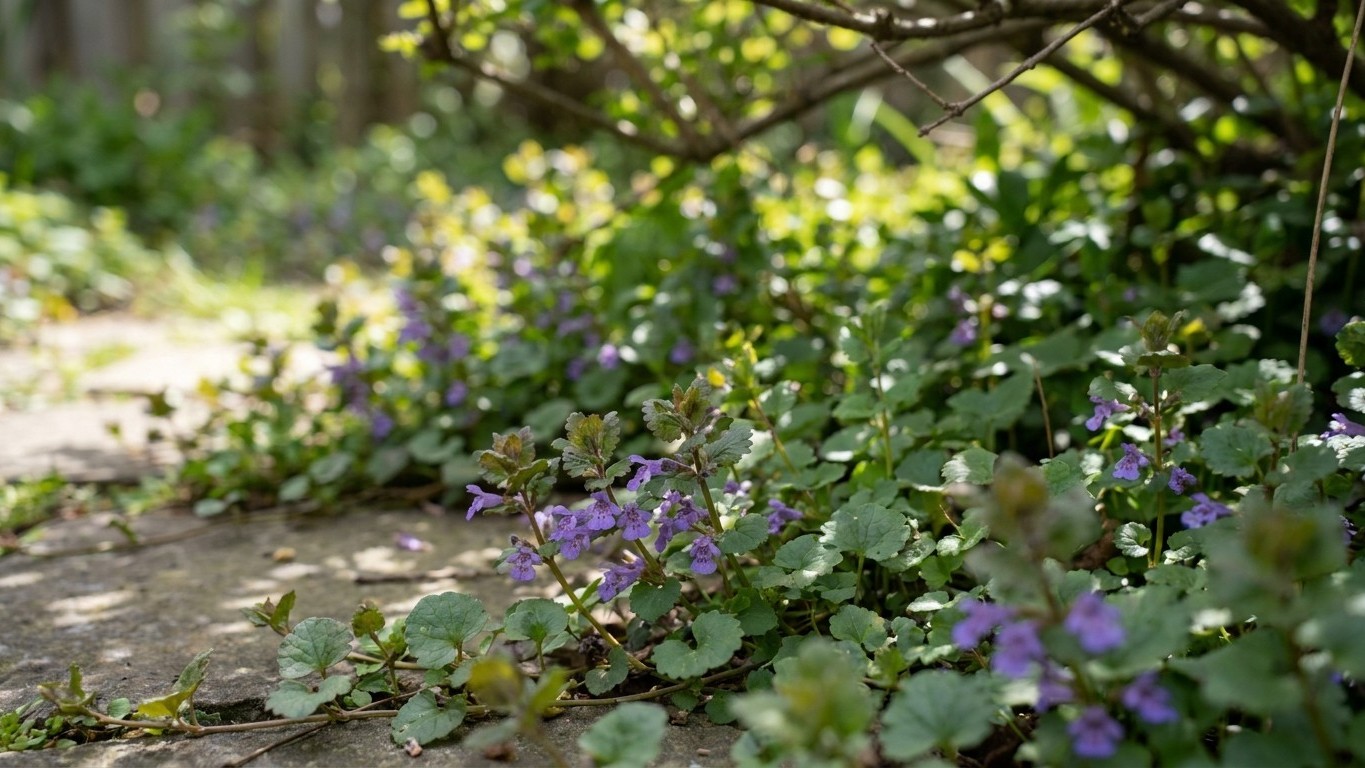

Creeping Charlie is Glechoma hederacea, a low, mat-forming perennial in the mint family that spreads by rooting at every leaf joint along its stem, not by seed. One plant can cover a shaded, damp corner of lawn in a single season just by running along the soil surface. Before you do anything else, pinch a stem between your fingers: if it is square rather than round, you are looking at creeping charlie or a close mint-family relative, and simple mowing will not slow it down.
How to be sure that is what you have

Creeping charlie grows flat against the ground, sending out slender stems that root wherever a leaf node touches soil. The leaves are round to kidney-shaped with a scalloped edge, arranged in opposite pairs, and they stay green through most of the growing season, sometimes holding color into winter in sheltered shade. In spring the plant sends up small purple-blue, trumpet-shaped flowers just above the foliage. Crush a leaf and it smells distinctly minty, which is the fastest field check you have.
The plant is most often mistaken for two others. The common blue violet (Viola sororia) also grows low and spreads in shady turf, but its leaves are heart-shaped rather than round, its stems are round instead of square, and crushing a leaf produces no mint smell at all. The second look-alike is henbit, another square-stemmed member of the mint family. Henbit’s leaves are more triangular and scalloped, and the upper leaves clasp the stem directly rather than sitting on a short leaf stalk. The real difference is habit: henbit grows upright as a winter annual and dies out with summer heat, while creeping charlie stays prostrate, roots at every node it touches, and persists as a perennial year after year.
Where you find it also tells you something. Creeping charlie shows up first in the shadiest, dampest parts of a lawn, along foundations, under tree canopies, and in low spots that hold moisture after rain. A patch that starts under a shrub and creeps outward across otherwise decent turf is a strong sign you have found it rather than one of its look-alikes.
Why it is in your lawn
A weed this specific to shade and moisture is telling you something about the ground underneath it before it becomes a problem in its own right. Creeping charlie moves into lawn where turf density has already dropped, usually because grass is struggling for light, and thin, open turf gives its low stems room to spread across bare soil rather than compete against a full canopy. It also favors soil that stays wet, so a lawn with poor drainage, a low spot that puddles, or a downspout that empties across the grass is prime territory.
Compacted soil compounds the problem. Foot traffic and equipment repeatedly rolling over the same strip of lawn presses soil particles together, which starves turfgrass roots of oxygen and water infiltration slows. The grass canopy above ground thins in response, and creeping charlie, which roots shallowly at each stem node rather than depending on a deep root system, tolerates that compaction far better than most lawn grasses do. Mowing too short adds to the opening: a scalped lawn lets more light reach bare soil, which is exactly what a stem-rooting groundcover needs to establish.
The same conditions, shade, moisture, and thin turf, also favor annual bluegrass, so if you are seeing both weeds in the same low, damp stretch of lawn, that is not a coincidence. Fixing the underlying issue, whether that means raising the mower deck, correcting drainage, or thinning a tree canopy for more light, does more long-term work than any single herbicide application, a point worth remembering before reaching for a sprayer.
The window that decides everything
Why pre-emergents mostly miss it
Pre-emergent herbicides work by stopping germinating seeds before they establish, which is why they are the standard tool against annual weeds like crabgrass. Creeping charlie spreads almost entirely by rooting stems rather than by seed, so a pre-emergent application over an established patch does very little. Clemson Cooperative Extension’s Tall Fescue Maintenance Calendar (HGIC 1219) times spring pre-emergent applications to forsythia and dogwood bloom, a signal tied to soil temperature that works well for crabgrass and other annual grassy weeds. For creeping charlie, that same bloom signal is more useful as a reminder that the spring window for anything else is closing fast as temperatures climb.
Where the real window sits
The tool that actually works against creeping charlie is a post-emergent broadleaf herbicide, and timing follows the plant’s own physiology rather than the calendar. The most effective applications land when the plant is actively moving sugars down into its root and stem network, which for most broadleaf perennials happens in fall as growth slows for the season, with a secondary window in spring before flowering, while the plant is growing vigorously but has not yet set seed. Because bloom and growth timing shift by weeks across the country, from a coastal Southeast lawn to a lawn in the upper Midwest, check your own region’s timing against a maintenance calendar for your specific turf species before you spray. As with most lawn weeds, hitting the right week matters more than the product you choose.
Getting rid of it
Hand pulling is worth trying on a small patch, but it only works if you get the whole thing. Because creeping charlie roots at every node along its stem, any fragment left behind with a node attached can put down new roots and regrow, so raking the area afterward to catch broken stem pieces matters as much as the pulling itself. Expect to repeat this over a season on anything larger than a spot patch, since a single missed runner can reestablish a mat within weeks.
For established infestations, a post-emergent broadleaf herbicide containing triclopyr is generally more effective against creeping charlie than 2,4-D used alone, which often struggles against this particular weed. Dicamba is another active ingredient used against it, frequently in combination products. None of these will touch grassy weeds like crabgrass or annual bluegrass, they are formulated for broadleaf plants specifically, so treating a lawn with a mixed weed problem may take more than one product.
Read the label before you buy. Triclopyr and similar broadleaf actives can injure or kill St. Augustinegrass and centipedegrass at rates that are perfectly safe on cool-season lawns, so a product that works on a fescue lawn in one region can damage a warm-season lawn in another. Several broadleaf herbicide actives are also restricted for homeowner purchase or use in some states, so check with your state’s department of agriculture or your local Extension office before buying, rather than assuming a product sold at one garden center is legal everywhere.
Keeping it out
Thicker turf is the only lasting fix
Every control method above buys time. The only thing that keeps creeping charlie from coming back is a turf canopy dense enough that it never gets the open soil and light it needs to root in the first place. That starts with mowing height: cutting cool-season grass at the top of its recommended range shades the soil surface and crowds out low-growing weeds far better than a close cut does. Feeding on the schedule laid out in HGIC 1201, Fertilizing Lawns, keeps that canopy thick through the season rather than thinning under stress.
Where shade is the real limiting factor, choosing the right grass matters more than any single maintenance habit. The table below lines up mowing height and shade tolerance for the species Clemson HGIC 1214, Selecting a Lawn Grass, and Penn State Extension both rate for shaded turf.
| Grass | Season | Mowing height | Shade tolerance |
|---|---|---|---|
| Fine Fescues | Cool-season | 2.5 to 3.5 in | Excellent |
| Rough Bluegrass | Cool-season | 2 to 3 in | Excellent |
| St. Augustinegrass | Warm-season | 2.5 to 4 in | Excellent |
| Zoysiagrass | Warm-season | 0.75 to 2 in | Excellent |
| Tall Fescue | Cool-season | 2.5 to 3.5 in | Good |
| Centipedegrass | Warm-season | 1.5 to 2 in | Fair |
| Kentucky Bluegrass | Cool-season | 2 to 3 in | Fair |
Overseeding a thin, shaded stretch of cool-season lawn with a fine fescue closes the canopy gaps that let creeping charlie establish in the first place, and it does more for the long run than any single spray. For a warm-season lawn, St. Augustinegrass or zoysiagrass fills the same role. Whichever species you settle on, the point is the same: a full canopy leaves no bare soil for a stem-rooting weed to grab onto.
Common questions
Is creeping charlie the same thing as ground ivy?
Yes. Ground ivy and creeping charlie are both common names for Glechoma hederacea, the same plant. Which name you hear tends to depend on the region rather than any difference in the plant itself.
Will pouring boiling water or vinegar on it kill it for good?
It will kill the leaves and stems you douse, but it almost never reaches the full network of rooted nodes spreading under the surface. Expect regrowth from the untouched portion of the mat within a few weeks unless you also remove the roots.
Can I just leave it if nothing else grows in that spot anyway?
You can. Creeping charlie is not toxic to lawn grass and some gardeners let it stand as a low groundcover in deep shade where turf genuinely will not thrive. The tradeoff is that it will keep creeping outward into any adjoining bed or lawn area that borders the patch, so a physical edge or barrier helps keep it contained.
My patch turned brown and disappeared over winter, then came back. Is that normal?
It is. In exposed spots, the above-ground growth can die back with cold and look completely gone, but the stem network at the soil surface often survives and resprouts once temperatures rise. Brown foliage on this plant is rarely a sign it is actually dead.