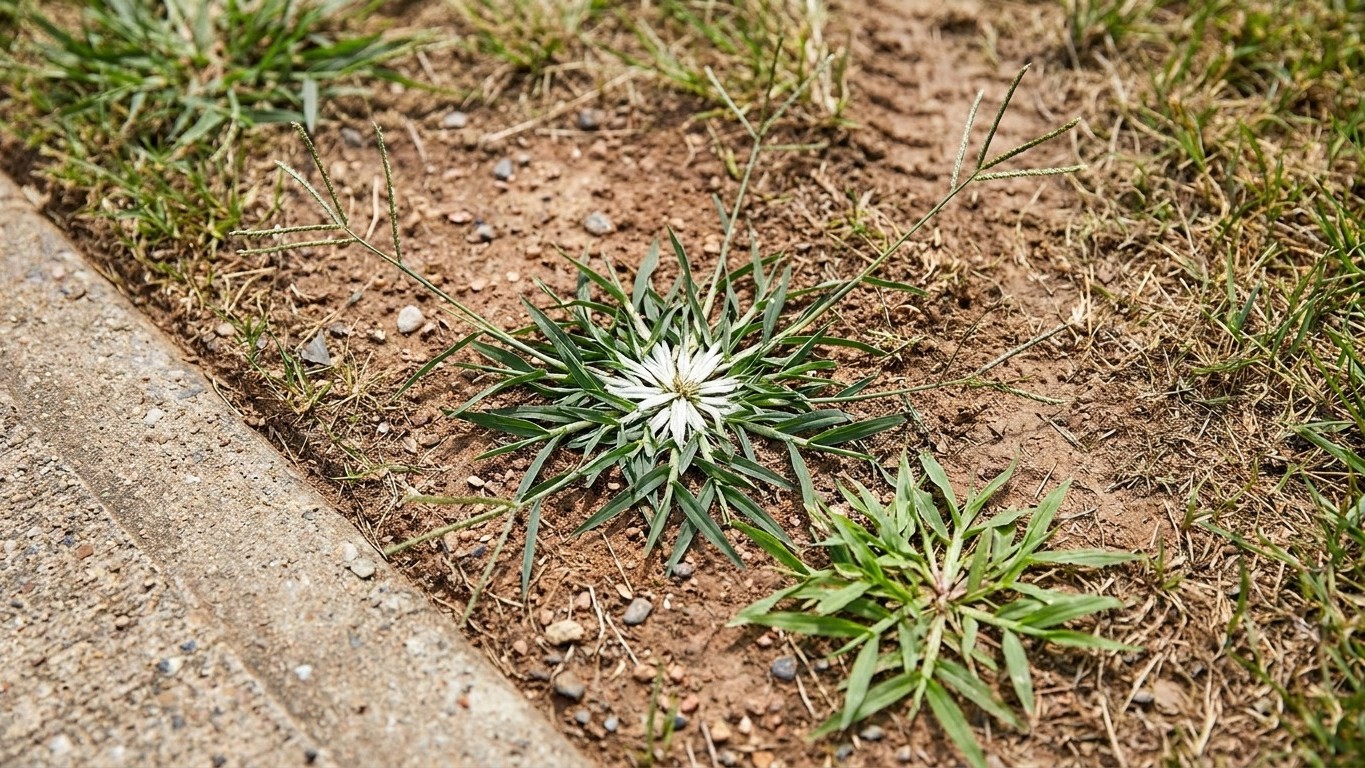

A white to silvery patch at the base, right where the leaves fan out from the crown, is the tell. Crabgrass never has it. That single detail settles most driveway-edge arguments about which weed you’re staring at, and it matters because the two plants respond to completely different timing and treatment.
How to be sure that is what you have

Goosegrass grows as a flattened rosette, its leaves radiating outward from a central point like spokes on a wheel, pressed close to the ground before the seedheads rise. Pull one leaf back and look at the base of the plant: that white-to-silver crown is the giveaway. The leaves themselves are folded rather than rolled, dark green, and a bit coarser and wider than crabgrass foliage. By midsummer the plant sends up wiry stems topped with two to thirteen fingerlike spikes arranged almost like a zipper, each one lined with seeds in two neat rows.
It shows up in the toughest real estate on the property: compacted paths, mower turnarounds, the strip along a driveway, gaps between patio pavers. Spring growth is low and easy to miss. By late summer the rosettes have widened into flattened mats that can smother a patch of turf a foot or two across, and the seedheads stand out against mowed grass.
The two plants people mix it up with
Crabgrass (Digitaria species) is the most common mix-up, and the fastest way to tell them apart is that base. Crabgrass often shows a reddish or purplish tinge at the stem base but never the goosegrass white center, and its leaves are softer and thinner. Crabgrass also germinates earlier in spring, once soil warms into the mid-50s Fahrenheit, while goosegrass waits for warmer, more settled soil.
Dallisgrass is the second look-alike, and it’s a perennial rather than an annual, growing in thick clumps instead of a flat rosette. Its seedhead has more branches and each one carries fine hairs on the spikelets, a texture goosegrass doesn’t have. Pull a dallisgrass plant and you’ll find a short, thick rhizome; goosegrass has none.
Why it is in your lawn
Goosegrass is a compaction indicator before it’s anything else. It tolerates low-oxygen, heavily trafficked soil better than turfgrass and better than crabgrass, which is why it colonizes the exact spots where wheels, feet, and mower turns have packed the ground tight: field entrances, gate paths, the strip where the mower always pivots, the edge along a driveway where cars clip the grass.
Mowing height plays into it too. Cutting cool-season grass like tall fescue or Kentucky bluegrass below 2.5 inches, or warm-season grass like bermuda scalped down past its recommended height, opens the canopy and lets sunlight hit bare soil, exactly the conditions goosegrass seed needs to germinate. Thin turf from summer heat stress on a cool-season lawn, or from a scalped warm-season lawn coming out of dormancy slowly, gives it the same opening.
Poor drainage compounds all of it. Soil that stays wet and compacted starves grass roots of oxygen while goosegrass shrugs it off, so puddling spots and low areas with heavy clay tend to be where it establishes first and spreads outward. None of this is a disease process or a sign the lawn is failing wholesale. It’s a soil and mowing habit showing up as a plant, and fixing the compaction does more long-term work than any product sprayed on the leaves.
The window that decides everything
Timing beats product choice with goosegrass, and the trigger isn’t a date on a calendar, it’s soil temperature. Clemson Cooperative Extension’s Home & Garden Information Center fact sheet HGIC 1219 times crabgrass pre-emergent applications to forsythia and dogwood bloom, a reliable seasonal marker connected to soil warming rather than a fixed month. Goosegrass follows the same logic but lags behind: it needs consistently warmer soil than crabgrass does before it germinates, typically several weeks after the crabgrass window opens.
That lag is exactly why a single spring pre-emergent application often lets goosegrass through even when it stopped crabgrass cold. Many pre-emergent products start breaking down in the soil before goosegrass ever germinates, so a split or sequential application, an early spring treatment followed by a second dose four to six weeks later, closes that gap. Once goosegrass seedlings are up and growing, pre-emergent products stop working on them entirely; the plant has already crossed the line into needing a different approach.
The bloom-based trigger Clemson describes moves at different times depending on where you garden, arriving weeks apart between the Gulf Coast and the upper Midwest. Rather than picking a date off a national chart, match the application to what’s blooming locally and check your regional lawn care calendar for the soil-temperature window that applies to your area.
Getting rid of it
Mechanical control
Hand-pulling works, especially on isolated plants caught early, but it has to be thorough. Goosegrass is an annual, so it won’t resprout from scattered root fragments the way a perennial weed would, but if the crown itself stays in the ground with even a portion intact, it can push new growth back up. Pull after rain or watering, when soil is soft enough to bring the whole crown and root mass out cleanly, and check the spot again in a couple of weeks.
Chemical control
Pre-emergent actives that home growers can buy and apply themselves include pendimethalin, prodiamine, and dithiopyr, all sold under various lawn-care brand names as granular or liquid products labeled for crabgrass and goosegrass prevention. These only work before germination, which loops back to the timing problem above.
Post-emergent options are thinner on the ground. Once goosegrass is established, few selective herbicides kill it without also damaging the lawn grass around it, and some products effective against mature goosegrass, including MSMA-based herbicides, are restricted or banned outright for residential turf use in a number of states. Warm-season lawns are particularly at risk here: some post-emergent goosegrass treatments that are labeled safe on bermuda will injure or kill St. Augustine and centipede grass. Read the label against your specific turf species before applying anything, and treat chemical control as the last step after mechanical removal and cultural fixes, not the first.
Keeping it out
Thick, actively growing turf is the only control that holds up season after season, because it shades the soil surface and denies goosegrass seed the light and warmth it needs to germinate in the first place.
Mowing height does most of the work. Cool-season lawns (tall fescue, Kentucky bluegrass, perennial ryegrass) hold density best mowed at 3 to 3.5 inches; warm-season lawns like bermuda and zoysia should stay within their recommended range rather than getting scalped low, which opens exactly the gaps goosegrass exploits.
Feeding timing matters just as much as height. Cool-season grasses build their thickest turf from fall fertilization, when they’re storing energy for the next growing season. Warm-season grasses do their heaviest growing and thickening in late spring through summer, so that’s when feeding pays off most. Overseeding thin or worn patches, ideally in early fall for cool-season lawns, fills in the bare soil before next year’s germination window opens. Where compaction is the underlying cause, core aeration once a year addresses the root problem directly instead of just treating the symptom on the surface.
Common questions
Does goosegrass come back every year from the same plant?
No. It’s an annual grass weed that dies with the first hard freeze in cool climates or simply completes its life cycle after seeding. What returns each year is new growth from seed dropped the previous season, which is why breaking the seed cycle with timely pre-emergent and thick turf matters more than repeated spot-treatment of visible plants.
Can I just mow goosegrass down instead of pulling or spraying it?
Mowing keeps the seedheads from maturing and dropping seed, which limits next year’s population, but it won’t kill the flattened rosette itself since the growing point sits below typical mowing height. It’s a useful stopgap, not a fix.
Is goosegrass a sign my soil needs to be tested?
It’s a strong visual clue that compaction and possibly drainage are involved, but a soil test still tells you more, particularly about pH and nutrient levels that affect how well turf can outcompete it once the compaction issue is addressed.
Will one pre-emergent application in spring stop goosegrass for the whole season?
Often not on its own. Because goosegrass germinates weeks after crabgrass once soil is consistently warmer, a single early application can break down before the goosegrass window even opens, which is why a split or sequential application is the more reliable approach.