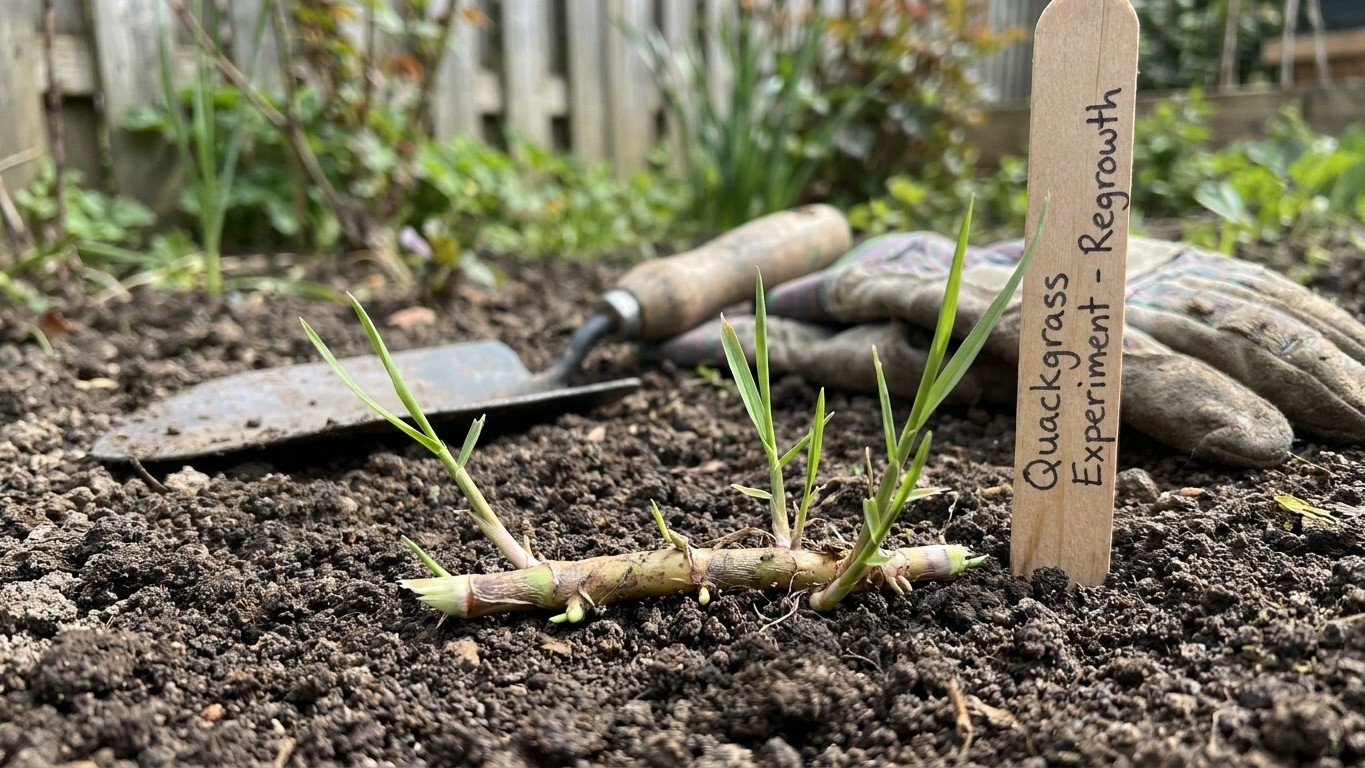

Quackgrass regrows because it spreads through tough, jointed rhizomes underground, and almost any fragment of that rhizome left in the soil can root and send up a new shoot. Pulling the visible leaves without lifting the connected root mat just breaks the rhizome into more pieces, each one capable of starting a fresh patch. If you find a clump, dig a shovel’s width around the edge and lift the whole white-yellow root network out, rather than tugging at the grass blades.
How to be sure that is what you have

Quackgrass (Elymus repens) is a coarse, cool-season perennial grass with flat, dull blue-green blades that feel rough on the top surface and smooth underneath. It grows upright at first, then spreads sideways through pale, hollow rhizomes just under the surface, which is why a small patch this year can be a three-foot mat next year. The clumps often show up first at the edge of a driveway, along a disturbed fence line, or in a spot that was tilled and reseeded the year before.
The single most reliable identifying feature is at the base of the leaf, where it wraps the stem. Quackgrass has small, claw-like auricles that clasp around the stem like tiny fingers, a detail neither of its two lookalikes share. Tear a blade back gently at the collar and you can usually see them without a hand lens.
The two plants people mistake it for are crabgrass and tall fescue. Crabgrass is an annual that dies at the first hard freeze and has no rhizomes at all. It spreads by seed and by stems that root only where they touch soil, so if you dig a suspect patch in late summer and find no underground rhizome, you are looking at crabgrass. Tall fescue, by contrast, is a coarse, clump-forming perennial that some readers keep on purpose as their lawn species. Tall fescue grows in dense bunches with no spreading rhizome, so a fescue clump stays a clump. Quackgrass keeps moving outward year after year, and that lateral spread, plus the clasping auricles, is what separates it from both.
Why it is in your lawn
Quackgrass is a colonizer of disturbed and thin ground. It rarely invades a dense, actively growing lawn from a standing start. It moves in where the turf canopy has gaps: a strip scalped by a mower deck set too low, a section compacted by repeated foot traffic or equipment, a bed edge left bare after a shrub was pulled, or a lawn seeded thin the previous fall that never filled in.
Compacted soil is a common invitation. Turfgrass roots struggle in compacted ground, but quackgrass rhizomes, which are tougher and more mechanically resilient than fine turf roots, push through it without much trouble. Any bare or thinning patch is an open door, and quackgrass rhizomes travel underground looking for exactly that kind of gap before a leaf ever appears above ground.
It is worth noting that a thin lawn rarely produces just one weed. The same compacted, underfed turf that lets quackgrass in is the same turf that lets in Spotted Spurge: The Mat That Appears in Every Thin Spot and Clover in a Lawn: Weed, or the Sign of Hungry Soil. If you see quackgrass alongside either of those, treat it as one underlying turf problem with three symptoms, not three separate weeds. Reviewing the wider picture of Lawn Weeds before you spray anything will usually tell you whether the fix is mowing height, feeding schedule, or drainage, rather than a single herbicide pass.
The window that decides everything
Why a calendar date is the wrong trigger
Because quackgrass spreads mainly by rhizome, not by seed, a pre-emergent herbicide, which works by stopping germinating seedlings, does very little against an established patch. Pre-emergent timing matters more for the seed-spread grassy weeds sharing the lawn, and Clemson Cooperative Extension’s HGIC 1219, the Tall Fescue Maintenance Calendar, times that application to a biological event rather than a date: forsythia and dogwood bloom, which mark the soil warming to the range where crabgrass and similar seeds start to germinate.
That bloom trigger does not arrive on the same week nationwide. Forsythia and dogwood flower weeks apart as you move from the Gulf Coast toward the northern tier, so a reader should watch their own yard rather than a printed date, and cross-check the timing against their own state extension’s lawn calendar for their zone.
For quackgrass itself, the decisive window is different: a systemic post-emergent herbicide works best while the rhizomes are actively pushing new growth, typically in the weeks of vigorous spring or fall growth when the plant is moving sugars down into the root system and will carry the chemical with it. Spraying a dormant or drought-stressed patch wastes the application, because the plant is not translocating much of anything at that point.
Getting rid of it
Mechanical removal
Digging works on small patches if you are thorough. Loosen the soil around the entire perimeter of the clump, then lift the root mass in one piece rather than raking through it, and sift the surrounding soil by hand for any pale, jointed fragments that broke off. Any rhizome piece left behind with an intact node can resprout, so the job is not done when the visible leaves are gone. Bag the debris rather than composting it in a home pile that may not get hot enough to kill the rhizome nodes.
For a patch too large to dig, smothering with a tarp or heavy black plastic held down for an extended stretch of the growing season can exhaust the rhizome’s stored energy, though it will also kill or set back any turf underneath. This works better as a renovation step, where you plan to reseed the whole area afterward, than as a spot treatment inside an otherwise healthy lawn.
Chemical control
Because quackgrass is a grass growing inside another grass, there is no herbicide that reliably kills it while leaving desirable turf grasses untouched over an established lawn. The active ingredient most often used against it is glyphosate, a nonselective systemic herbicide that kills whatever green tissue absorbs it, lawn grass included. That makes it a spot treatment for isolated patches, applied carefully to the quackgrass leaves with a foam applicator or shielded sprayer to avoid drift onto surrounding turf, and it works best matched to the same active-growth window described above.
Some grass-selective actives, such as fluazifop, are labeled to suppress certain grassy weeds in specific ornamental or dormant-turf situations, but they are not a safe universal fix for quackgrass growing inside a cool-season or warm-season lawn and can injure or kill the turf species you are trying to keep. Read the product label for the species it names as safe, not just the weed it claims to control, and check with your state’s department of agriculture or your local extension office before buying, since herbicide availability and restrictions differ from state to state.
Keeping it out
Turf that crowds out a rhizome weed
A lawn with no bare ground gives quackgrass rhizomes nowhere to surface. The two levers that build that density are mowing height and feeding timing, both covered in Clemson Cooperative Extension’s HGIC 1205, Mowing Lawns, and HGIC 1201, Fertilizing Lawns. Mowing at the tall end of the recommended range for your species shades the soil surface and slows weed seedling establishment, and feeding on the schedule appropriate to whether your turf is a cool-season or warm-season species keeps the canopy dense through the months quackgrass tries to move in.
Species choice also matters, since some lawn grasses simply close ranks faster than others. Clemson HGIC 1214, Selecting a Lawn Grass, and Penn State Extension’s Lawn Establishment guide list mowing height alongside shade, drought, and wear tolerance for the common species:
| Species | Season | Mowing height | Shade | Drought | Wear |
|---|---|---|---|---|---|
| Fine Fescues | Cool | 2.5-3.5 in | Excellent | Good | Poor |
| Kentucky Bluegrass | Cool | 2-3 in | Fair | Fair | Good |
| Tall Fescue | Cool | 2.5-3.5 in | Good | Fair | Fair |
| Zoysiagrass | Warm | 0.75-2 in | Excellent | Good | Very good |
| St. Augustinegrass | Warm | 2.5-4 in | Excellent | Good | Fair |
| Bermudagrass | Warm | 0.75-1.5 in | Very poor | Excellent | Excellent |
A cool-season lawn overseeded in its own establishment window, and a warm-season lawn plugged or sprigged to fill gaps promptly, both close the bare soil that quackgrass depends on faster than a thin lawn left to fill in on its own. Reviewing your species against this table tells you whether your mowing height is already working against you, which is the cheapest fix available before any herbicide.
Common questions
Is quackgrass the same thing as crabgrass?
No. Crabgrass is an annual with no underground rhizome, and it dies on its own after a hard freeze. Quackgrass is a perennial that survives winter as rhizome and regrows from the same root system year after year, which is why it needs a different removal approach entirely.
Can I just keep mowing it down instead of removing it?
Mowing controls the seed head but does nothing to the rhizome underground, so the patch will keep spreading sideways even if you never see it flower. Mowing alone manages the symptom, not the plant.
Will a broadleaf weed killer take care of it?
No. Broadleaf herbicides target dicot weeds like dandelion and clover and have essentially no effect on a grass like quackgrass, since it shares the same plant family as your turf. It needs a grass-targeted approach, either mechanical removal or a carefully applied nonselective spot treatment.
How long does a small patch take to show up as a real problem?
That depends heavily on how thin and disturbed the surrounding turf is, and there is no fixed timeline that holds across regions or soil types. A patch left in bare, compacted ground will visibly widen within a single growing season, while the same patch inside dense, well-fed turf may barely move.