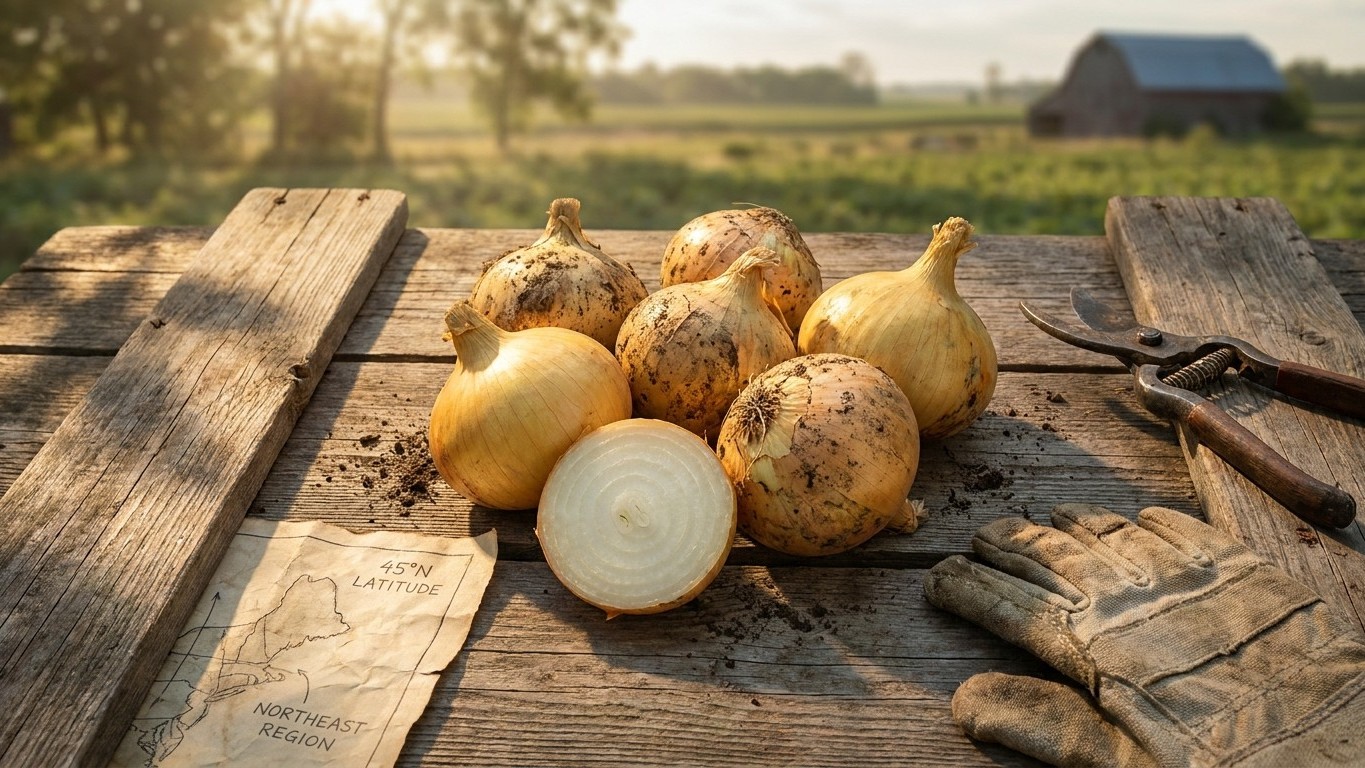

Safrane is a long-day onion, which means it needs roughly 14 to 16 hours of summer daylight to form a bulb. That puts its working range at 42 to 50 degrees north latitude, a band that runs across the northern United States and most of Canada. Below that line, skip it. Above it, expect a sharp yellow onion that keeps six months or more.
Will Safrane bulb where you are

This is the question to settle before anything else, because nothing about flavor or storage matters if the plant never makes a bulb. Safrane belongs to the long-day group, and it bulbs correctly between 42 and 50 degrees north latitude. That range covers states like Minnesota, Wisconsin, Michigan, New York, Washington, and most of the northern tier, plus southern Canada.
Here’s the part that trips people up: bulbing has nothing to do with heat. It’s triggered by day length, specifically the number of daylight hours the plant is exposed to during the growing season. A long-day onion won’t start swelling into a bulb until it senses 14 to 16 hours of light, and that threshold only shows up naturally at northern latitudes in summer. This is why long-day varieties belong up north, and short-day varieties belong down south, even though the south is warmer. Warmth grows the leaves. Day length triggers the bulb.
Plant Safrane in Georgia or Texas, and here’s what happens: the days never get long enough to flip the switch. The onion keeps putting energy into leaves all season, never forms a proper bulb, and what little swelling occurs won’t survive storage. It rots. This isn’t a matter of getting a smaller harvest. It’s a matter of getting no harvest worth keeping.
If you’re gardening at 40 degrees north (think Philadelphia, Denver, or Indianapolis) or at 51 degrees north (parts of the Canadian prairies), you’re in the blurred zone right at the edge of the range. Results there can go either way depending on the specific summer, your exact latitude, and how the season plays out. Don’t treat 42 degrees as a hard wall or 50 degrees as a firm ceiling. Treat them as guideposts on a continuum, and if you’re within a couple degrees of either line, expect variable results rather than a guaranteed outcome.
What Safrane is like
Assuming the latitude works out, here’s what a grower actually pulls out of the ground. The catalogue facts are straightforward, and worth having in one place since they’re the kind of thing you look up rather than read start to finish:
- Color: Yellow
- Days to maturity: 106 days from transplant
- Flavor: Sharp
- Storage life: 6+ months
The sharpness is the detail that decides whether you’ll actually like this onion, and it’s tied directly to how long it lasts in storage. Onions get their bite from sulfur compounds, the same chemistry that makes you tear up cutting one open. Those compounds aren’t just about flavor. They’re a preservative. A bulb loaded with sulfur compounds resists rot and sprouting far longer than a mild one, because those compounds are doing double duty as a natural defense system.
That’s why sweet onions, the Vidalia and Walla Walla types, spoil within weeks of harvest while a sharp yellow onion like this one holds into spring. It’s not a marketing distinction. It’s chemistry. A grower hoping for something mild enough to eat raw on a sandwich, with the storage life of a keeper onion too, is asking for two things that don’t come in the same bulb. Safrane picked its lane: it’s a pantry onion, built for cooking, soups, and stews, not for raw rings on a burger.
When to plant it
Planting timing follows directly from the day-length group, and this is where a lot of gardeners get confused, because the calendar advice changes depending on where you live. Short-day onions go into the ground in fall in mild-winter regions of the South, overwinter as small plants, and get harvested the following late spring. Long-day types, Safrane among them, follow the opposite schedule: they go in during late winter to early spring, timed so the plant has a full growing season to bulk up before summer’s long days trigger bulbing.
For a long-day variety like this, that means starting seed indoors in late winter, or setting out transplants as soon as the soil can be worked in early spring, well before the solstice pushes day length past the bulbing threshold.
The size test that matters more than the date
A planting date on a calendar is a rough guide. What actually determines your onion’s final size is a different test entirely: how big is the plant when day length hits the trigger point? Whatever leaf mass the plant has built by that moment is what gets converted into bulb size. A plant with four or five sturdy leaves when bulbing kicks in will produce a respectably sized onion. A plant that’s still small and spindly at that same moment will bulb anyway, because day length doesn’t wait, but it’ll produce a small bulb regardless of how much growing season is technically left.
This is why getting transplants in early, and getting them growing vigorously right away, matters more than hitting some ideal date on a seed packet. The plant needs weeks of unimpeded growth before the solstice arrives, not just a technical planting window.
Growing it well
Onions have shallow root systems and don’t compete well with anything growing nearby. That’s not a minor detail, it’s the single biggest factor separating a good bulb from a disappointing one. A weed patch crowding an onion bed doesn’t just look messy. It’s actively pulling water and nutrients away from roots that can’t reach very deep or very wide to compensate. The visible result shows up weeks later as undersized bulbs, even though the plants looked fine early on.
The same logic applies to water. Onions need consistent moisture through the bulb-forming stage, and because those roots stay shallow, the topsoil drying out for even a few days can stall growth right when the bulb should be packing on size. Skipping a watering during a dry stretch doesn’t kill the plant. It just quietly shrinks the harvest.
Watch for bolting
Occasionally a plant sends up a flower stalk instead of, or in addition to, bulbing normally. This is bolting, usually triggered by a cold snap early in the season or by stress later on. A bolted plant redirects its energy into the flower stalk, and the bulb that results won’t store well no matter how carefully it’s cured. The fix isn’t complicated: pull bolted onions and use them first, right away, rather than setting them aside for the pantry. They’re fine to eat. They’re just not going to make it to spring.
Harvesting and keeping it
The onion itself tells you when it’s ready, no calendar required. As the bulb finishes maturing, the green tops start to weaken at the neck and fall over on their own, first a few plants, then most of the bed within a week or so. That flop is the signal, not a date circled back in spring when you planted.
What happens after the tops fall over decides whether the harvest actually lasts six months or rots in the garage by November. Curing is the step most home gardeners either skip entirely or rush through, and it’s the reason a perfectly good harvest can turn to mush within weeks of coming out of the ground.
- Once most of the tops have fallen over, stop watering and let the bulbs sit in the ground for a few more days if the weather is dry.
- Pull the bulbs and lay them out in a single layer somewhere warm, dry, and out of direct sun, a covered porch or open garage works.
- Leave them there for two to three weeks, until the outer skins turn papery and the necks are fully dry and tight, not soft or green.
- Trim the dried tops (or braid them, if you’re storing that way) and clean off loose soil without breaking the papery skin.
- Move the cured bulbs to a cool, dark, well-ventilated space, mesh bags or slatted crates work better than sealed containers.
Skip the curing step, and even a variety rated for six months of storage will start softening within a few weeks, because moisture trapped in an undried neck is an open door for rot. Do it right, and a six-month keeper like this one carries a household from harvest straight through winter and into spring, which is a very different experience from a three-month onion that has to be used up before the season even turns. That gap, three months versus six, is the difference between planning meals around what’s in the pantry and running out before the ground even thaws again.