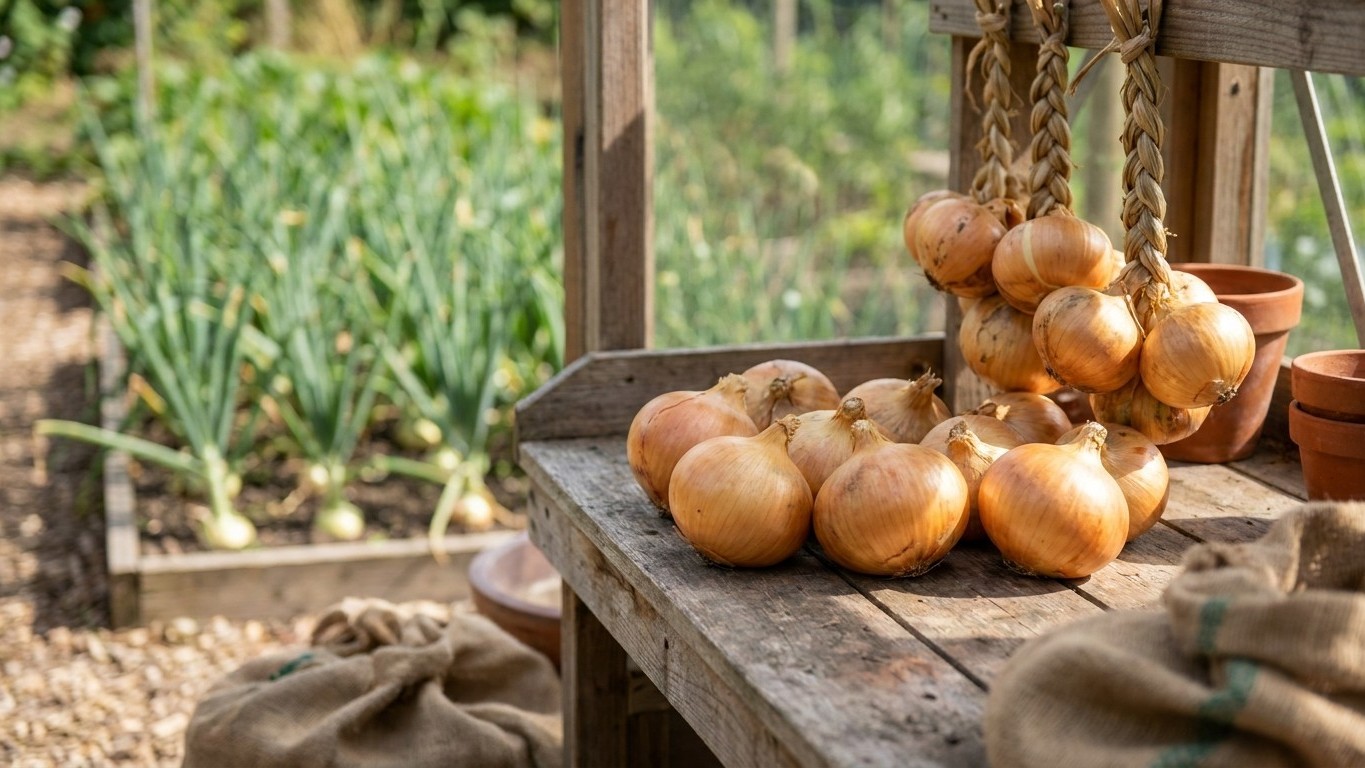

Ailsa Craig belongs to the long-day group, and that single fact decides more about whether it will work for you than soil, water, or anything else in this guide. Grow it north of roughly the 38th parallel and it bulbs reliably. Grow it well south of that line and the plant may never form a bulb at all, just leaves and eventually rot in the ground. Check your latitude before you order seed, not after.
Will Ailsa Craig bulb where you are

Ailsa Craig is a long-day onion, and that classification matters more than soil type, watering schedule, or anything else you might read about growing it. Long-day onions bulb correctly between roughly 38 and 60 degrees north latitude, a band that covers the northern half of the continental United States and most of Canada.
The mechanism behind this is not what most gardeners expect. Onions bulb in response to how many hours of daylight they receive, not how warm the soil gets. As days lengthen through spring and into summer, a long-day onion needs a long stretch of daylight, something on the order of 14 to 16 hours, before it will start swelling into a bulb. Northern locations get far more summer daylight than southern ones do, which runs backwards from how most vegetables behave, where the south usually has the advantage. That is exactly why long-day types like Ailsa Craig belong in the north and short-day types belong closer to the Gulf Coast.
| Day-length group | Region | Planting season | Storage tendency |
|---|---|---|---|
| Short-day | Southern latitudes | Autumn, in mild-winter climates | Milder, shorter storage life |
| Long-day (Ailsa Craig) | 38-60 degrees N | Late winter to early spring | Sharper, longer-keeping tendency |
Plant Ailsa Craig well south of that boundary and the plant does not respond by making a smaller bulb. It puts out leaves, keeps putting out leaves, and eventually the neck softens and the plant rots in the ground or in storage without ever forming a proper onion. There is no partial credit here. This is a threshold crop, not a sliding scale of gradually worse results.
If you are gardening close to that boundary, you are in a blurred zone, not a clear yes or no. The range given for this variety is a continuum, so a location just a degree or two south of 38°N may still bulb, especially in a year with an early, warm spring that lets the plant put on size before the daylight threshold arrives. It is not a reliable outcome, though, and a gardener in that zone might do better with a different option, such as the one profiled in the Safrane onion guide. For a broader look at how day length sorts onion varieties by region before you commit a whole bed to one type, see the Onion Varieties overview.
What Ailsa Craig tastes like, and what to do with it
An onion’s flavor and its keeping ability come from the same source: the volatile sulfur compounds that build up in the bulb as it matures. Those compounds are what make a raw slice bite back, and they are also what make the flesh resistant to rot and sprouting once the onion is cured. A bulb low in these compounds tastes mild and sweet, but with little chemical defense it breaks down quickly and has to be eaten soon after harvest. A bulb high in these compounds is sharper on the tongue, but that same sharpness is what lets it sit in a mesh bag through the winter without going soft. There is no way around this trade-off; the qualities that make an onion pleasant raw are the same ones that make it a poor keeper, and vice versa.
Skin color tracks this trade-off closely across the three common onion colors. Yellow onions, as a group, sit at the storing end of the spectrum, red onions fall in the middle, and white onions sit at the mild, short-storage end. Ailsa Craig is a yellow onion, which places it with the group bred and selected for keeping rather than for eating raw straight off the vine.
No specific flavor description for this variety has been published beyond that. What can be said with confidence is what its color category implies: expect an onion built for the root cellar or a cool pantry, not for slicing into a salad the day it comes out of the ground. The kitchen approach that follows from this is straightforward. Let the bulbs cure fully, with their necks dried down and their skins papery, before storing them somewhere cool, dark, and dry. Treat Ailsa Craig as stock for soups, roasts, and braises through the colder months rather than as a raw garnish onion, and save any sweeter, milder onions in the garden for that job instead.
What Ailsa Craig is like
Once conditions are right, Ailsa Craig produces a globe-shaped bulb with yellow skin, reaching maturity in about 110 days from transplant. That count starts the day you set transplants or thinned seedlings into the garden, not the day you sowed seed indoors, and it will run a week or two longer or shorter depending on how warm the season is and how much daylight the plant had banked before bulbing began.
Flavor and storage: two sides of the same chemistry
Onion flavor and onion keeping quality come from the same source: sulfur compounds in the bulb. A milder onion has fewer of these compounds, tastes sweeter raw, and also has less natural protection against rot, so it tends to break down in storage within weeks to a couple of months. A sharper onion carries more sulfur compounds, bites harder on the tongue and in the pan, and that same chemistry is what lets it sit in a mesh bag in a cool closet for months without turning soft. You cannot have both in one variety. An onion bred for sweetness will not also be the one that lasts you through winter.
Long-day onions as a group tend toward the sharper, better-keeping end of that trade-off, the opposite of short-day types such as Walla Walla Sweet, prized for eating fresh and known for not keeping long. That said, no flavor rating and no storage duration has been published specifically for Ailsa Craig, so it would not be honest to hand you a number for either one. What is fair to say is the tendency: expect a firmer, more assertive onion than a sweet salad type, and expect it to outlast a short-day variety in the pantry, without a guaranteed figure attached to that expectation.
When to plant it
Planting time for onions follows the day-length group, and it flips depending on where in the country you garden, which trips up a lot of first-time growers. Short-day onions go into the ground in autumn in mild-winter regions and are harvested the following late spring, using the mild winter itself as the growing season. Long-day onions, including Ailsa Craig, do the opposite. They go in during late winter to early spring, in time to build enough leaf growth before the long days of summer arrive and trigger bulbing.
Size before the trigger, not a date on the calendar
The date on the calendar matters less than a simpler test: the plant has to be big enough before day length crosses the bulbing threshold, because whatever size the top growth has reached at that moment is roughly the size the bulb will end up. A spindly, thin-necked seedling that hits the daylight trigger in early summer will form a small bulb no matter how much you water and feed it afterward, because the plant simply does not have the leaf mass to fill one out. A transplant with several sturdy leaves and a thickened base at that same point will make a full-sized bulb.
In practice, that means starting seed indoors well ahead of your last frost so the transplants already have some size on them by the time you set them out in late winter or early spring, rather than direct-sowing and hoping the plant catches up in time. Gardeners farther north, where the growing season is compressed, benefit even more from getting a head start indoors, since the days cross the bulbing threshold earlier relative to a short local season. If you are unsure how your own frost dates line up with a late-winter planting, that is worth checking with your local extension office, since it varies by region in ways a variety guide cannot cover.
Growing it well

Onions have shallow, sparse root systems and are poor competitors for space and water, so anything that shades the row or steals moisture costs you bulb size directly, not just plant health. A weedy onion bed does not just look untidy. The onions in it size up smaller because grass and weed roots are pulling water and nutrients from the same thin top layer of soil the onion roots occupy. Keep the row clear by hand or hoe rather than letting weeds get established, since pulling a mature weed later disturbs the onion’s shallow roots right alongside it.
Water matters for the same reason. Onions do not have the deep taproot that lets a tomato or squash coast through a dry week. A bulb that runs short of water partway through sizing up will simply stop growing at whatever size it had reached, and no amount of water afterward brings it back up to full size. Keep the soil evenly moist through the bulbing period rather than letting it swing between soaked and bone dry.
Watch for bolting
Some plants in any onion bed will bolt, sending up a thick flower stalk instead of putting all their energy into the bulb. This is usually triggered by a cold snap early in the season followed by a stretch of warm weather, and it shows up more often in transplants that were already oversized or stressed when set out. A bulb that has bolted will not store well. Once you see the flower stalk starting, mark that plant and use it first, fresh from the garden, rather than setting it aside for winter storage where it will be the first bulb to soften and spoil.
Harvesting and keeping it
Ailsa Craig tells you when it is ready without needing a calendar. As the bulb finishes sizing up, the green tops weaken at the neck and fall over on their own, usually across most of the bed within a few days of each other. That collapse, not a target date counted from transplanting, is the signal to stop watering and begin the harvest. Pulling bulbs while the tops are still upright and green means pulling before the bulb has finished maturing.
Curing: the step most gardeners skip
Once the tops have fallen, lift the bulbs and let them cure, meaning dry down, in a warm, airy, shaded spot for a couple of weeks before you put them into storage. The point of curing is the neck. It needs to dry down until it is tight and papery, not soft and green, because a bulb stored with a wet neck rots from the top down within weeks regardless of how well it grew. Skipping this step is the single most common reason home-grown onions do not keep as long as gardeners expect.
Signs a bulb is properly cured and ready to store:
- Outer skin is dry, papery, and rustles when handled
- Neck is tight and thin, not thick or moist
- Roots have shriveled and darkened
- No green color remains anywhere on the neck
As for how long a cured Ailsa Craig will actually keep, no storage duration has been published for this specific variety, so it would not be honest to give you a number of months. What can be said is the general tendency of its group: long-day onions like this one typically run sharper in flavor and hold up longer in storage than short-day, sweeter types, and that is a real practical difference in the kitchen. An onion that keeps through the winter means you are still cooking with home-grown bulbs in March. An onion that only holds for a few months means the bin is empty well before the new season’s crop is ready, and you are back to buying onions at the store until you can dig fresh ones from a spring-planted bed.