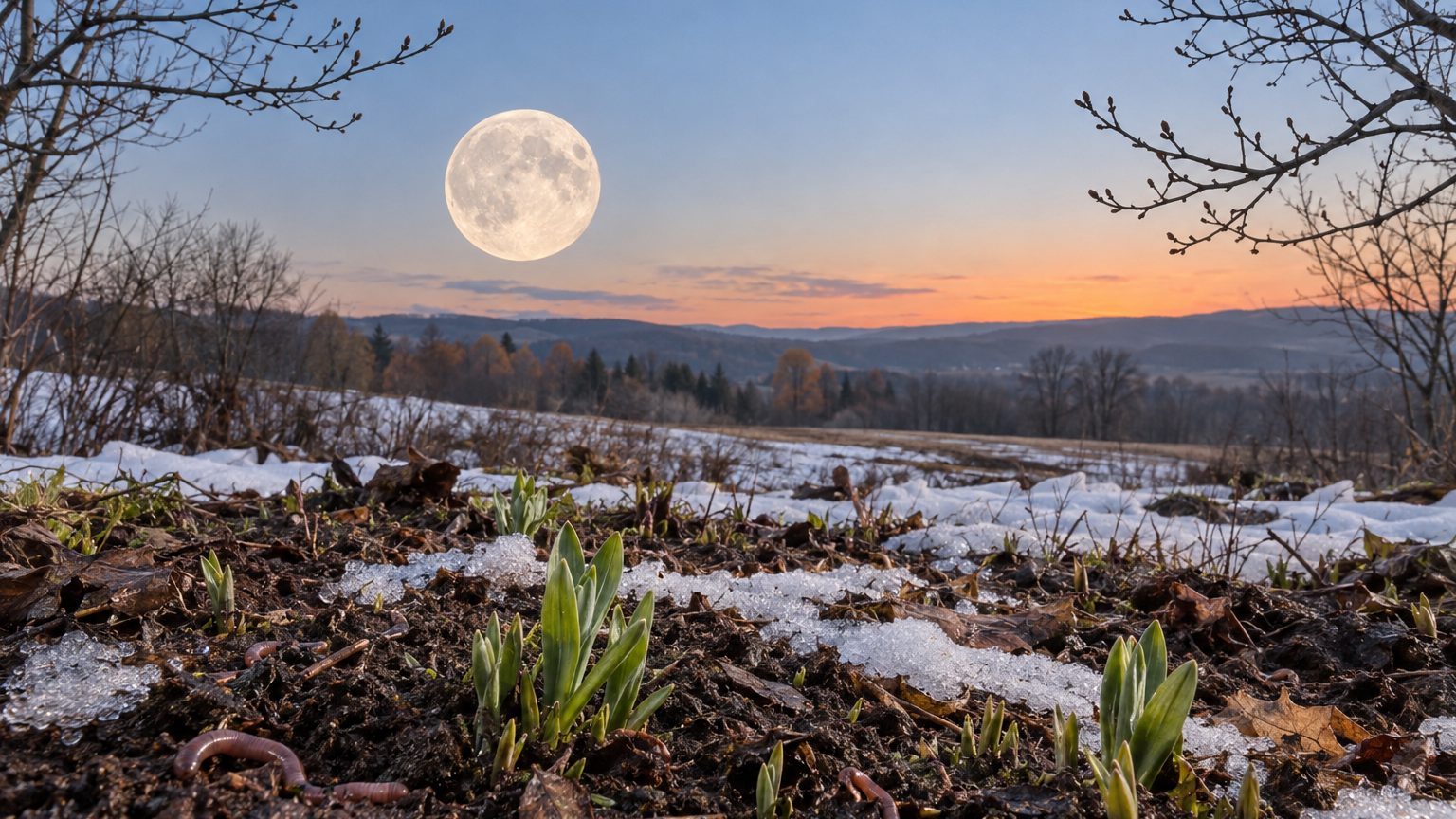

The Worm Moon is the full moon of March. It peaks on March 3, 2026, at 6:37 a.m. ET, with the Moon in Virgo, and again on March 22, 2027, at 6:43 a.m. ET, with the Moon in Libra. The name comes from old almanac tradition about the ground waking up at the end of winter. It marks a point in the season. It does not carry a planting rule of its own.
Worm Moon in 2026 and 2027
A full moon is a single instant, the moment the Moon sits directly opposite the Sun in the sky. Every time below is therefore a clock reading in Eastern time, and readers in other U.S. time zones adjust the hour to their own clock.
| Year | Full moon date | Time (ET) | Moon sign | Name that year |
|---|---|---|---|---|
| 2026 | March 3 | 6:37 a.m. | Virgo | Worm Moon |
| 2027 | March 22 | 6:43 a.m. | Libra | Worm Moon |
The Moon sign is the zodiac sign the Moon occupies at that instant. Almanac planting charts use it to label days, and this page reads nothing more into it.
The two years sit on opposite sides of the spring equinox. In 2026 the Worm Moon arrives before the March equinox, which falls on March 20 at 10:45 a.m. ET. In 2027 it arrives after the equinox, which falls on March 20 at 4:24 p.m. ET. So the 2026 moon belongs to the last stretch of astronomical winter, and the 2027 moon is the first full moon of astronomical spring.
The name does not shift between these two years. March holds a single full moon in both 2026 and 2027, so no other moon competes for the label. The one name that does move is the Harvest Moon, which goes to the full moon nearest the September equinox, so its month can change from year to year. In both 2026 and 2027 it falls in September.
Anything practical, such as what can go into the ground and when, depends on where you live. Your state’s planting guide answers that. A date on this table does not.
Where the name comes from and what it marks
Full moon names were handed down through almanacs, and the Old Farmer’s Almanac popularized the set most Americans know today. It credits Native American, colonial American and European sources. Each name tags a moon with something people noticed in that part of the year. The March name is among the most literal.
A name from the thaw
According to almanac tradition, the Worm Moon is named for the return of earthworms as the ground softens at the end of winter. Worm casts show up on thawing soil, and birds follow them. Some almanac accounts offer a second explanation, that the “worms” were beetle larvae emerging from tree bark as the weather turned. Either way, the name describes a seasonal change and not a gardening instruction.
Other March names
The same moon has carried several other names in almanac sources:
- Crow Moon
- Sap Moon
- Crust Moon
- Lenten Moon
Each one points to a different sign of the same turning season, from returning birds to running sap to the crust of old snow. The names do not conflict. They come from different peoples and regions describing the same weeks. The Old Farmer’s Almanac uses Worm Moon for its March entry, and this page follows that usage. For the full set of monthly names, see the full moon names page.
What the season looks like on the calendar
The name follows the month, not the weather. A March 3 full moon in 2026 and a March 22 full moon in 2027 are both Worm Moons, even though they sit almost three weeks apart. The seasonal turn the name describes arrives on very different dates in Florida, Ohio and Montana. A tradition that tags one moon for the whole country cannot track that, and it was never meant to.
The astronomical marker is the equinox. Spring begins on March 20 in both years, at 10:45 a.m. ET in 2026 and 4:24 p.m. ET in 2027. What the soil is doing at your address is a separate matter. Local frost dates and soil temperature are the guides there, and your state’s planting guide lists them.
The Worm Moon in the garden
Gardeners who plant by the Moon split each lunar cycle into four quarters. The almanac rule for the third quarter, which runs from the full moon to the last quarter, is that it suits root crops and other below-ground work. The fourth quarter, from the last quarter to the new moon, is traditionally set aside from sowing. That is the rest period in the almanac scheme. This is tradition handed down through almanacs. The effect of the Moon on crops has not been proven.
Counted from the Worm Moon, the two years run like this:
- 2026: third quarter from the full moon on March 3, 6:37 a.m. ET, to the last quarter on March 11, 5:38 a.m. ET. The rest period then runs to the new moon on March 18, 9:23 p.m. ET.
- 2027: third quarter from the full moon on March 22, 6:43 a.m. ET, to the last quarter on March 29, 8:53 p.m. ET. The rest period then runs to the new moon on April 6, 7:51 p.m. ET.
The Moon never overrides the calendar of the place. Frost dates and soil temperature decide whether a crop can go in the ground. The Moon, for those who follow it, only picks among days that are already open. In early March that may leave very few days, or none at all, depending on the state.
Gardeners who follow the almanac scheme also read the Moon sign day by day. Those day-by-day listings sit in the monthly tables of the full moon calendar 2026 and the full moon calendar 2027. The broader rules behind the quarters are laid out in the guide to planting by the moon.
Questions
Is the Worm Moon the same moon every year?
It is always the March full moon, but the date changes. It falls on March 3 in 2026 and March 22 in 2027. March has one full moon in each of those years, so there is no ambiguity.
Does the Worm Moon tell me when to plant?
No. The name records a seasonal sign in almanac tradition, the return of worms as the ground thaws. It gives no planting date. Frost dates and soil temperature in your state decide what can go in, and your state’s planting guide is the place to check them.
What is the next full moon after the Worm Moon?
The Pink Moon. It peaks on April 1, 2026, at 10:11 p.m. ET and on April 20, 2027, at 6:27 p.m. ET.