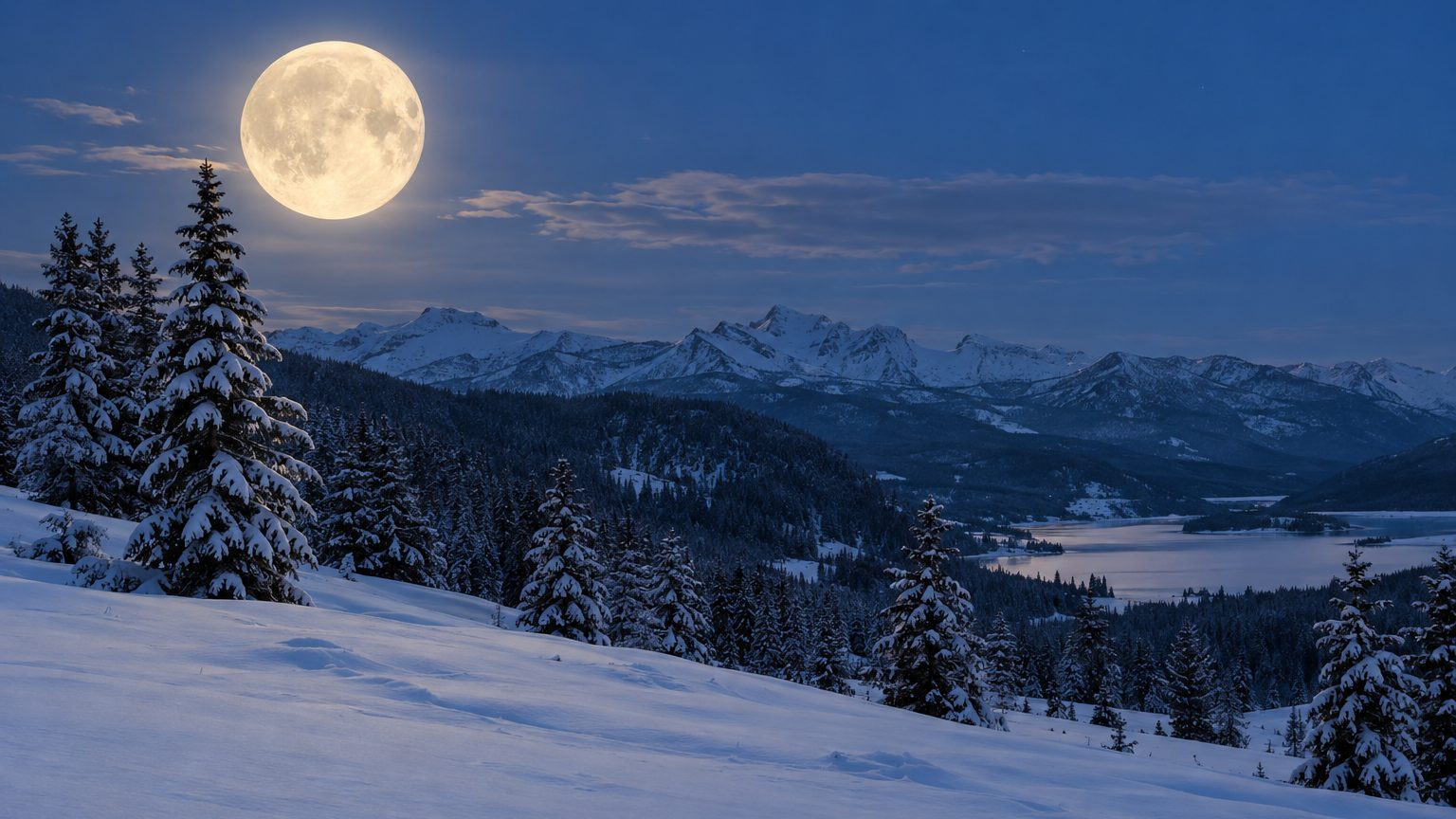

The Snow Moon of 2026 is the full Moon of February 1, 5:09 p.m. ET, with the Moon in Leo. In 2027 it arrives on February 20 at 6:23 p.m. ET, in Virgo. In the Old Farmer’s Almanac naming tradition, the Snow Moon is the February full Moon, whatever its date. What follows covers the timing, the origin of the name, and what almanac tradition says to do around it.
Snow Moon in 2026 and 2027
A full Moon is a moment, not a day. It happens when the Moon sits directly opposite the Sun as seen from Earth, and almanacs list that instant to the minute. Both Snow Moons fall in the evening, Eastern time. Central readers subtract one hour and Pacific readers subtract three. The calendar date stays the same in every US time zone in both years.
| Year | Date | Time (ET) | Moon sign | Name that year |
|---|---|---|---|---|
| 2026 | February 1 | 5:09 p.m. ET | Leo | Snow Moon |
| 2027 | February 20 | 6:23 p.m. ET | Virgo | Snow Moon |
The sign is simply where the Moon sits at the moment it turns full. Leo in 2026 and Virgo in 2027 are two snapshots, not a pattern. The gap between the two dates is also worth a glance. The 2026 Snow Moon comes early in the month, and the 2027 one comes nearly three weeks later.
The name does not shift in either year. February holds exactly one full Moon in 2026 and in 2027, so the label lands on it without any debate. The year-to-year shuffling happens elsewhere. In 2026 the second full Moon in a single month is May 31 (the Flower Moon, also called a Blue Moon). The Harvest Moon, meanwhile, goes to the full Moon nearest the September equinox. That is September 26 in 2026, with the equinox on September 22 at 8:05 p.m. ET. In 2027 it is September 15, with the equinox on September 23 at 2:01 a.m. ET.
For every other month, the full moon calendar 2026 and the full moon calendar 2027 list each date, time and name.
Where the name comes from and what it marks
The names on the almanac’s list were calendar markers long before printed calendars existed. Each full Moon was a landmark in the year, and each one got a label tied to what the season looked like outdoors. The Old Farmer’s Almanac draws its list from Native American, colonial American and European sources, which is why one month can carry several names. For February, “Snow Moon” is the best known. Another is “Hunger Moon,” a name that traditionally reflects how hard late winter was when stored food ran low and hunting was difficult.
So the name marks weather, not a planting task. It comes from regions where February brings snow, and that describes only part of the country. Snow cover is a fact of life in Minnesota, Maine and Montana. In Florida, southern Texas and much of coastal California, a February with no snow at all is normal. The name still applies in those places, because the almanac assigns it by month and not by local conditions.
It helps to see the Snow Moon in its neighborhood on the calendar. The almanac names the full Moons on either side of it like this:
- Wolf Moon, January 3 in 2026 and January 22 in 2027
- Snow Moon, February 1 in 2026 and February 20 in 2027
- Worm Moon, March 3 in 2026 and March 22 in 2027
Read together, the three names trace winter loosening its grip. Wolves, then snow, then the worms of early spring. The full list, with the stories behind each name, is on the full moon names page.
There is one piece of astronomy that suits a snowy night. In winter the Sun rides low in the sky, and the full Moon sits opposite it, so it rides high. A winter full Moon rises near sunset, crosses the sky for most of the night and sets near sunrise. Over snow, that long stretch of reflected light is probably what the name’s first users noticed.
What can actually go into the ground in February is a local question, and the Moon does not answer it. Planting guides built for each state do. They are the place to look for what your area allows and when, and nothing on this page replaces them.
The Snow Moon in the garden
Almanac tradition divides the lunar cycle into four quarters. The rule gardeners who plant by the Moon pass down is that the third quarter, from the full Moon to the last quarter, is the stretch for root crops and other plants that develop below ground. Tradition also treats the days around the full Moon itself as a period of rest from sowing. The Snow Moon sits at the start of that third quarter.
| Year | Third quarter begins (full Moon) | Third quarter ends (last quarter) |
|---|---|---|
| 2026 | February 1, 5:09 p.m. ET | February 9, 7:43 a.m. ET |
| 2027 | February 20, 6:23 p.m. ET | February 28, 12:16 a.m. ET |
Some almanac conventions add a second filter, the Moon’s sign. Under the older convention, Leo and Virgo are both labeled barren signs, which the tradition reads as days for rest rather than sowing. Other conventions assign the signs differently, so check which one your almanac follows before comparing notes with a neighbor.
The effect of the Moon on crops is not proven. Treat all of this as an old custom, and a pleasant one, rather than a method with a guaranteed result. The Moon also never overrides the calendar of the place. Frost dates and soil temperature decide whether a crop can go in the ground at all, and the Moon, if you choose to follow it, only picks among days that are already open. In much of the country in February, that means few or none, which is a good reason to consult your state’s planting guide first.
If you want to follow the tradition anyway, the planting by the moon guide explains how the phases and signs fit together. For the rest of the year, the two calendars linked above list every full Moon.
Questions
When is the Snow Moon in 2026?
February 1, 2026, at 5:09 p.m. ET, with the Moon in Leo. It is the only full Moon of that month.
Is the Snow Moon the same as the Hunger Moon?
Both names belong to the February full Moon. The Old Farmer’s Almanac uses Snow Moon as its main name, and Hunger Moon is an alternate from the same tradition. The date and time are identical, February 1 in 2026 and February 20 in 2027.
Does the Snow Moon tell me when to plant?
No. The Snow Moon is a name and a point on the lunar calendar. Almanac tradition attaches root crops to the days after the full Moon, but that is a custom and not a proven effect. Your local frost dates and soil conditions set the real limits, and your state planting guide lists them.