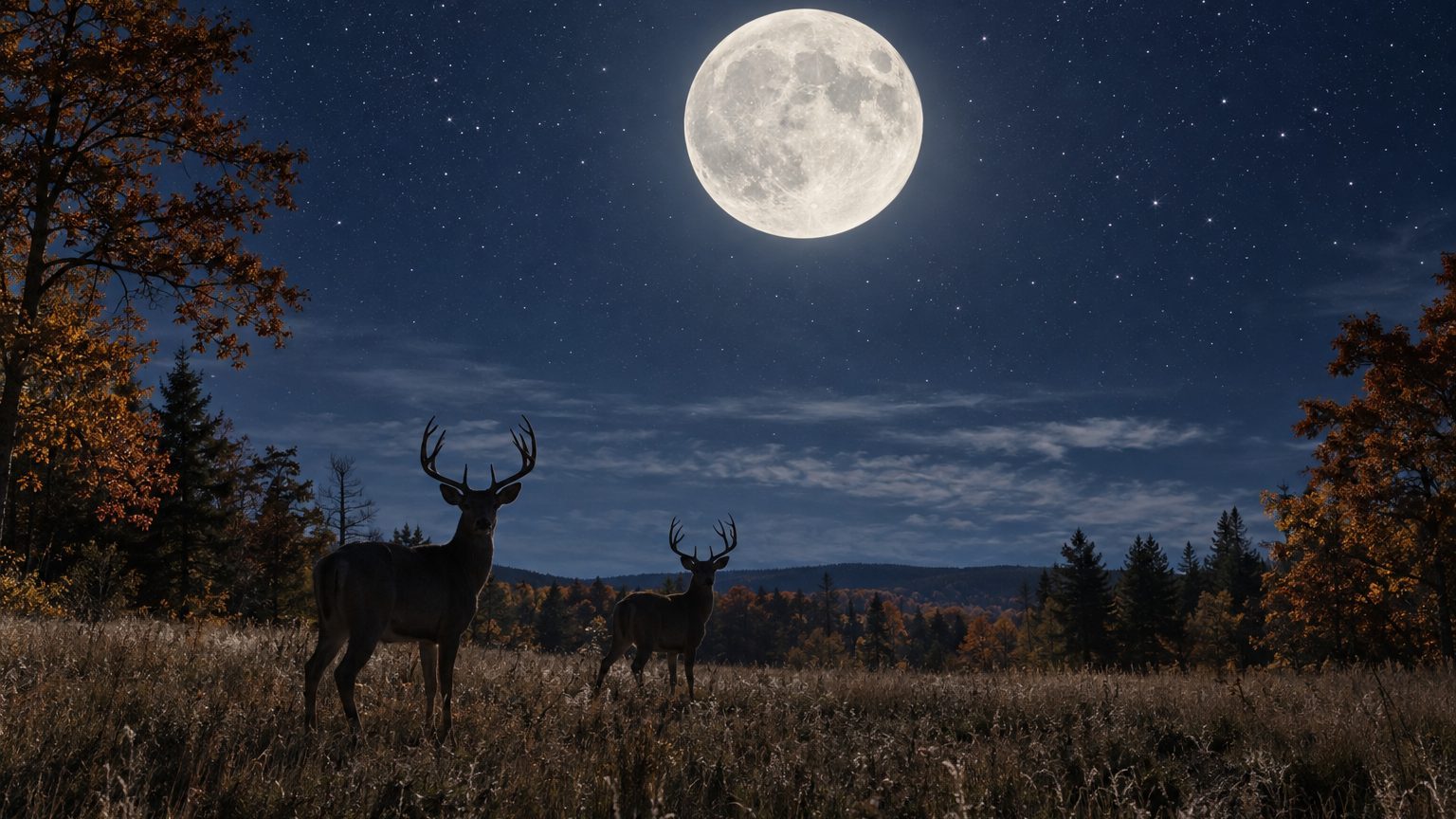

The Buck Moon in 2026 is the full moon of July 29, at 10:35 a.m. ET, with the Moon in Aquarius. In 2027 it arrives earlier in the month, on July 18 at 11:44 a.m. ET, with the Moon in Capricorn. Old Farmer’s Almanac usage gives the July full moon this name. It refers to male deer, whose antlers are growing in midsummer.
Buck Moon in 2026 and 2027
A full moon is an instant, not a day. It is the moment the Moon sits directly opposite the Sun as seen from Earth, and the almanac lists that moment to the minute. The disk looks full to the eye for a night or so on either side. Both Buck Moon times fall in late morning on the East Coast, so the calendar date is the same in every U.S. time zone. Readers elsewhere should convert from Eastern time.
| Year | Full moon date | Time (ET) | Moon sign | Name that year |
|---|---|---|---|---|
| 2026 | July 29 | 10:35 a.m. ET | Aquarius | Buck Moon |
| 2027 | July 18 | 11:44 a.m. ET | Capricorn | Buck Moon |
The Moon sign is the zodiac position the almanac assigns to the Moon at that moment. It matters only to gardeners who follow sign conventions, and this page treats it as a label, not a force.
Does the name shift between years?
Not in these two years. Each year has one July full moon, and both are called the Buck Moon. The name that moves is the Harvest Moon, which goes to the full moon nearest the September equinox. That is September 26, 2026, at 12:49 p.m. ET (equinox September 22, 8:05 p.m. ET), and September 15, 2027, at 7:03 p.m. ET (equinox September 23, 2:01 a.m. ET). Neighboring names stay put as well. The Strawberry Moon comes before the Buck Moon, on June 29, 2026, and June 18, 2027. The Sturgeon Moon follows it, on August 28, 2026, and August 17, 2027. The one 2026 oddity is the Blue Moon on May 31, which pushes nothing in July out of place.
Where the name comes from and what it marks
A buck is a male deer. According to the almanac’s explanation, bucks grow their new antlers in early summer, and by July those antlers are pushing out. The name follows that animal calendar, not a crop calendar. It belongs to the family of full moon names the almanac traces to Native American tribes and to colonial settlers who borrowed and adapted them. The full moon names page lays out the whole set, month by month.
Other names for the same moon
July’s full moon carries more than one name in almanac lore. Thunder Moon is one, a nod to summer storms. Hay Moon is another. The almanac settles on Buck Moon, and that is the name this site uses. Names for a given month were never standardized across tribes or regions, so any single list is a convention, not a fixed record.
What the calendar says about the season
Astronomically, the Buck Moon sits in the stretch between the June solstice and the September equinox. The 2026 solstice falls on June 21 at 4:24 a.m. ET. The 2027 solstice falls on June 21 at 10:10 a.m. ET. By late July the days have begun to shorten, though the change is slow, and the name does not tell you anything about what is growing in a particular yard.
That part depends on where you live. A July full moon in Maine and one in Georgia land on the same date, but the garden beneath them is in a different state of play. The almanac name marks the point in the year. Your own frost dates and soil temperature describe the ground. For what can go in during July in your state, the state planting guides on this site are the place to look.
A small point on the name itself. The Buck Moon is not tied to a sign, a weather event or a farm task in the almanac. It is a label for the July full moon, and in 2026 and 2027 the label lands on July 29 and July 18.
The Buck Moon in the garden
Gardeners who plant by the Moon divide the lunar month into quarters. The almanac rule is that the weeks after a full moon, the waning third quarter, are assigned to root crops and other below-ground work. Some versions of the rule add that the day of the full moon itself is a pause, not a planting day. None of this is proven. The effect of the Moon on seeds, roots or yield has not been demonstrated, and this page presents the rule as tradition only.
The third quarter after each Buck Moon
For readers who follow the rule, the third quarter after the Buck Moon runs between two exact moments. In 2026 it goes from the full moon on July 29 at 10:35 a.m. ET to the last quarter on August 5 at 10:21 p.m. ET. In 2027 it goes from July 18 at 11:44 a.m. ET to the last quarter on July 26 at 12:54 p.m. ET. Those are the moments the almanac uses, so the quarter starts and ends partway through a day.
The calendar of your place comes first
The Moon never overrides the calendar of the place. Frost dates and soil temperature decide whether a crop can go in the ground. The Moon, for those who follow it, only chooses among days that are already right. If a crop does not belong in your ground in late July, no quarter of the Moon changes that.
For every full moon of the year with its time and name, see the full moon calendar 2026 and the full moon calendar 2027. The full tradition, including the four quarters and the sign conventions, is explained in the guide to planting by the moon.
Questions
When is the Buck Moon in 2026?
July 29, 2026, at 10:35 a.m. ET, with the Moon in Aquarius. It is the only full moon of July that year. The nearest named neighbors are the Strawberry Moon on June 29 and the Sturgeon Moon on August 28.
When is the Buck Moon in 2027?
July 18, 2027, at 11:44 a.m. ET, with the Moon in Capricorn. The Strawberry Moon precedes it on June 18, and the Sturgeon Moon follows on August 17.
Does the Moon decide when to plant?
No. Almanac tradition offers a rule for the days after a full moon, but the effect on crops is not proven. Frost dates and soil temperature in your area set what can go in the ground. If you follow the Moon, treat it as a way to pick among days that already suit your local calendar.