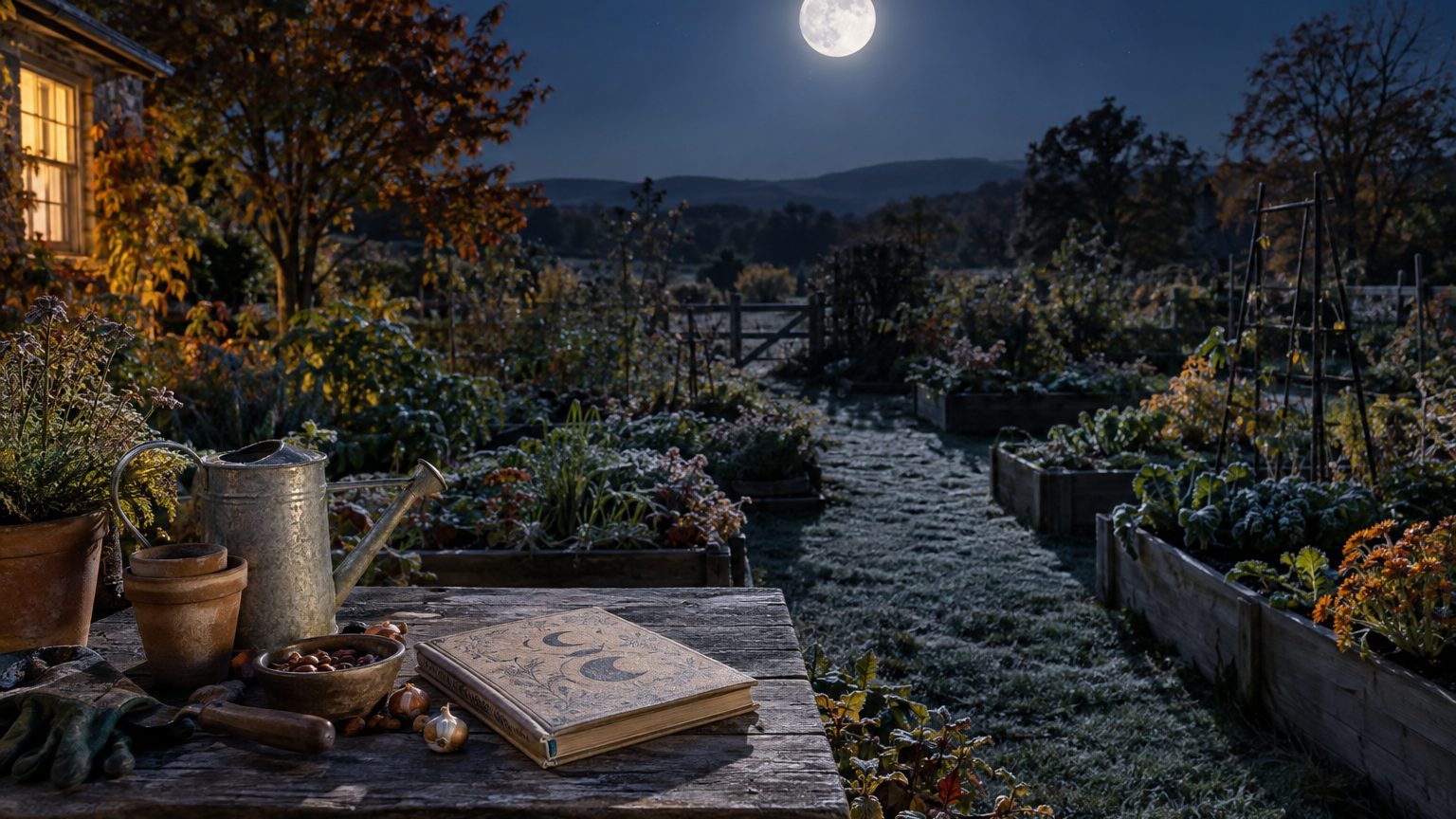

The 2026 calendar holds 13 full moons, from the Wolf Moon on January 3 at 5:02 a.m. ET to the Cold Moon on December 23 at 8:28 p.m. ET. One of them is a Blue Moon, the second full moon of May, on May 31. All times below are Eastern. Gardeners who plant by the Moon use these dates as anchors, but the practice is almanac tradition, not a proven method.
Full moon dates in 2026
Why the year has 13
A full moon is an instant, not a day. It is the moment the Moon sits directly opposite the Sun as seen from Earth. Those moments come roughly 29 to 30 days apart, which is slightly shorter than most calendar months. Over a year the gap adds up, and sooner or later a month fits two of them. In 2026 that month is May, with full moons on May 1 and May 31.
By the calendar-month definition, the second full moon in a month is a Blue Moon. The color of the Moon has nothing to do with it. The almanac keeps the name Flower Moon for both May full moons and marks the second as the Blue Moon.
Every full moon, date by date
| Date | Time (ET) | Name | Blue Moon |
|---|---|---|---|
| January 3 | 5:02 a.m. | Wolf Moon | No |
| February 1 | 5:09 p.m. | Snow Moon | No |
| March 3 | 6:37 a.m. | Worm Moon | No |
| April 1 | 10:11 p.m. | Pink Moon | No |
| May 1 | 1:23 p.m. | Flower Moon | No |
| May 31 | 4:45 a.m. | Flower Moon | Yes |
| June 29 | 7:56 p.m. | Strawberry Moon | No |
| July 29 | 10:35 a.m. | Buck Moon | No |
| August 28 | 12:18 a.m. | Sturgeon Moon | No |
| September 26 | 12:49 p.m. | Harvest Moon | No |
| October 26 | 12:11 a.m. | Hunter’s Moon | No |
| November 24 | 9:53 a.m. | Beaver Moon | No |
| December 23 | 8:28 p.m. | Cold Moon | No |
Reading the times
Two of these moments fall just after midnight Eastern: August 28 at 12:18 a.m. and October 26 at 12:11 a.m. In time zones farther west, they land on the previous calendar date. If you track a specific date, convert the time to your own zone first.
The Moon also looks full to the eye for a night or so on either side of the exact moment, so a full moon at 5:02 a.m. ET on January 3 does not mean the sky looks different on January 2 or 4. This table lists full moons only. Moon signs and day-by-day planting windows are covered in planting by the moon 2026.
The names of the 2026 full moons
The names below follow Old Farmer’s Almanac usage. Other sources sometimes give a different name to the same full moon, so you may see variations elsewhere. The origins and variants of each name are in the full moon names guide.
- Wolf Moon, January 3. The first full moon of the year.
- Snow Moon, February 1. It falls on the first day of the month.
- Worm Moon, March 3. It comes before the March equinox on March 20 at 10:45 a.m. ET.
- Pink Moon, April 1. The first full moon after that equinox.
- Flower Moon, May 1. The first of two full moons in May.
- Flower Moon (Blue Moon), May 31. The second May full moon, and the only Blue Moon of 2026.
- Strawberry Moon, June 29. It follows the June solstice on June 21 at 4:24 a.m. ET.
- Buck Moon, July 29.
- Sturgeon Moon, August 28. The moment falls just after midnight ET.
- Harvest Moon, September 26. The almanac gives this name to the full moon nearest the September equinox, which arrives on September 22 at 8:05 p.m. ET.
- Hunter’s Moon, October 26. It follows the Harvest Moon, again just after midnight ET.
- Beaver Moon, November 24.
- Cold Moon, December 23. It arrives after the December solstice on December 21 at 3:50 p.m. ET.
Note that the Harvest Moon is defined by its closeness to the equinox, not by the month. In some years it lands in October. In 2026 it is the September 26 full moon.
Full moons and the garden calendar
According to almanac tradition, the Moon’s cycle divides into quarters, and the stretch from a full moon to the following last quarter is the third quarter. The almanac rule is to sow or plant root crops, the ones that form below ground, during that waning stretch. As an example, one such stretch runs from the September 26 full moon at 12:49 p.m. ET to the October 3 last quarter at 9:25 a.m. ET. Gardeners who plant by the Moon treat the full moon as the point where the rule changes, from the waxing weeks to the waning ones.
The effect of the Moon on crops is not proven, and this page does not claim that following the cycle changes a harvest. If you follow it anyway, the Moon never overrides the calendar of your place. Frost dates and soil temperature decide whether a crop can go in the ground, and the Moon only picks among days your local calendar already allows. For what to plant and when, use your state’s planting guide. For the full tradition and how the quarters and signs fit together, see the guide to planting by the moon.
Questions about the 2026 full moons
How many full moons are there in 2026?
Thirteen. The first is the Wolf Moon on January 3 at 5:02 a.m. ET and the last is the Cold Moon on December 23 at 8:28 p.m. ET. May has two, on May 1 at 1:23 p.m. ET and on May 31 at 4:45 a.m. ET, which is why the year runs one over twelve.
Is there a Blue Moon in 2026?
Yes. The May 31 full moon, at 4:45 a.m. ET, is a Blue Moon under the calendar-month definition, because it is the second full moon of May. The Old Farmer’s Almanac still calls it the Flower Moon. No other month in 2026 has two full moons.
When is the Harvest Moon in 2026?
September 26 at 12:49 p.m. ET. It is the full moon nearest the September equinox, which falls on September 22 at 8:05 p.m. ET. The Hunter’s Moon follows on October 26 at 12:11 a.m. ET.