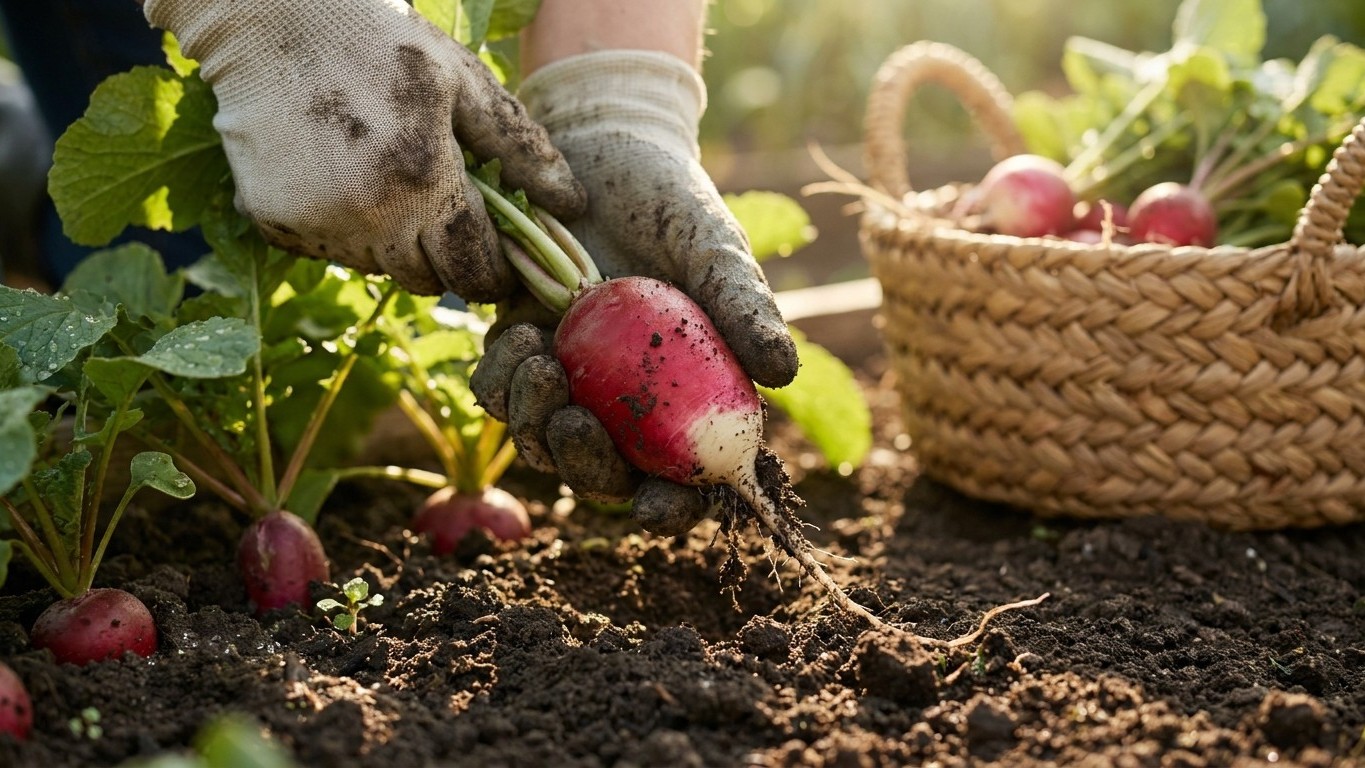

Pull radishes the moment the roots reach full size, not later. Utah State University Extension’s guide on Radishes in the Garden notes that once harvested, radishes need their tops trimmed and a quick trip into plastic bags in the refrigerator, where they hold for 2-4 weeks. That storage window is the real clue: radishes don’t wait around in the ground, and neither should you. Time the pull against your first hard frost, not a date on the calendar.
The short answer
Radishes are one of the few garden crops where “done” and “ruined” sit only a few days apart. Utah State University Extension counts backward from the first heavy frost rather than forward from a planting date, sowing the autumn crop 25-45 days ahead of that frost so the roots mature in cool weather instead of summer heat. That backward count matters more than any calendar page, because it’s the heat exposure during those final weeks, not the number of days since sowing, That Decides Whether a radish stays mild and crisp or turns hot and splits open.
Here’s what changes the answer for your own garden: radishes don’t mature all at once, and they don’t wait patiently once they do. Utah State University Extension figures that 10 linear feet of planted row yields about 10 bunches, with 3-5 feet of row recommended per person for fresh eating. That’s a compact harvest window packed into a short row, which means a home gardener is often pulling the whole planting within a matter of days, not weeks. Leave even a portion of that row in the ground a few days past full size, especially if a warm spell hits, and those roots start converting stored sugars into pungent compounds while the internal tissue grows faster than the skin can accommodate.
The fix built into the extension’s own guidance is simple: harvest as soon as the roots reach full size, don’t hold them in the ground as a informal storage strategy. Pull by the tops, trim the leaves, wash, and move straight to bagged refrigerator storage, where the clock resets to 2-4 weeks of usable life. That’s a far more forgiving window than anything the soil offers once a radish hits maturity. The plant simply isn’t built to hold; it’s built to grow fast, mature fast, and decline fast if left standing.
So the short answer really has two parts. First, use the frost-count method (25-45 days back from your first heavy frost) to land the crop’s maturity in cool weather, since heat is the trigger behind nearly every quality problem this crop develops. Second, once the roots hit full size, treat that as a hard deadline, not a suggestion. Waiting for “a little bigger” is where hot flavor and splitting begin.
What actually decides it

Radishes run on one governing principle: speed. Everything about this crop, from the recommended sowing depth to the tight row spacing, exists to keep roots growing fast and finishing fast. Every defect gardeners run into with radishes traces back to something that slowed that growth down, whether it’s heat, competition from neighboring seedlings, or simply too much time between maturity and harvest.
Heat interrupts the sugar-to-heat balance
Radishes accumulate mild-tasting compounds when they grow quickly in cool soil. Heat slows that growth just enough to let sharper, hotter compounds build up in the root instead. This is precisely why Utah State University Extension frames fall planting around a frost count rather than a fixed date: the goal is landing root maturity in a cool stretch, not a hot one. A radish that spends its final growing days in warm soil is a radish that’s already headed toward a sharper, less pleasant flavor before it’s even pulled.
Crowding steals the energy roots need
The extension’s guidance calls for thinning to 1-2 inches apart in rows spaced 10-12 inches. That spacing isn’t cosmetic. Crowded seedlings compete for light and nutrients, and radishes respond to that competition by putting energy into leafy top growth instead of the root below. A row left unthinned produces exactly what gardeners dread: bushy green tops sitting over roots that never bulked up, because the plant’s limited resources went toward the visible part of the plant instead of the part meant to be eaten.
Delay past maturity is the final slowdown
Even a radish grown correctly, in cool weather and proper spacing, runs into trouble if it’s left standing after reaching full size. Growth doesn’t stop cleanly at maturity; it continues unevenly, and that uneven continuation is what cracks the root open and lets internal tissue turn woody or hollow. The plant’s entire strategy is built around a fast finish. Once it’s finished, there’s no “grace period,” only decline.
How to do it
- Prepare loose, well-drained soil. Radishes are always direct-sown; there’s no transplanting step to fall back on if the bed isn’t ready, so work the soil before seed goes in the ground.
- Sow seed directly, about a half inch deep. This is the depth Utah State University Extension’s body text specifies for getting radish seed up quickly and evenly.
- Space rows 10-12 inches apart. That spacing gives each row enough room to develop without shading its neighbor.
- Thin seedlings to 1-2 inches apart within the row. This step is not optional; crowded rows are one of the main reasons gardeners end up with all top growth and no usable root.
- Count backward from your first heavy frost when planting a fall crop. Sowing 25-45 days ahead of that frost lands root maturity in cooler conditions, which keeps flavor mild and roots crisp rather than hot and cracked.
- Water consistently as roots size up. Steady moisture supports the fast, even growth this crop depends on.
- Check root size regularly once the crop approaches maturity. Because radishes mature quickly and roughly together across a row, a planting can go from “not ready” to “past ready” in a short stretch.
- Pull plants by the tops as soon as roots reach full size. Don’t leave mature roots standing in the ground.
- Trim off the leaves, then wash the roots. This is the step that prepares them for storage.
- Store in plastic bags in the refrigerator. Utah State University Extension notes this keeps radishes usable for 2-4 weeks, which is the real cushion for gardeners who can’t process an entire row at once.
What Goes Wrong
- Hot, sharp flavor: This happens when roots mature during warm weather instead of cool weather. The fix is timing: use the 25-45 day frost count for a fall crop so maturity lands in a cool stretch, and pull promptly once full size is reached rather than letting warm days accumulate on already-mature roots.
- Splitting or cracked roots: This is what happens when a fully mature radish is left in the ground rather than harvested. The remedy is scheduling your harvest around root size, not around convenience; check the row regularly once you expect maturity and pull as soon as roots reach full size.
- Hollow centers from being left too long: Once a radish passes its peak size, internal growth continues unevenly even as the root looks fine from outside. The fix is the same discipline as above: don’t treat a mature row as ground storage, pull and refrigerate instead.
- Hollow centers from crowded, slow-growing plants: Roots that developed slowly because of competition for space often show internal gaps even at a smaller size. The fix here is thinning correctly the first time, down to 1-2 inches apart in rows 10-12 inches, so no plant is starved of room from the start.
- Hollow centers from inconsistent watering: Growth that stalls and restarts because of uneven moisture can leave gaps inside the root even when timing and spacing were both handled correctly. The fix is steady, even watering through the entire growing period, not just at planting.
- All tops, no root: This is the clearest sign of overcrowding. Thin seedlings promptly to the 1-2 inch spacing the extension recommends; a row that never gets thinned will keep pushing energy into leaves instead of roots.
- Bolting before harvest: Warm conditions and stress push radishes toward flowering instead of root development. Sowing so maturity lands in cool weather, using the frost-based count rather than guessing at timing, is the way to avoid triggering it.
Common questions
Can radishes be started indoors and transplanted?
No. Utah State University Extension’s guidance treats radishes as a direct-sown crop only. There’s no transplant step to rely on, so seed goes straight into the garden bed at the recommended half-inch depth.
How long can harvested radishes actually last?
Once pulled, tops trimmed, washed, and bagged, radishes hold for 2-4 weeks in the refrigerator, according to Utah State University Extension. That window is far more forgiving than leaving mature roots standing in the garden.
Do different radish varieties change the harvest timing rule?
Utah State University Extension names several varieties, including Champion, Cherry Belle, Daikon Long White, Icicle, and Easter Egg, and notes that root shape, size, and color vary among them. The source gives no maturity figures for any variety, so the same principle applies across all of them: harvest by root size and condition, not by a fixed number of days.
How much row should I plant if I only want fresh eating, not storage?
Utah State University Extension recommends 3-5 feet of row per person for fresh use, with roughly 10 bunches expected from every 10 linear feet planted. That’s enough to plan a small, manageable row that matures and gets harvested within the same short window.