
Most roses need one hard cut a year, in late winter, removing anywhere from a third to two-thirds of the previous season’s growth down to an outward-facing bud. But the exact depth and month shift with the type of rose you’re holding pruners over, and a few groups break that rule entirely.
Why this matters
Pruning is not tidying. It’s how you tell a rose bush where to put its energy next spring. Roses bloom on new growth pushed out after a cut, so the cane you leave behind becomes the launch point for that season’s flowers. Cut too little and the plant wastes resources on old, congested wood that produces smaller blooms further from the light. Cut too much on the wrong type, and you remove the very wood that was about to flower.
Skip pruning for a year or two and a rose doesn’t die, but it declines in a specific way: canes cross and rub, creating wounds that let in fungal spores; the center fills with thin, shaded stems that never flower well; and airflow drops, which matters because roses are already prone to powdery mildew and black spot. Bad pruning tends to show up fast instead: flat cuts that dry out and die back, or cuts made toward an inward bud that push growth into the center of the plant instead of away from it.
When to do it
Timing depends on which of the main groups you’re growing, and the exact date depends on your climate zone, covered on your state’s rose page rather than here. What matters nationally is the sequence relative to the plant itself, not the calendar.
For most repeat-blooming roses, the signal is the plant coming out of dormancy: watch for buds that are swelling and starting to show color. That’s the moment to make the yearly cut, before new shoots get long and soft. Prune too early, while the plant is still fully dormant, and a late hard freeze can kill back the fresh cuts; prune too late, after shoots are already several inches long, and you waste the energy already spent on growth you’re about to remove.
Once-blooming varieties are the exception, and it’s an important one. Because they set flower buds on the previous year’s wood, they get pruned in early summer, right after flowering, not in late winter. Prune a once-bloomer on the late-winter schedule and you’ll cut off the wood that was going to carry this year’s only flush of blooms. Climbers flower on new wood and tolerate the late-winter approach; ramblers flower on old wood and are better handled on the after-flowering schedule.
How to do it
Start with clean, sharp bypass pruners for anything pencil-thick or thinner, and loppers or a small pruning saw for thicker, older canes. A clean cut matters: dull blades crush stem tissue instead of slicing it, and a crushed cut heals slower and invites disease. Wipe blades with rubbing alcohol between plants, especially if you’ve seen any sign of disease, since that habit actually prevents spread.
Work in this order:
- Remove any dead, damaged, or diseased canes first, cutting back into healthy wood. Healthy cane centers are pale and solid; dead or diseased wood is often brown or gray inside.
- Take out canes that cross through the center or rub against another cane, since those wounds become entry points for fungal problems.
- Thin remaining canes so air can move through the center. On a mature shrub rose this usually means keeping the strongest three to eight canes and removing thin, twiggy growth thinner than a pencil.
- Make final shaping cuts on the canes you’re keeping, cutting back by roughly a third to two-thirds of the cane’s length depending on the type and vigor of the rose.
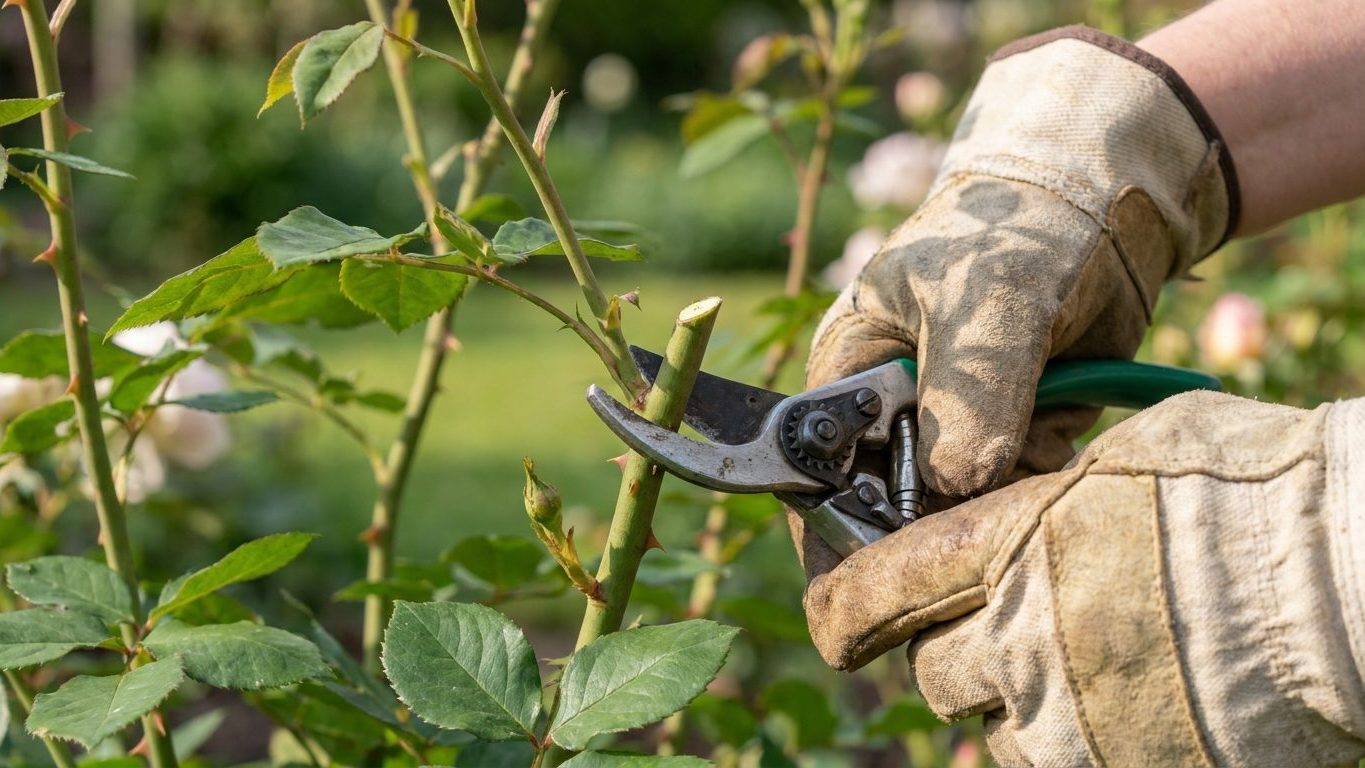
Every cut follows the same rule: cut above an outward-facing bud, on a slant away from the bud, about a quarter inch above it. The slant sheds water away from the bud instead of pooling on it, and the outward orientation pushes new growth away from the center instead of into it. A bud looks like a small reddish or greenish swelling where a leaf was attached; on dormant wood it may be barely visible, so look closely before cutting.
Knock Out roses, among the most widely planted shrub roses in home landscapes, follow a simplified version of this: cut the whole bush back to about 12 inches once a year, without the cane-by-cane selection hybrid teas need. It looks aggressive the first time, but the variety rebounds hard from a severe cut, and that single cut is essentially the entire pruning job for the year.
When finished, a well-pruned rose should look sparse, almost too open, with a handful of strong canes arranged like an open vase rather than a dense ball. That bare look right after pruning is normal and correct; it fills back in fast once new growth starts.
For canes removed because they’re dead rather than diseased, there’s a middle option: rather than cutting flush to the ground everywhere, leaving some dead stems cut back to 12 to 24 inches gives stem-nesting native bees a place to nest. It’s not a substitute for removing genuinely diseased wood, but it costs nothing.
What goes wrong
The most common structural mistake is cutting flat instead of on a slant, or cutting too far above the bud. A flat cut holds water against the bud and cane tip, which can lead to dieback several inches down the cane. A cut left too high above the bud, sometimes called a stub, just dies back to the bud anyway, wasting the gap in between and giving disease an easy foothold.
Cutting toward an inward-facing bud instead of an outward one is easy to miss on a first pass, and it shows up weeks later as new growth crowding into the center of the plant rather than opening it up. The fix is to check bud direction before every cut, not after.
Pruning once-blooming or rambler varieties on the standard late-winter schedule is a timing error that looks reasonable but isn’t: it removes the old wood carrying that year’s flower buds, and the plant simply won’t bloom, or will bloom very lightly, that season.
One mistake genuinely masquerades as diligence: sealing every pruning cut with wound paint or glue. It feels like extra protection, but on most rose cuts it isn’t necessary and can trap moisture against the cut surface instead of letting it dry and callus naturally. Removing every last bit of dead wood down to the soil line falls in the same category, it looks thorough but strips out standing dead stems that could otherwise serve as nesting sites, without any real disease benefit if that wood was already dry and inactive.
Doing it differently
Container-grown roses generally need a lighter touch than the same variety in the ground, since a restricted root system can’t always support vigorous regrowth; leaning toward the lower end of the recommended cutback is usually safer. Roses in a greenhouse or high tunnel come out of dormancy earlier than the same plant outdoors, so the swelling-bud signal arrives sooner and pruning should follow that earlier cue rather than an outdoor neighbor’s schedule.
Climbing and rambling roses genuinely need different handling, not just a different look. Climbers, flowering on new wood, take the late-winter approach along with most repeat bloomers. Ramblers, flowering on old wood, need the after-flowering approach instead, with the oldest canes removed at the base every few years to make room for vigorous new canes that will carry next year’s flowers.
Whether a rose is grafted or grown on its own roots also changes what a hard cut means for the plant. Budded roses, common among hybrid teas, grandifloras, and many climbers, have a graft union near the base that needs to stay above the final cut line; own-root roses, which include most modern landscape shrub roses on the market today, have no union to protect and can be cut harder near the crown without losing the named variety. Check the plant tag if you’re not sure which type you have before deciding how low to go.
Common questions
Are rose thorns dangerous? They are prickles, not true thorns. Prickles grow from the outer skin of the stem rather than from deeper woody tissue, which is why they can be rubbed off and why a heavy glove is enough protection when pruning.
Do I need to seal the pruning cuts? Generally no. Wound sealant is not required for routine rose pruning and can trap moisture against the cut instead of letting it dry naturally.
How do black spot and powdery mildew survive the winter, and does cleanup stop them? Black spot overwinters both in fallen leaves and in lesions on the canes themselves, while powdery mildew overwinters in dormant buds and on stems rather than in leaf litter. Raking up fallen leaves helps with black spot but doesn’t address either disease on its own, since both can also be riding on the wood you’re pruning.
Does pruning affect when I can cut roses for a vase? Indirectly. Once you’ve shaped the bush for the season, cut vase flowers once the sepals have folded back and the first one or two petals are starting to unfurl; a bud cut tighter than that often never opens properly in water.