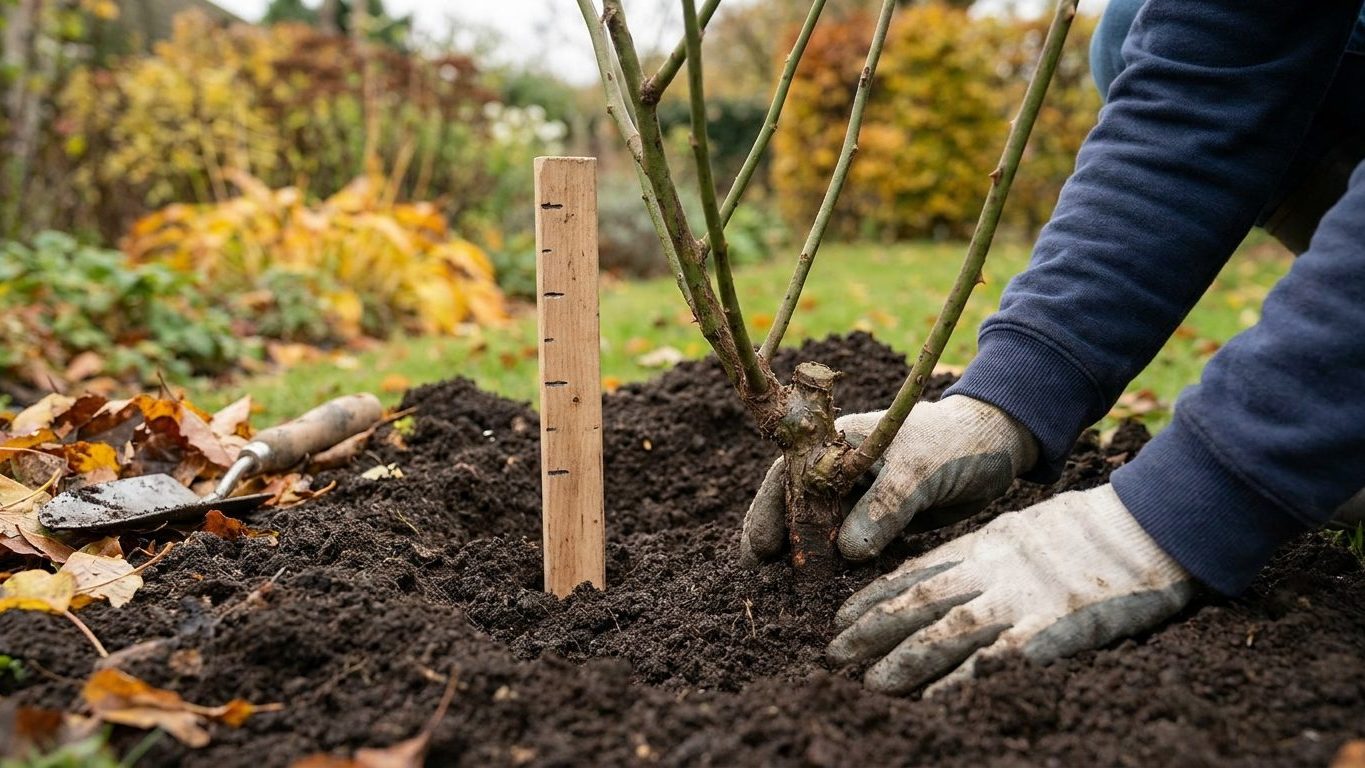

Planting depth is the one step in rose planting that isn’t optional and isn’t universal. If your rose is budded onto a rootstock, the knobbly graft union at its base has to sit at a depth set by your winter cold, not by habit. If it’s grown on its own roots, there’s no union to protect, only a crown that wants to sit right at soil level. Check the tag before you dig.
Why this matters
The graft union is a healed wound where a nursery grower fused the top growth you want onto a different root system chosen for vigor. That fusion point is weaker than solid wood on either side of it. Bury it too deep in wet clay and it can sit in constant moisture, inviting rot before the wound has fully sealed. Leave it exposed in a hard freeze and the tissue splits, killing the bud union outright, and what regrows afterward is often rootstock suckers, not the rose you bought.
Own-root roses sidestep that risk entirely; most landscape shrub roses sold today have no union at all. For those, the concern shifts to the crown, the point where stems meet roots. Bury a crown too deep and you smother the plant’s ability to push new basal canes, which is how a rose renews itself year after year. Get this step wrong, either way, and you’re looking at a plant that dies back to rootstock or stalls out for a season while it recovers.
When to do it
Plant while the rose is still dormant or just breaking dormancy, before the first flush of new growth has hardened. A dormant bare-root rose shows dry-looking canes with tight, unswollen buds; that’s the window. A container-grown rose can go into the ground later in the season, but it settles in fastest if it’s planted before soft new shoots appear that could get stressed by transplant shock while they’re still trying to ripen.
Watch the plant itself rather than a calendar. Swelling buds mean the growing season is starting; canes that are still uniformly firm and dormant-colored mean you have more room to work. Roses grow across USDA zones 5a through 11b, and the safe planting window in each zone runs on a different clock. That’s also true for how deep the graft union needs to sit, since that depth tracks how cold your winters get. This national guide can’t hand you a date or an inch measurement that works everywhere; your state page in this same guide covers both, tied to your zone.
If you’re moving an established rose rather than planting a new one, the same logic applies: wait for dormancy, not a specific month, and use the transplant as an opportunity to check whether the union or crown was ever buried correctly the first time around.
How to do it
Start with the site, not the hole. Roses want full sun, six or more hours of direct light a day, and soil that drains rather than holds water, with a pH anywhere from acid (below 6.0) to neutral (6.0 to 8.0). Soil pushing well past 7.5 is where iron chlorosis shows up as yellowing between leaf veins; a simple soil test before you dig tells you where you stand.
Dig the hole roughly twice as wide as the root ball or the spread of a bare-root plant’s roots, but no deeper than the roots themselves need. A hole that’s too deep, then backfilled, just gives the plant loose soil to sink into over the following months, dragging the union or crown down with it. For bare-root roses, mound a small cone of loosened native soil in the center of the hole and drape the roots down and outward over it; for container-grown plants, tease the outer roots loose from their potbound shape before setting the root ball in.
Now check that tag again. If it’s budded, find the graft union, the swollen knob just above where the roots begin. Your state page in this guide gives the exact depth for your zone; in general, colder climates call for burying it below soil level, milder ones for keeping it at or just above the surface. If it’s own-root, skip that calculation and simply set the crown flush with the surrounding soil grade, no deeper.
Backfill halfway, then fill the hole with water and let it drain completely before adding the rest of the soil. That step collapses hidden air pockets around the roots that would otherwise dry them out. Finish backfilling, firm the soil gently with your hands, and water again thoroughly, the equivalent of a full two-gallon watering can for a typical shrub-sized rose.
Finish with 2 to 3 inches of mulch in a ring around the base, pulled back an inch or two from the crown or union itself so it isn’t buried under the mulch layer. Done correctly, the plant should stand upright without staking, with the graft union or crown visible right where you positioned it, not sinking below a mound of loose soil a week later.
What Goes Wrong
The most common failure is planting too deep across the board, budded or own-root, out of a vague sense that deeper means safer. It doesn’t. An own-root crown buried several inches down struggles to push new basal canes and can rot in heavy clay regardless of climate.
The mistake that looks like extra care but isn’t: piling mulch high over the crown or union “to protect it,” especially in a mild climate where the union was correctly planted at or above grade. That mulch mound holds moisture against the union all season, not just through winter, and undoes the drainage you built into the hole in the first place.
Planting too shallow is the opposite failure: roots left partly exposed dry out fast and the plant never fully anchors, so it rocks in wind and the fine feeder roots keep breaking. And skipping the tag check entirely, treating every rose as if it’s budded when it’s actually own-root (or the reverse), means applying a depth rule that doesn’t match the plant in front of you. Since most modern landscape shrub roses are own-root, that assumption is wrong more often than gardening habit suggests.
One more quiet failure: backfilling the hole entirely with rich compost instead of blending it with the native soil around it. In clay, that creates a “bathtub effect” where water pools in the loose amended soil and can’t escape into the denser clay walls of the hole, keeping the root zone and the union wetter than they should be.
Doing it differently
In containers, the same union-versus-crown logic applies, just scaled down. Use a pot with drainage holes and a well-draining potting mix rather than garden soil, and position the union or crown relative to the rim the same way you would relative to grade in the ground. Containers also warm and cool faster than garden soil, so a graft union that would sit safely below grade outdoors may need extra winter protection, since the pot itself won’t insulate it the way surrounding earth does.
Raised beds behave more like loam than clay in most cases, since the mix is usually looser and better draining from the start, which reduces the “bathtub effect” risk and gives roots an easier path down. That makes raised beds a genuinely better option for gardeners working with heavy clay who don’t want to fight drainage every time they water.
Climbers and ramblers get planted using the same hole-and-depth method, just with more spacing, since these grow larger and need room for canes to be trained along a support. Miniature and ground cover roses use a proportionally smaller hole but follow the identical union-or-crown placement rule. The method doesn’t change by rose group; what changes is only the depth number, and that number comes from your zone, not your rose’s type.
Common questions
Are rose thorns dangerous?
They’re not true thorns at all. What roses have are prickles, outgrowths of the stem’s outer skin rather than a modified woody stem, which is why they can be rubbed off and tend to snap sideways instead of breaking clean. They can still puncture skin and gloves, so treat them with the same caution you would a thorn, but the plant structure behind them is different.
How deep should I bury the graft union?
That depends on how cold your winters get, and this national page can’t give you a single inch measurement that applies everywhere from zone 5a to zone 11b. Check the state page in this guide for your zone’s specific depth.
Can I plant a rose in a container instead of the ground?
Yes. Use a pot with drainage holes and a well-draining potting mix, and apply the same union-or-crown placement logic as you would outdoors, keeping in mind that a potted union may need extra winter protection since soil in a container offers less insulation than ground soil.
What’s the difference between an own-root rose and a grafted one?
A grafted, or budded, rose has a flowering variety fused onto a separate rootstock, visible as a swollen union at the base; that union needs specific depth protection tied to winter cold. An own-root rose grows on its own roots with no union, so planting depth is simply a matter of keeping the crown at soil level. Most modern landscape shrub roses are sold own-root, while many hybrid teas, grandifloras and climbers are still budded, so check the tag rather than assume.