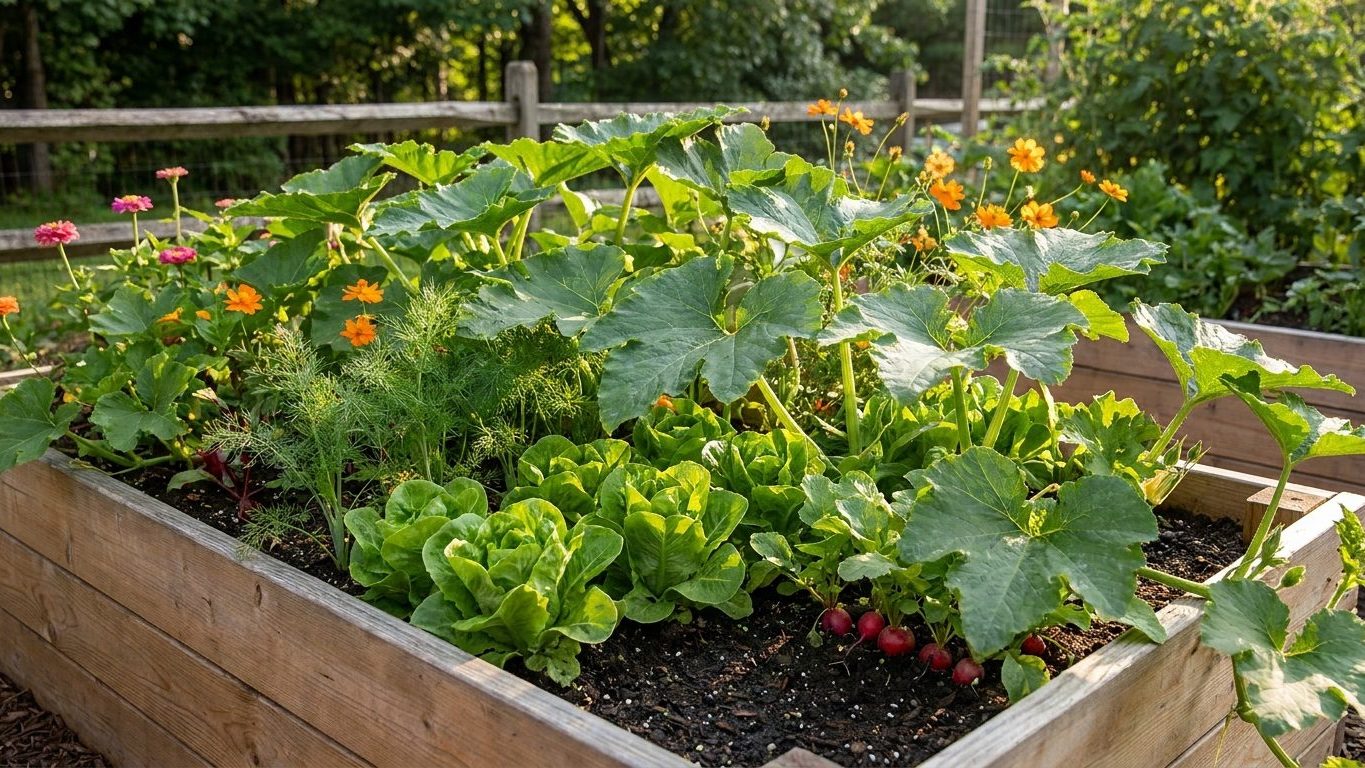

Corn, beans, bush-type flowers that draw pollinators, and living mulch crops like lettuce or dill in the early weeks all work alongside winter squash, but not because of any mystical affinity. They work because they solve a physical problem: bare soil, poor airflow, or a pest that both plants happen to attract. Pick partners for what they change in the bed, not for a folklore pairing chart.
What is actually going on

Most companion planting advice traces back to lists copied from one gardening book to the next, with the reasoning stripped out somewhere along the way. Strip it back in and only a few mechanisms survive: ground cover that keeps soil moisture even and suppresses weeds, airflow that keeps foliage dry enough to slow fungal disease, root competition that decides who gets the water and nitrogen in a shared bed, and shared pests or shared predators that make two crops rise or fall together. Everything else is a story someone liked the sound of.
Winter squash vines are the reason ground cover matters so much here. A single plant can spread eight to ten feet, and its broad leaves shade the soil beneath it once established. Planted next to a crop that needs full sun and a tidy, upright habit, like most brassicas, the squash simply wins the light fight by midsummer. Planted next to something that appreciates cooler, shaded soil and finishes before the vines take over, like a spring lettuce or a radish, the shade becomes a benefit instead of a conflict.
Airflow is the mechanism gardeners underrate the most. Winter squash foliage is dense, and in a humid week that density holds moisture on the leaf surface long enough for powdery mildew or downy mildew to take hold. Crowding a squash bed with more broad-leaved, low-growing plants makes that worse, not better. A trellised or upright neighbor, positioned so it does not shade the squash itself, actually helps by breaking up still air.
Shared pests cut both ways. Squash bugs and cucumber beetles move through curcurbit family plants, so packing squash next to cucumbers or melons concentrates the pest pressure instead of spreading it. Flowering plants that draw in predatory insects, ones that eat aphids and beetle larvae, are a more defensible choice than another curcurbit relative.
One distinction matters before anything else: winter squash is grown for its cured flesh and its keeping quality, not carving pumpkins grown for a hard shell and a hollow center. The two share a genus and a good deal of biology, so much of what follows applies to both, but where the growing goals diverge, the pumpkin section covers that ground.
Curing and storage sit downstream of all this, and they deserve the same caution. a Winter Squash that looks sound on the outside can still be compromised. Any soft spot, any weeping patch on the skin, any mold at the stem end ends the question of whether that squash goes into storage or into the compost. Looks are not a safety test.
In the garden
The pairings worth planting are the ones where each crop solves a problem the other one has. The table below lays out the common combinations, what each one is actually doing, and what tends to go wrong when a gardener gets the timing or spacing off.
| Pairing | Why it works | What goes wrong if mishandled |
|---|---|---|
| Winter squash with pole or bush beans (three sisters style) | Beans fix nitrogen in the soil that heavy-feeding squash draws on later in the season; corn stalks give beans a structure to climb | Beans planted too early get smothered once squash vines spread; corn planted too thin leaves nothing sturdy enough to climb |
| Winter squash with corn | Corn stands upright and casts little shade at ground level, so it does not compete for light the way another sprawling crop would | Squash seeded too close to corn competes hard for water in a dry stretch, since both are heavy drinkers with shallow, wide root systems |
| Winter squash with dill, cilantro, or other umbellifers left to flower | The small flowers draw in predatory and parasitic insects that keep squash bug and beetle numbers down | Left too long, these self-seed aggressively and crowd the squash bed the following year |
| Winter squash with radish or an early lettuce | Both finish and get pulled before the squash vines need the space, so the bed is never idle | Left in the ground past their season, they bolt and pull moisture and nutrients away from establishing squash roots |
| Winter squash with nasturtium | Nasturtium is often used as a trap crop, drawing aphids and some beetles away from the squash foliage | Planted right at the base of the squash instead of at a distance, it just adds another host plant in the same spot |
Why the three sisters planting works, mechanically
The traditional three sisters planting of corn, beans, and squash is often presented as a single unbreakable formula, but the mechanism is simpler than the tradition suggests. Corn provides height and a climbing surface. Beans return nitrogen to soil that corn and squash both deplete. Squash provides ground cover that suppresses weeds and holds soil moisture for all three. None of that requires the exact ratio or spacing described in any particular historical account, it requires the three roles to be filled, and a gardener working a small raised bed can fill those roles with a different structure entirely, like a cattle panel trellis in place of standing corn.
What breaks the system most often is sequencing. Corn and beans need a head start, corn especially, because once squash vines spread they shade out anything not already established. A gardener who direct-seeds all three on the same day usually ends up with squash smothering the corn before it tassels.
What it depends on where you are
Everything above is a mechanism, and mechanisms hold up nationally. What does not hold up nationally is the calendar and the pest pressure that decide whether a given pairing helps or just adds another mouth to feed. A grower with a short, cool season is fighting to get squash to size and cure before frost, and every companion crop in that bed is competing for a narrow window. A grower with a long, humid season is fighting fungal disease more than frost, and airflow becomes the priority companion planting has to serve.
Squash bug and cucumber beetle pressure also varies enormously by region and even by county, tied to overwintering populations and to what has been grown nearby in past seasons. A trap crop or a predator-attracting flower that earns its space in one garden may do very little in another where the pest simply is not present in numbers. Rainfall patterns change the fungal disease calculus the same way: a dry summer climate can get away with denser plantings that would rot a bed in a humid one.
This is the point where a national page has to hand off. The state-level pages on this site cover season length, typical pest pressure, and the growing conditions that actually apply to a given region, and a reader’s own state extension service goes a level deeper still, often down to county-specific pest alerts and variety trial results for what performs locally. Companion planting decisions made from a regional guide and a local extension bulletin will consistently outperform decisions made from a generic list, because the list cannot see the reader’s summer.
None of that changes the underlying mechanisms. Ground cover, airflow, root competition, and shared pests apply everywhere squash is grown. What changes is which of those four matters most in a given place, and that answer only shows up in local data.
The mistake that costs the most
The single costliest mistake is planting winter squash and its companions on a fixed spacing chart without accounting for how much room the vines will actually claim by late summer. A three or four foot spacing that looks generous in June is nowhere near enough once a vining variety runs eight or ten feet in every direction, and the companion crop planted at that safe-looking distance in spring ends up buried under squash foliage by August, cut off from light and often from airflow it needed to stay disease-free.
The fix is not a different number, it is a different habit: plant companions based on the mature spread of the squash type going into that bed, not the seedling spacing recommended for the companion crop alone. A compact, bush-type winter squash and a sprawling vine type from the same seed rack can have wildly different mature footprints, and a state extension service or seed source can confirm which habit a given type has before it goes in the ground. Planting bush types where space is tight and reserving vining types for beds with real room to run avoids most of the crowding problems described above before they start.
The second-order cost of this mistake is the one gardeners notice too late to fix that season: a companion crop smothered mid-season cannot be replanted with enough time left to mature, and a squash bed crowded past the point of good airflow tends to develop fungal problems that show up right around curing time, when the plant can least afford them. A soft, sunken lesion on a squash approaching harvest is often the delayed cost of a spacing decision made back in spring, not a failure at the storage stage itself. Checking mature spread before planting, rather than after the vines have already tangled, is the one habit that prevents most of what goes wrong in a mixed squash bed.