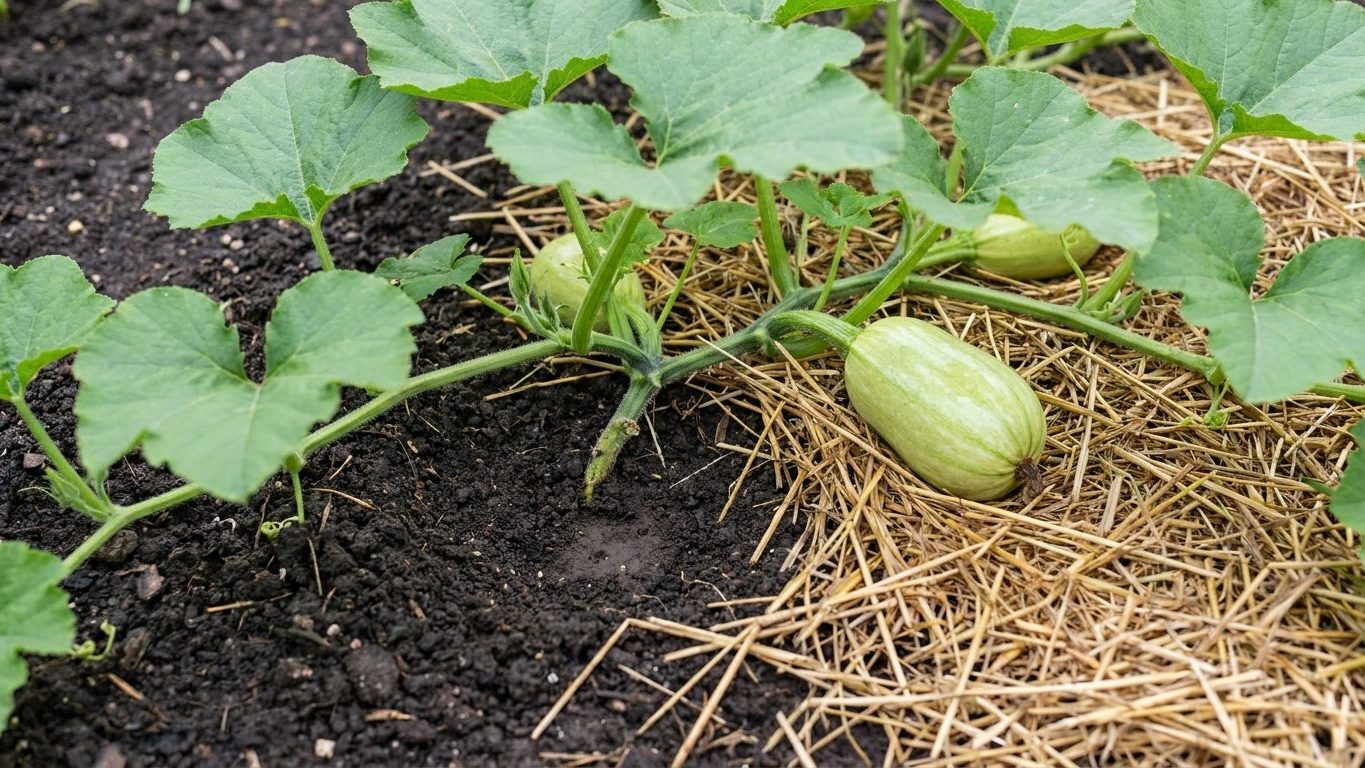

Straw, shredded leaves or grass clippings spread two to three inches deep around a Winter Squash Vine, kept a few inches back from the stem, do the real work: they hold soil moisture, stop rain from splashing fungal spores onto the leaves, and give the ripening fruit a dry surface instead of bare, damp dirt.
What is actually going on
Mulch under a squash vine is doing three separate jobs, and they don’t all matter on the same day. The first is moisture retention. Bare soil loses water fast through evaporation, especially once the vine’s own leaves start shading less ground than you’d think, and winter squash plants, with their sprawling root systems and huge leaves, pull a lot of water through the season. A layer of mulch slows that loss and evens out the wet-dry cycle that stresses roots and can make fruit split.
The second job is splash control, and it’s easy to underrate. Rain and overhead watering hit bare soil and bounce droplets, carrying soil-borne fungal spores, up onto the lowest leaves. That’s how a lot of powdery mildew and leaf spot problems actually start, from the ground up rather than blowing in from a neighbor’s garden. A mulch barrier between soil and leaf breaks that path. It doesn’t make the plant immune, but it removes one of the easiest ways disease gets a foothold early in the season.
The third job only matters at the end, and it’s the one gardeners forget until harvest week. Winter squash fruit sits on the ground for weeks, sometimes months, while it sizes up and starts to cure on the vine. A fruit resting directly on wet soil develops a damp contact patch, and that patch is where rot starts, sometimes invisibly, on the underside where you won’t see it until you turn the squash over. Mulch, or something like a board or upturned tray under a developing fruit, keeps that contact surface dry.
One distinction matters here. Winter squash is grown for its flesh and its ability to be stored for months after harvest, unlike a carving pumpkin, which is bred and grown mainly for a firm shell and a hollow interior. The two are close botanical relatives and share a lot of the same mulching logic, but if you’re growing pumpkins specifically for carving or fall display, the guidance on sizing, hardening the shell and handling the fruit lives on this site’s pumpkin pages, not here.
None of this means a squash sitting on straw is automatically safe to eat months later. Curing and mulch reduce the risk of rot, they don’t eliminate it. Any soft spot, any weeping patch on the skin, any mold at the stem end ends the question regardless of how the squash was mulched or how long it’s been in storage.
In the garden
The mulch itself matters less than people think. What matters more is timing, depth and the gap you leave around the stem. Get any one of those three wrong and the mulch works against you instead of for you.
| Mulch type | What it does well | What goes wrong if misused |
|---|---|---|
| Straw | Loose, dries out fast on top, lets air circulate | Packed too thick, it mats and holds moisture against the stem, inviting rot |
| Shredded leaves | Breaks down slowly, adds organic matter | Applied wet and un-shredded, whole leaves clump and smother the crown |
| Grass clippings | Cheap, breaks down fast, adds nitrogen | Piled thick and fresh, it heats up as it decomposes and can scorch the stem |
| Black plastic mulch | Warms soil early, blocks weeds completely | Laid without drip irrigation underneath, it sheds rain instead of letting it soak in |
| Landscape fabric | Long-lasting, good for perennial beds | Too rigid for a sprawling vine, it tears where fruit and stems press against it |
A depth of two to three inches for loose organic mulch is the range most extension guides settle on. Thinner than that and it dries out and blows around within a week, doing almost nothing. Thicker than that, especially with grass clippings or wet leaves, and you create a damp, airless layer right where the stem meets the soil, which is exactly the spot you don’t want moisture sitting.
Why the gap around the stem matters
Leave three to four inches of bare soil in a ring around the base of the plant before the mulch starts. Squash stems are more vulnerable to rot right at the soil line than almost anywhere else on the plant, and organic mulch piled against that spot holds exactly the kind of steady dampness that fungal and bacterial rot needs to get started. Gardeners who mulch right up to the stem to save time on weeding are, without meaning to, building a small wet pocket against the one part of the plant that can least afford it.
Timing follows the same logic as depth. Mulch applied while the plant is small and the soil is still cool holds that cold in, which slows root growth at exactly the point when the plant needs warm soil to get established. Wait until the vine has a handful of true leaves and the soil has had a chance to warm through, then mulch. As individual fruits form and start to size up later in the season, some gardeners slide a flat stone, a scrap of wood or a double layer of mulch directly under each developing squash, separate from the general bed mulch, specifically to keep that one contact point dry through to harvest.
What it depends on where you are
Mulch depth and mulch type are close to universal advice. What changes by region is almost everything else: how early you can mulch, how much moisture the mulch needs to hold, and how much disease pressure it’s actually protecting against.
In places with a long, hot, humid growing season, splash-borne fungal disease is a bigger threat, and mulch’s role in keeping leaves dry becomes more important than its role in retaining moisture, since rainfall or humidity is rarely the limiting factor. In places with a short growing season and cooler summers, the moisture-retention job matters more, and the timing question, how soon you can mulch without trapping cold into the soil, becomes the thing to get right, since a shorter season leaves less room to recover from a slow start.
Rainfall patterns shift the mulch-type decision too. A region with frequent light rain benefits from a mulch that breaks down and adds organic matter over the season, since it’s rarely at risk of staying soggy for long. A region with occasional heavy downpours followed by long dry spells needs a mulch that won’t mat down into an airless layer during the wet part of that cycle, which tends to favor coarser, looser material like straw over fine grass clippings.
The mechanism is general, but your own soil, your own summer and your own rainfall pattern are not. That’s local knowledge, and the best source for it is your state’s cooperative extension service, which will have trial data on what performs in your specific conditions, along with the squash types and mulch practices that have actually been tested in gardens near you rather than in a generic national average. This site’s own state-level pages for winter squash cover some of that regional detail as well, and they’re worth checking before you finalize a mulching plan for the season.
The mistake that costs the most
Mulching too early is the single error that does the most damage, and it’s also the easiest one to make with good intentions. A gardener sees bare soil around a young transplant, worries about weeds or drying out, and spreads mulch the same week the seedlings go in the ground. It feels responsible. It usually backfires.
Soil that’s still cool from spring holds that cold under a layer of mulch, because mulch is, by design, an insulator. It slows heat loss in fall, and it slows heat gain in spring, in exactly the season when a squash seedling needs the soil to keep warming so its roots can establish and start pushing real growth. Mulch too soon and you can end up with a plant that sits and sulks for two or three weeks while an un-mulched neighbor’s vine, in soil that’s been free to warm up naturally, pulls ahead and never looks back.
The fix costs nothing but patience. Wait until the plant has several true leaves and the soil has had real time in full sun to warm, then mulch. If weeds are the actual worry in that early window, a shallow hoeing every week or two does the job without the insulating downside, and it’s a habit most gardeners already have from other parts of the vegetable bed.
Get that timing right and the rest of the mulch decisions, straw or leaves, two inches or three, the gap around the stem, become much lower stakes. Get it wrong and no amount of mulch depth or mulch type fixes a plant that started the season several weeks behind where it should have been.