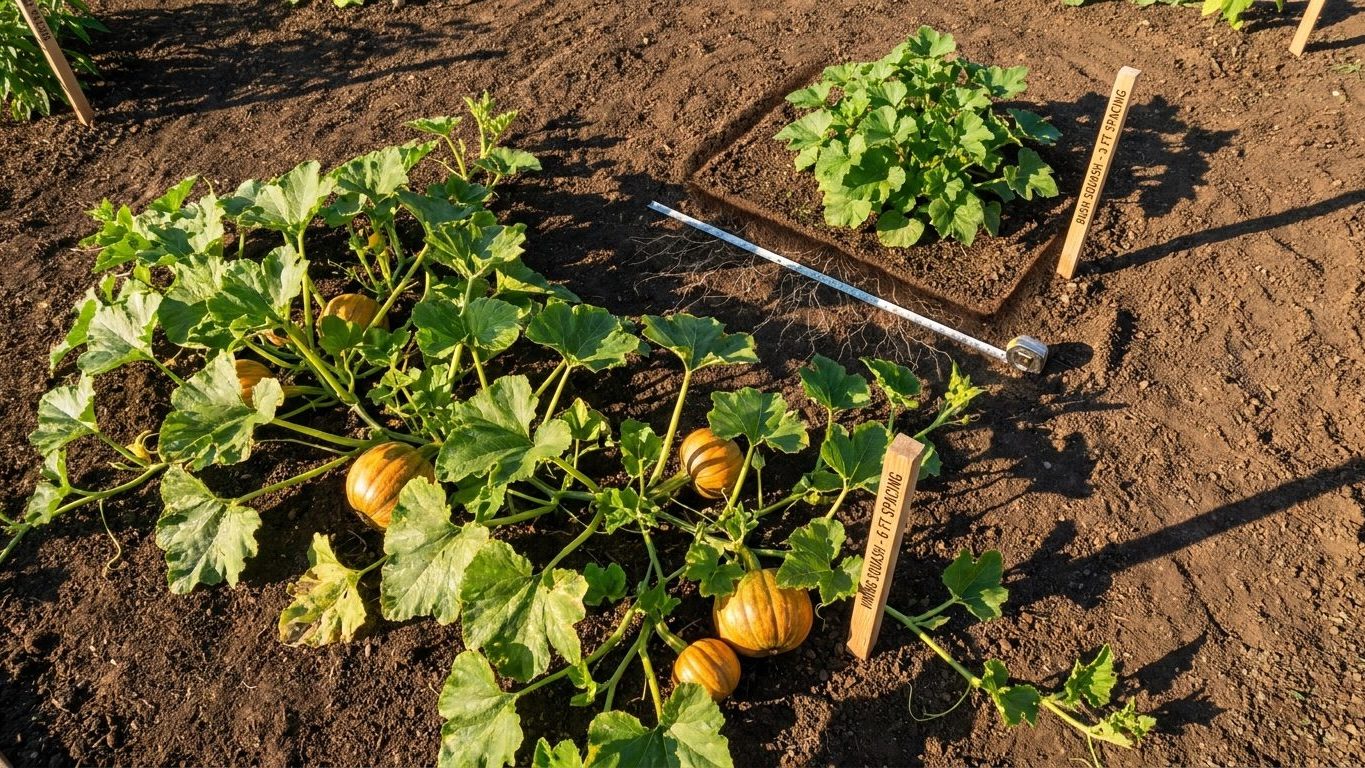

Bush-type winter squash need roughly 3 to 4 feet between plants, with rows spaced 4 to 5 feet apart. Vining types need far more: 4 to 6 feet between plants and 6 to 10 feet between rows, or a single hill every 6 to 8 feet if you’re planting in mounds. The exact number depends on which growth habit you’re dealing with, not a one-size figure for “winter squash.”
What is actually going on
A winter squash vine isn’t spreading out for no reason. It’s building leaf area to match a fruit load that, by late summer, can weigh more than the vine itself. Each fruit needs sugars produced somewhere, and that somewhere is the leaf surface strung out along the vine. Cramp the plant and you don’t just get a smaller vine, you get a plant that can’t finish filling the fruit it already set. The mechanism behind every spacing recommendation is the same: leaf area first, fruit second.
The root system tells the same story underground. Winter squash roots spread wide and shallow, foraging over several feet of soil rather than digging deep. Two plants set too close are drawing water and nutrients from the same limited volume of soil at the same time their leaf canopies are competing for the same light. Growth doesn’t stop when that happens. It just slows, and the fruit stops sizing the way it should.
Bush habit versus vining habit
Not every winter squash runs 10 feet. Breeders have selected bush-type and semi-vining forms specifically so they take less ground, and these are the ones suited to smaller beds or raised beds. Long-vining types, the ones that ramble across a garden path and keep going, are a different plant to plan for entirely. Neither habit is better squash, just a different footprint. Your state extension service will list which types and habits have been trialled successfully where you live, and that’s a better source for names than any generic list.
Not the same plant as a pumpkin
Winter squash and pumpkins are close relatives and share a lot of the same vine biology, but they’re grown for different reasons. A carving pumpkin is bred for a thick, uniform shell and a stem that holds up on a porch. A winter squash is bred for flesh quality and keeping ability, and its shell matters mostly as protection during storage, not display. Spacing pressures overlap between the two, but the fine points, like how pumpkins are trained for size and shape, belong in the pumpkin section of this site rather than here.
Curing and storage sit downstream of spacing too. A vine grown too tight rarely produces fruit with the thick, well-hardened skin that stores well. That’s worth knowing before you get to the curing stage, because no amount of curing fixes a soft-skinned squash that was undersized from competition in the row.
In the garden
The table below gives a working range for each growth habit, along with what typically goes wrong when spacing is ignored.
| Growth habit | Between plants | Between rows | What goes wrong when too tight |
|---|---|---|---|
| Bush / compact type | 3–4 ft | 4–5 ft | Leaves shade each other by midsummer, fruit set drops, powdery mildew moves in faster because air can’t move through the canopy |
| Semi-vining type | 4–5 ft | 5–7 ft | Vines tangle and cross, making it hard to find and harvest fruit before it overripens on the vine |
| Long-vining type | 4–6 ft (or hills 6–8 ft apart) | 8–10 ft | Vines overrun neighboring crops, fruit sets in inaccessible spots, and root competition stunts the whole planting |
Hills deserve a mention on their own. Planting in hills, 3 to 4 seeds thinned to 2 plants per hill, spaces the root systems the same way row spacing does but concentrates organic matter and drainage right where the plants need it. It’s a traditional method for a reason: it works particularly well on ground that’s slow to warm or slow to drain in spring.
The trick of running vines out of the bed
Gardeners with limited space use a simple workaround: instead of shortening the spacing, they let the vine run out of the growing bed and into an area that isn’t otherwise in use. A vine planted at the edge of a raised bed can be trained to run out over a lawn edge, a gravel path, or a fence line, effectively borrowing ground that wasn’t going to grow anything else. This doesn’t reduce the plant’s actual space requirement. It just relocates where that space comes from, so the bed itself can stay smaller.
Trellising works on the same principle but takes it vertical. Sturdier vining types can be trained up a stout support, and once fruit starts sizing, it gets a sling made from a soft, breathable material to keep the weight off the vine. This isn’t a fix for every winter squash. Very large-fruited types are simply too heavy to trellis safely, and forcing the issue tends to strip fruit off the vine before it’s finished sizing.
What it depends on where you are
Everything above is a national baseline. Local conditions push the real number up or down.
Season length is the biggest variable. In regions with a short frost-free window, gardeners often plant vining types slightly closer than the standard range to get more plants producing before the season runs out, accepting some crowding as a trade for total yield. In regions with a long growing season, the opposite logic applies: wider spacing lets each plant reach its full size and often produces better-keeping fruit per plant, even if the total plant count is lower.
Summer heat changes airflow needs. In hot, humid regions, tighter spacing raises humidity inside the canopy and speeds up foliar diseases, so growers in those areas often move toward the wider end of every range in the table above, even for bush types. In hot, dry regions, the concern flips: wider spacing can mean more exposed soil losing moisture faster, so some gardeners compensate with mulch rather than tightening the spacing itself.
Rainfall patterns matter just as much, and they’re harder to generalize about than heat. Regions with frequent summer rain need airflow between plants to keep fungal disease down; regions relying on irrigation can sometimes run slightly tighter spacing because they control moisture than rainfall allows. None of this is something a national page can resolve for a specific yard. Your state’s extension service publishes trial data and spacing recommendations calibrated to your actual conditions, and the state-by-state guides on this site point to where to find that information for the types most commonly grown in your region.
The mistake that costs the most
Overcrowding at planting time is the single error that costs gardeners the most on this point, and it usually happens for an understandable reason: seed packets are cheap, seedlings look small at transplant, and the spacing on the label looks excessive next to a 4-inch seedling in a 6-inch pot. So gardeners plant closer “to be safe,” or they can’t bring themselves to thin extra seedlings once several have come up in the same spot. Three months later, the bed is a solid mat of leaves, fruit set is patchy, and nobody can tell where one plant ends and the next begins.
The fix isn’t complicated, it’s just uncomfortable. Thin to the wider end of the range for whatever type you’re growing, even when it means pulling healthy seedlings out of the ground. A winter squash vine given full spacing from the start builds a stronger root system, holds up better against disease pressure, and channels its energy into fewer, better-finished fruit rather than spreading itself thin across too many undersized ones. That’s the plant you want going into curing, because a well-grown, properly spaced squash is the one most likely to have the hardened, intact skin that curing depends on.
If you’re unsure whether a stand is too tight, look at the canopy in July. If you can’t see soil or mulch between plants, and leaves are stacking on top of each other rather than spreading laterally, that planting is overcrowded regardless of what the seed packet said at planting time. Pulling a few plants at that stage still helps the ones that remain, even though it feels like a late fix for an early mistake.