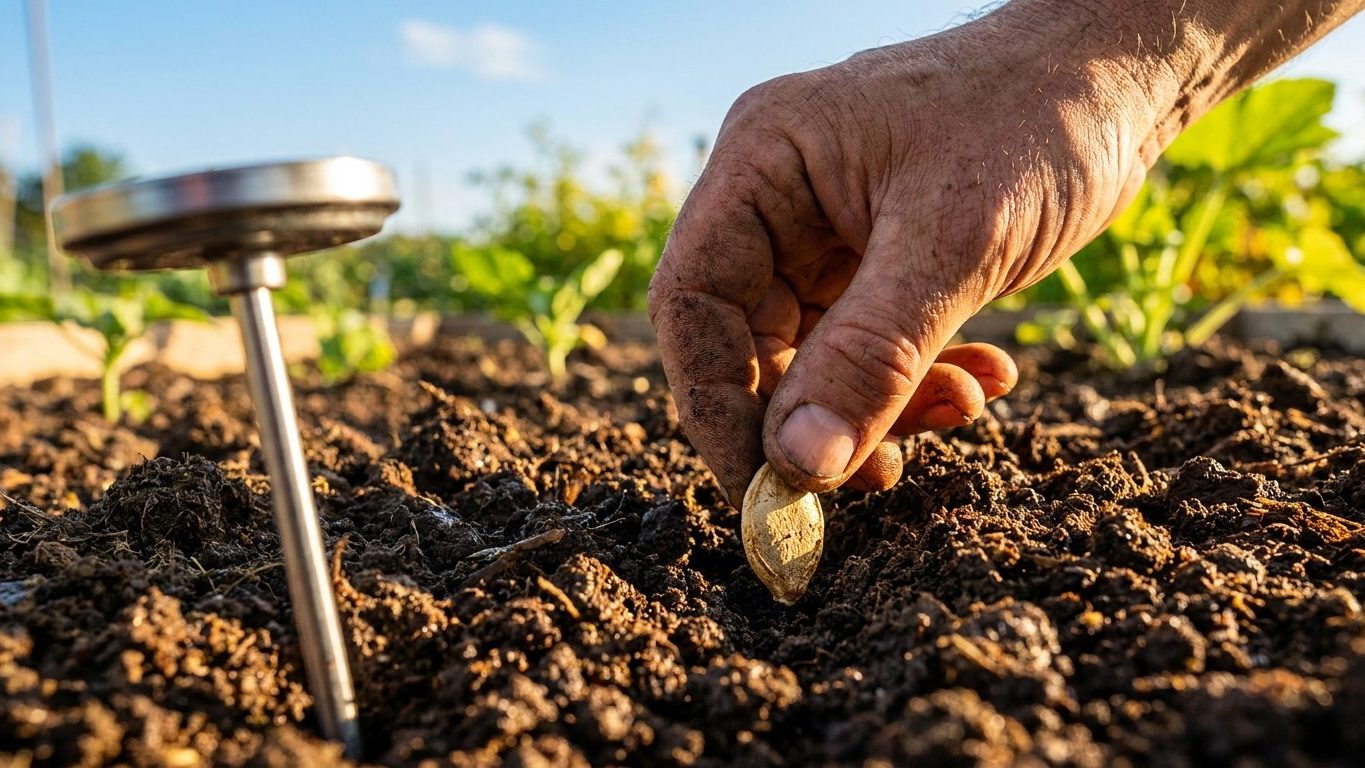

Cold soil is the single biggest reason winter squash seed fails outright. The seed needs soil consistently at 65°F or warmer at planting depth, with 70°F to 95°F as the range where germination is fast and even. Below that, seed sits, weakens, and often rots before it ever sends up a leaf.
What is actually going on

A squash seed is not dormant the way a tree seed is. Once it takes up water it starts spending its stored energy on one outcome: a root and a shoot within a matter of days. In warm soil that spend pays off fast. In cold soil, the seed keeps drawing on those reserves while nothing above ground shows for it. That is the mechanism to hold onto: germination is a race against a fixed energy budget, and cold soil slows the runner without stopping the clock.
Wet, cool ground makes the problem worse in a second way. The same conditions that stall a squash seed are ideal for the soil fungi that cause seed rot and damping-off. A seed that would have germinated fine in warm, well-drained ground can sit long enough in cold, damp soil for those organisms to get ahead of it. The seed does not fail because the garden is unlucky. It fails because the odds shifted against it the moment the ground stayed cold.
This matters more for winter squash than for most other vegetables because the crop runs long. a Winter Squash needs the entire warm season to build vine, set fruit, size that fruit, and then let the rind and stem harden enough to cure and store. A week lost at the seedling stage is not a week the plant makes up later. It is a week subtracted from the end of the season, which is exactly when the plant needs time to finish ripening before frost cuts it off.
It helps to be clear about what winter squash actually is, because the word “squash” gets stretched to cover a lot of ground. A winter squash is grown for its flesh and its ability to keep in storage for weeks or months, not for a shell meant to be carved. Carving pumpkins are a related but separate subject on this site, with different harvest timing and different handling once cut from the vine; see the pumpkin growing guides for that crop specifically. Winter squash types fall into a few broad botanical groups, generally sold as butternut-type, hubbard-type, acorn-type, and similar descriptions rather than a single named variety. Your state extension service publishes lists of the specific varieties that have performed well in local trials, which is a better source for a name than any general guide can be.
In the garden
Judging soil warmth by feel or by the calendar is how most cold-soil failures happen. A soil thermometer pushed to seed depth, roughly an inch to an inch and a half down, read in mid-morning before the sun has swung the number up artificially, gives an honest picture. Take that reading for three or four days running rather than once. A single warm afternoon after a cold week does not mean the soil has turned the corner.
What happens at each stage of that reading changes the decision:
| Soil temperature at seed depth | What actually happens |
|---|---|
| Below 60°F | Seed sits and often rots before germinating; damping-off fungi get the advantage |
| 60–65°F | Germination is slow and uneven; seedlings that do emerge are weak and more open to soil pests like seedcorn maggot |
| 65–75°F | Germination is fast and reliable; this is the working target for direct sowing |
| 75–95°F | Still good, often the fastest germination of the range |
| Above 95°F | Germination rate drops again; seedlings can scorch if soil surface bakes hard |
Warming the soil ahead of sowing is usually more useful than waiting on the weather. Black plastic mulch laid over the bed a week or two before the intended sowing date pulls soil temperature up several degrees by trapping solar heat. A floating row cover placed over the bed does something similar with less warming power but more protection against a late cold snap once the seedlings are up. Both are worth using together in a season that is running cold.
When a transplant beats a direct seed
Squash roots dislike disturbance, which is why direct sowing is the usual advice. But in a short season, or in a spring that stays cold longer than expected, starting seed indoors three to four weeks ahead and setting out transplants once soil has warmed can buy back the time that cold ground would have cost. The trade-off is real: lift a squash seedling out of a standard pot and the root check can set it back nearly as much as slow germination would have. Growing the transplant in a biodegradable or fiber pot that goes into the ground intact avoids most of that setback, because the roots are never exposed or torn.
What it depends on where you are
When your soil actually reaches 65°F depends on your particular yard. Season length sets the outer boundary: a shorter growing season leaves less room to wait for ideal soil temperature and pushes more gardeners toward the transplant route described above. Summer heat changes the other end of the equation, since regions with intense mid-summer heat sometimes see squash pollination and fruit set stall during the hottest stretch, regardless of how well the crop started. Summer rainfall matters too, both for how fast soil warms in spring, wet ground warms more slowly than dry ground, and for disease pressure later in the season.
These factors interact differently in a humid river valley than they do on a high, dry plain, and differently again along a coast where soil warms late but stays warm long into fall. There is no single number that fits all of that, which is why the soil thermometer reading matters more than any regional average. Your own state’s cooperative extension service tracks local soil temperature data, frost dates, and variety trial results specific to your growing conditions, and that information will always be more accurate for your garden than a national guide can be. This site’s state-by-state winter squash pages gather some of that local detail together, but the extension service itself remains the primary source, especially for anything tied to a specific date or a specific zone.
What stays constant no matter where you garden is the underlying mechanism: cold, wet soil favors rot over germination, and a long-season crop cannot afford to lose time at the start. The local variables change when that window opens and how wide it stays, not whether the window exists at all.
The mistake that costs the most
The single costliest mistake is sowing by the calendar instead of by the soil. Spring makes gardeners impatient. A warm afternoon in a normally cool week feels like permission, and the seed packet’s planting window on the back of the packet gets treated as an instruction rather than a rough guide. The result is seed going into ground that looks ready but tests cold two inches down, and a week or two later, an empty row where a stand of seedlings should be.
The fix is not complicated, but it does require patience most gardeners would rather skip. Take a soil temperature reading at seed depth for several consecutive mornings before sowing, and don’t count a single warm reading as proof. If the numbers are close but not quite there, warm the bed with black plastic or clear cover rather than gambling on the seed itself to push through marginal conditions. If the season is simply too short to wait, move to a transplant grown in a root-friendly pot rather than forcing an early direct sowing.
The same patience applies at the other end of the season. A winter squash that matured in soil that started warm and even is more likely to reach full maturity with a hardened rind and a dry, corked-over stem, both of which matter for how well it keeps. Before that squash goes into storage, check it over: any soft spot, any patch that weeps or feels spongy, any mold starting at the stem end, ends the question of whether it is fit to keep or eat. No amount of careful curing changes that once damage has started. Getting the seed into properly warmed soil at the start of the season is what gives the plant its best chance of producing fruit sound enough to pass that check at the end of it.