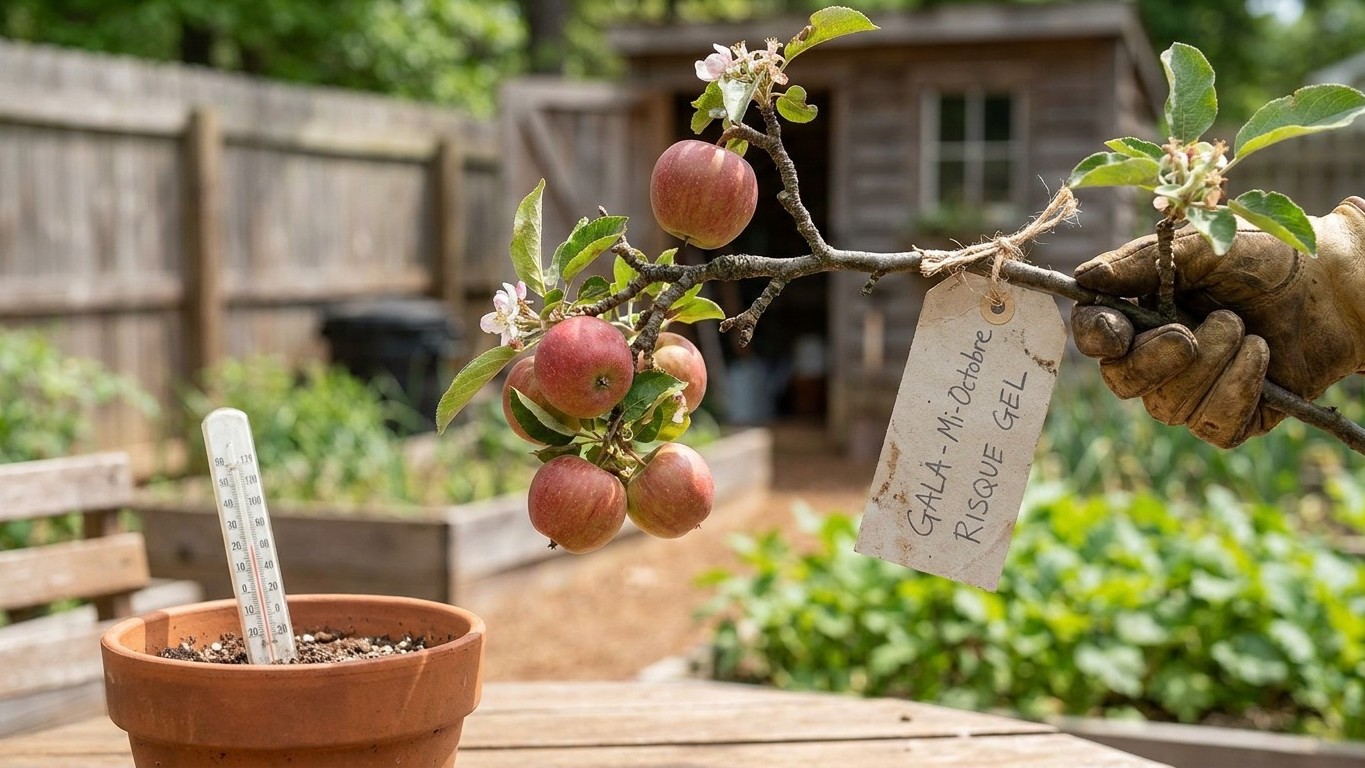

Georgia will grow an apple tree almost anywhere in the state — the question is whether your winter gets cold enough, long enough, for it to bloom right. A tree that’s fine in the north Georgia mountains can sit on the coastal plain and flower raggedly for weeks instead of all at once, because the two ends of the state bank completely different amounts of winter chill. Before buying a tree, work out roughly how cold your particular spot runs each winter, then pick a variety whose chill requirement actually matches that number.
Can you grow apples in Georgia
Yes, apples grow across Georgia, but the state runs from cool mountain valleys to humid coastal plain, and that spread decides which apple belongs where. The USDA Plant Hardiness Zone Map, 2023 edition, based on 1991-2020 normals, puts the state at zones 6a to 9b, a range wide enough that a tree suited to the north Georgia mountains can sit in the wrong climate entirely two hundred miles south.
At the Atlanta reference station, NOAA’s NCEI 1991-2020 climate normals put the coldest month’s average daily minimum at 34.3°F. That’s a mild figure by apple-country standards, and it tells you Atlanta and the Piedmont around it are in no danger of winter-killing a hardy apple tree. The number that actually decides whether a Georgia apple tree fruits well is not survival. It’s whether the site accumulates enough winter chill to break dormancy cleanly and bloom in a tight window instead of dribbling out flowers over weeks, a process laid out in detail in The Georgia Apple Calendar, Stage by Stage.
North Georgia, above roughly 1,500 feet in the Blue Ridge foothills around towns like Ellijay and Blue Ridge, is where the state’s commercial apple industry actually sits, and elevation is the reason. Higher ground there banks more winter cold than the Piedmont or the coastal plain get in an average year, which suits the moderate-chill varieties most home orchardists reach for first. Far south Georgia, on the coastal plain, runs mild enough most winters that only specific low-chill varieties are worth the ground they’d take up.
Atlanta’s figures describe one city in the Piedmont, not the whole state. A grower near Blairsville or Clayton, in the mountains, is working a colder, higher-chill site than a grower near Valdosta or Tifton on the coastal plain, even though both technically sit inside the same statewide 6a-9b hardiness band. Treat the hardiness zone as the first filter, telling you the tree will live, and treat winter chill as the second, telling you it will actually flower and fruit.
Georgia’s humidity is worth planning around too, separate from cold or chill. Warm, wet summers push fungal disease pressure that drier apple regions don’t deal with as heavily, and that shapes which cultivars are worth the trouble here as much as chill hours do — see this rundown of Georgia apple Best varieties for cultivars bred to handle exactly that pressure.
Which varieties suit this climate

Hardiness zone tells you whether a tree survives winter. It says nothing about whether it flowers well, and in a state this mild, winter chill is the filter that decides whether the tree is worth planting at all at a given site. A low-chill variety planted in the mountains wastes its short dormancy requirement on a colder winter than it needs. A moderate-chill variety planted on the coastal plain never accumulates enough cold hours, and the result is a thin, ragged bloom spread over weeks instead of a tight, well-pollinated flowering.
Low-chill varieties for the coastal plain and far south Georgia
‘Anna’, ‘Dorsett Golden’ and ‘Ein Shemer’ were all bred or selected for regions with mild winters, and their published chill requirements sit in roughly the 200 to 300-hour range, low enough to satisfy dormancy on Georgia’s coastal plain most years. ‘Anna’ ripens early, typically around 100 to 115 days after full bloom on the seed and nursery catalog figures, with ‘Dorsett Golden’ close behind at roughly 110 to 120 days. Both numbers shift by a week or two depending on the season, since they’re counted from bloom, not from a fixed calendar date.
Moderate-chill varieties for north Georgia and the upper Piedmont
‘Gala’, ‘Golden Delicious’ and ‘Arkansas Black’ need substantially more winter cold, with published chill requirements running from roughly 500 hours for ‘Gala’ up toward 800 hours for ‘Arkansas Black’, and they suit the north Georgia mountains and the higher upper Piedmont far better than the coastal plain. North Georgia’s higher-chill orchard country has more in common, climate-wise, with the moderate-chill apple belt covered in Growing Apples in Kentucky: Varieties, Timing and Frost Risk than with south Georgia three hours down the road.
| Variety | Approx. chill hours needed | Where it fits in Georgia | Days to maturity (from full bloom) |
|---|---|---|---|
| ‘Anna’ | ~200-300 | Coastal plain, far south Georgia | ~100-115 |
| ‘Dorsett Golden’ | ~200-300 | Coastal plain, pollen partner for ‘Anna’ | ~110-120 |
| ‘Ein Shemer’ | ~300 | Coastal plain and lower Piedmont | ~100-110 |
| ‘Gala’ | ~500 | North Georgia mountains, upper Piedmont | ~125-135 |
| ‘Golden Delicious’ | ~600-700 | North Georgia mountains | ~140-150 |
| ‘Arkansas Black’ | ~800 | North Georgia mountains, highest sites | ~160-170 |
No source consulted here publishes a county-by-county variety list for Georgia, so treat these chill and maturity figures as catalog data to cross against your own site rather than a local recommendation. Where your elevation or region sits between the two groups above, lean toward the lower-chill option. A tree that flowers reliably every year beats one that occasionally sits dormant into a warm spell and blooms thin.
Planting a pair that works here
Almost no apple variety sets a full crop on its own pollen. You need two trees that bloom at the same time, with at least one of them producing pollen the other can actually use, and in Georgia the realistic pairs fall out along the same low-chill versus moderate-chill line drawn above.
On the coastal plain, ‘Anna’ and ‘Dorsett Golden’ bloom on the same short, low-chill schedule and each carries pollen the other can use, which is why nursery catalogs already pair them by name for the Deep South.
In the north Georgia mountains and upper Piedmont, moderate-chill ‘Gala’ and ‘Golden Delicious’ overlap in bloom timing and both produce fertile pollen, making them a workable two-tree planting where the site has enough winter chill for either.
Watch for triploid varieties such as ‘Stayman Winesap’, which bloom well but produce little to no usable pollen of their own. A ‘Stayman Winesap’ planted with only one other tree can leave both unfertilized if that second tree also turns out to be a weak pollen source. Where a triploid variety is wanted, plan for a third tree, a reliable diploid pollen producer blooming in the same window, rather than assuming any second tree nearby will do the job.
If space only allows for one apple tree, an ornamental crabapple with a long bloom window and fertile pollen can substitute for a second full-size tree, as long as it flowers at the same time as the apple it’s meant to pollinate.
The frost that costs a crop here

At the Atlanta reference station, NOAA’s NCEI 1991-2020 climate normals put the last spring freeze, the 32°F threshold, in the window of March 11 to March 29, based on the 30 to 70 percent freeze-probability band. That’s a three-week span at one urban airport station that runs warmer than the ground around it. North Georgia’s mountain valleys typically stay at risk of a killing freeze later into that window than Atlanta’s figures suggest, while the coastal plain generally clears earlier.
The calendar date matters less than the stage the buds are in when frost arrives. Buds move through green tip, then swell to the pink stage, then open into full bloom, and a freeze that lands after the buds show pink kills the open or opening flowers, not the wood. The tree itself comes through untouched and leafs out on schedule that spring. The crop for the year is simply gone, because the flower is the only part of the tree that becomes an apple, and a flower killed by frost cannot be replaced once bloom has passed for that season.
A grower with real frost exposure has two practical responses. One is to lean toward a genuinely later-blooming variety, so the flowers stay closed through more of the risky window: among the moderate-chill options suited to north Georgia, ‘Golden Delicious’ and ‘Arkansas Black’ tend to bloom later than ‘Gala’, though bloom order should be confirmed on the actual planting site since elevation and local cold pockets shift timing by days. The other is to watch the forecast once buds reach pink and cover young, low trees with frost cloth or a bedsheet on any night temperatures are forecast to drop toward freezing.
- Site the tree away from low ground where cold air pools overnight
- Leave mulch and winter protection in place until the frost window has passed
- Cover young, low-growing trees with frost cloth once buds reach the pink stage and a freeze is forecast
- Favor a later-blooming variety on any site with a known history of late frost
Georgia’s frost window arrives weeks later in the calendar than the frost season that shapes orchard planning in Growing Apples in North Dakota: Varieties, Timing and Frost Risk, but the mechanism at bloom time is identical: the freeze doesn’t need to be severe, it only needs to reach the open flower.
The apple year in Georgia
Apple timing in Georgia is best tracked by the tree’s stage, anchored on the local frost dates, rather than by a fixed date on the calendar.
Dormancy
The tree sits leafless and accumulates winter chill through this stretch. At the Atlanta reference station, NOAA’s NCEI 1991-2020 normals place the first fall freeze between November 13 and December 1, and the last spring freeze between March 11 and March 29, so dormancy at that site spans roughly that four-month stretch. Mountain sites typically enter dormancy earlier in fall and come out of it later in spring than that Atlanta window suggests. This is the stage to prune, while the tree is fully leafless and the wood is easy to see.
Green tip
The first green shows at the tips of the buds, usually well before the last spring freeze date passes. There’s little to do at this stage besides watching the buds move and checking that any frost protection materials are on hand before the next stage arrives.
Pink
Buds swell and show color just before opening. This is the stage where a late freeze does its damage, and it’s the point to start checking the forecast nightly if the last spring frost window given above hasn’t passed yet on your site.
Bloom and petal fall
Flowers open, pollinators move in, and no insecticide should go on the tree while bees are working the blossoms. As petals drop, the fertilized flowers begin swelling into small fruit.
Fruit set
Once fruit is clearly set, thin each cluster down to one or two apples so the remaining fruit sizes up properly instead of the tree carrying an overloaded, undersized crop.
Harvest
Timing depends on the variety’s own days-to-maturity figure, counted from full bloom. A low-chill ‘Anna’ on the coastal plain, at roughly 100 to 115 days from bloom, comes off the tree well before a mountain-grown ‘Arkansas Black’, which needs closer to 160 to 170 days from bloom and typically finishes just ahead of that region’s own first fall freeze.
Local help
For a variety list matched to your county and a spray schedule tied to local pest and disease pressure, the UGA Cooperative Extension is the reference to check before planting. Extension agents can also tell you whether a specific site sits in a known frost pocket, something a statewide guide like this one can’t tell you, and can point to chill-hour records gathered closer to your county than the Atlanta station cited above.
Common questions
Will an apple tree survive Georgia’s summer heat and humidity?
Heat itself is rarely the problem for a hardy apple tree in Georgia. Humidity is, because it drives fungal disease pressure like fire blight, cedar apple rust and apple scab harder than it runs in drier apple regions. Cultivars with published resistance to these, such as ‘Liberty’ and ‘Enterprise’, cut down on spray needs considerably compared with a disease-susceptible variety like ‘Golden Delicious’.
Can I grow apples on the Georgia coast?
Only with low-chill varieties, and even then it’s a marginal proposition some winters. ‘Anna’, ‘Dorsett Golden’ and ‘Ein Shemer’ are the catalog options built for that little winter cold, but no state extension list consulted here names a formal coastal Georgia recommendation, so check with UGA Extension for the closest local guidance before committing to a coastal planting.
How long before a new apple tree bears fruit in Georgia?
Most standard apple trees on typical nursery rootstock begin bearing in their third to fifth year, regardless of what state they’re planted in. Trees on more dwarfing rootstock can fruit a year or two sooner, but the first few years’ crop is usually light no matter the variety.
Do I really need two different apple trees?
Yes, in almost every case, since very few apple varieties reliably set fruit on their own pollen. If you only have room for one full-size tree, a flowering crabapple with fertile pollen and an overlapping bloom window can stand in for the second tree.
My tree bloomed heavily but set almost no fruit. What happened?
The most common cause here is a late frost that hit the open flowers without visibly damaging the tree, which leaves growers assuming the tree is simply unproductive when the wood is actually fine. Cold, wet weather during bloom that keeps bees from flying, or a pollen partner that turns out to be a poor pollen source like a triploid variety, are the other two usual explanations.