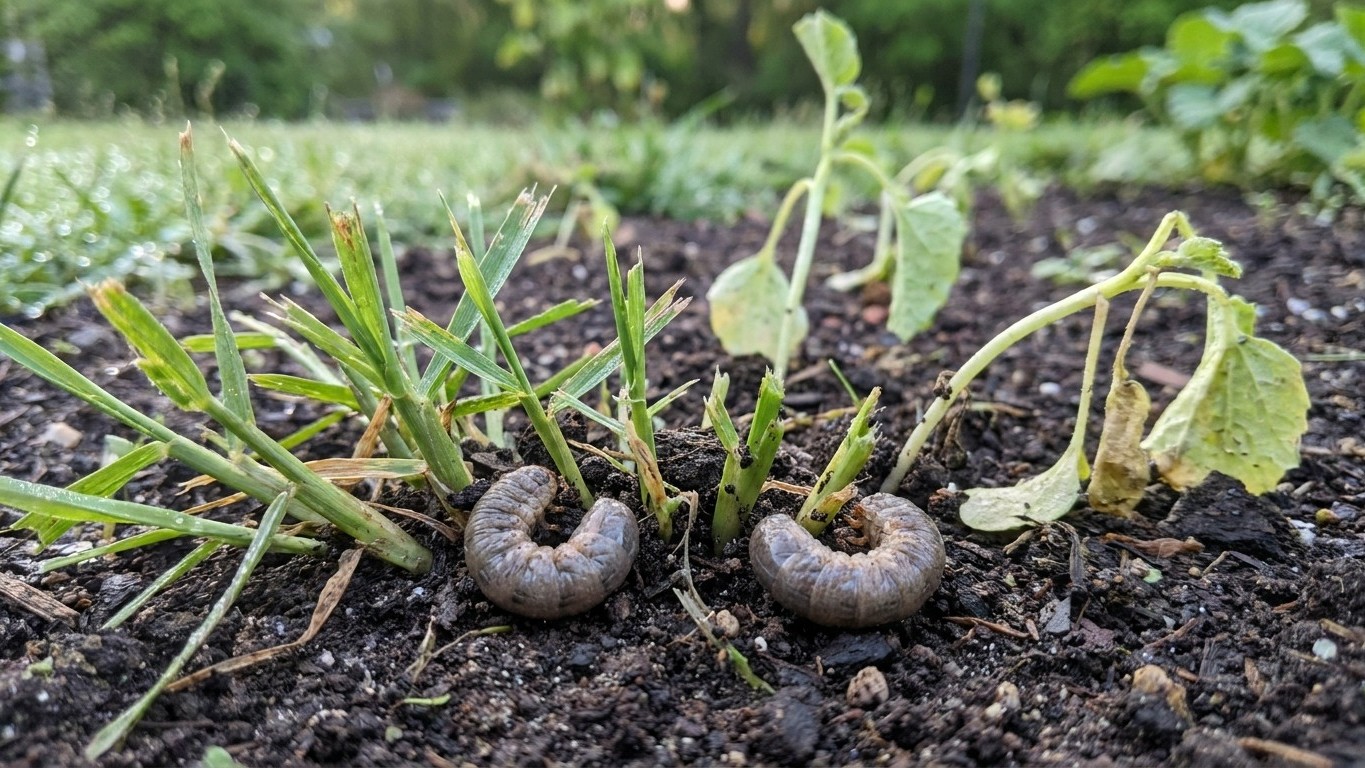

Cutworms show up in Georgia twice a year in most of the state: a spring wave from March through May and a second, often heavier, wave in September and October. In the warmer coastal plain and south Georgia, mild winters let larvae overwinter in the soil, which means activity can start earlier and run through more generations than in the cooler Blue Ridge counties up north. The larvae themselves, plump and gray-to-brown with a habit of curling into a tight “C” when poked, do their damage at night, chewing turfgrass blades and vegetable seedlings off right at the soil line.
When Cutworms Are Active Across Georgia

Georgia’s climate splits into distinct zones, roughly USDA hardiness zone 6a in the mountains around Blairsville and Helen, up to 8b and even 9a along the coast near Savannah and Brunswick. That range matters more than most homeowners realize. In north Georgia, cutworm moths (the adult stage, which don’t feed on plants) typically produce two generations a year, with larval feeding concentrated in late spring and again in late summer. Head south toward Albany, Valdosta, or the coast, and the growing season stretches long enough for three to four overlapping generations, so damage can appear almost any month between March and November, with only a brief winter lull.
The granulate cutworm (Feltia subterranea) is the species most frequently blamed for turf damage statewide, favoring centipede, bermudagrass, and zoysia lawns. Black cutworms and variegated cutworms show up too, particularly in vegetable gardens and newly seeded turf, and they’re less picky about host plants. All three overwinter as partially grown larvae or pupae just a few inches down in the soil, which is exactly why a mild Georgia winter, like the one much of the state saw in early 2024, tends to produce a noticeably earlier and heavier spring outbreak.
Weather Triggers Worth Watching
Moth flights and egg-laying pick up after warm, humid nights following rain, since females seek moist soil and thick thatch to lay eggs. A stretch of 70-degree nights in March, common in south Georgia but arriving later in the mountains, is often the first real signal that larvae will be feeding within two to three weeks.
Spotting the Damage Before It Spreads
Cutworm damage looks different depending on where it happens. In lawns, the classic sign is small, irregular brown patches, usually 2 to 4 inches across, where grass blades have been sheared off at ground level rather than turning brown from drought or disease. Walk the patch at dusk with a flashlight and you’ll often catch the larvae mid-meal, since they feed almost exclusively after dark and retreat into the thatch or top inch of soil by sunrise.
Vegetable gardeners see a more dramatic version: seedlings, especially tomatoes, peppers, and young corn, clipped clean at the base overnight, sometimes with the toppled plant left lying right next to the stump. A single larva can take out several seedlings in one night, which is why gardeners in Georgia who transplant in March often lose a whole flat before they even suspect a pest is involved.
Birds can be an unexpected early-warning system. Robins, starlings, and grackles probing a lawn for grubs and cutworms, leaving small peck holes, often show up a few days before homeowners notice the brown patches themselves. If you see unusual bird activity on an otherwise healthy lawn in March or September, it’s worth checking for larvae before assuming it’s just foraging.
Confirming It’s Actually Cutworms
The soap flush test remains the most reliable at-home check: mix a tablespoon of dish soap into a gallon of water, pour it over a damaged section of turf, and wait five minutes. Cutworms, along with armyworms and other soil-dwelling larvae, will surface to escape the irritation. In garden beds, sifting the top inch of soil within a few inches of a clipped seedling usually turns up the culprit curled up nearby, since they don’t travel far after feeding.
What Actually Stops Cutworms in Georgia Yards
Timing beats intensity when it comes to control. Because cutworms feed at night and hide during the day, any treatment applied in the morning largely misses the target. Insecticide applications, whether a pyrethroid or carbaryl-based product labeled for turf, work best applied in late afternoon or early evening, watered in lightly afterward to move the active ingredient into the thatch layer where larvae hide during the day.
Cultural practices reduce the odds of an outbreak in the first place. Thatch thicker than half an inch gives cutworm eggs and young larvae a protected nursery, so regular dethatching on centipede and bermudagrass lawns removes habitat before it becomes a problem. Avoiding late-evening irrigation matters too, since damp soil right at dusk is prime egg-laying territory for the adult moths; watering earlier in the day lets the surface dry out somewhat by nightfall.
Biological options have gotten more reliable in recent years. Products containing Bacillus thuringiensis (Bt) target caterpillar-stage pests including cutworms without harming most beneficial insects, though they need to be reapplied more often than synthetic options since they break down quickly in sunlight. Beneficial nematodes, specifically Steinernema carpocapsae, applied to moist soil in the evening, actively hunt down soil-dwelling larvae and have shown solid results against cutworms in university turf trials.
Protecting Vegetable Gardens Specifically
For garden beds, physical barriers still work as well as anything chemical. A simple collar, a cardboard toilet paper tube or a cut-open aluminum can pushed an inch into the soil around each seedling stem, blocks larvae from reaching the base of the plant. It’s low-tech, but for a raised bed with a dozen tomato transplants, it’s often faster and cheaper than any spray, and it avoids putting insecticide near food crops close to harvest.
Georgia-Specific Timing for Treatment
South Georgia lawns and gardens, think Albany, Tifton, or Waycross, should have their first cutworm check scheduled by mid-March, given how early larvae become active in that warmer climate. Metro Atlanta and the Piedmont region generally see the spring wave peak in April, while north Georgia counties near the Tennessee line can wait until late April or even early May before feeding really ramps up.
The fall generation deserves just as much attention as spring, and it’s the one homeowners most often overlook. September and October cutworm damage on Georgia lawns coincides with overseeding season for cool-season grasses like ryegrass, meaning tender new seedlings are especially vulnerable right when a second wave of larvae is most active. Checking new seedbeds nightly during the first three weeks after overseeding catches problems before whole sections need to be reseeded a second time.
One detail that surprises a lot of Georgia gardeners: cutworm larvae can travel up to several feet from where they hatched before settling in to feed, meaning damage sometimes appears in a tidy line across a bed rather than in a random scatter, a pattern that’s easy to mistake for disease until you know what caused it.