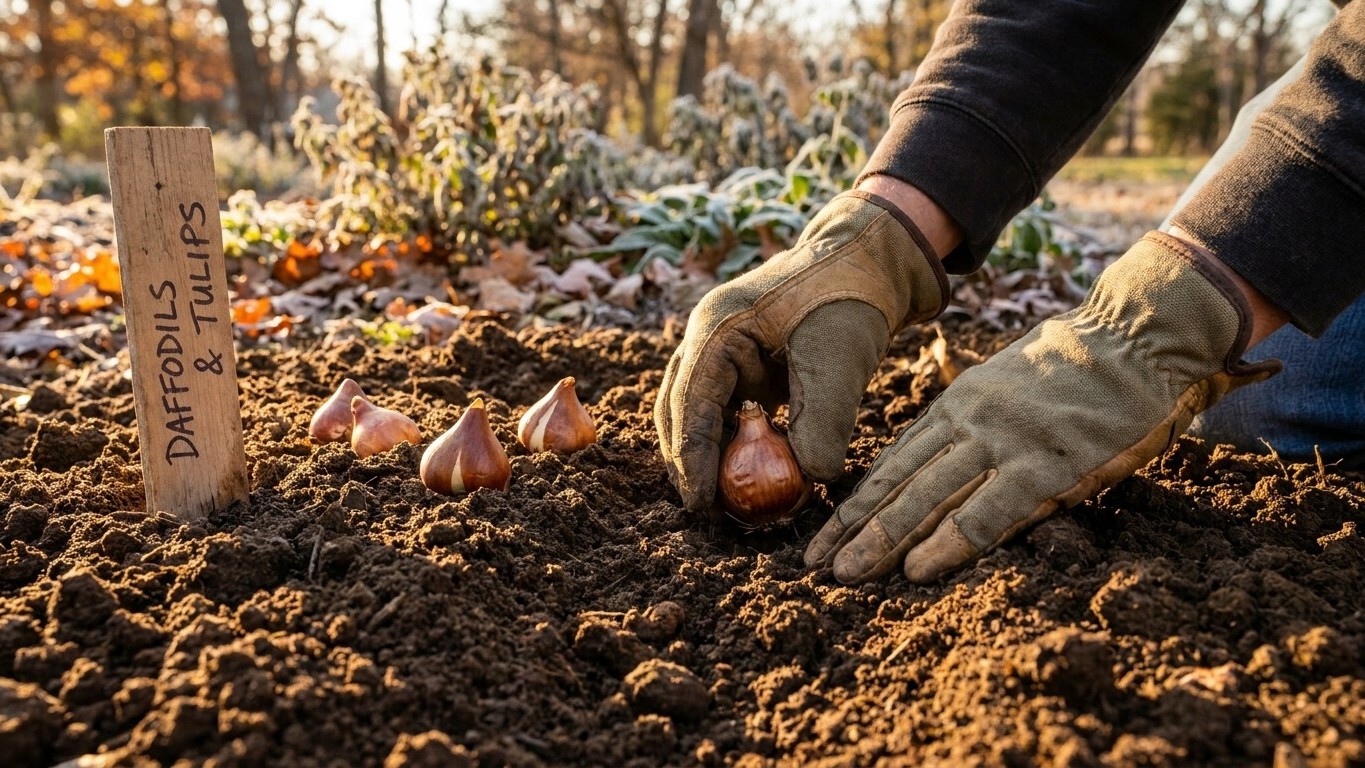

Oklahoma gardeners get a real winter, but not the same winter everywhere. Whether your daffodils and tulips come back next spring depends less on how pretty the bulb looks in the bag and more on whether your particular patch of ground gets cold enough, long enough, to trigger a flower instead of just leaves.
When to plant bulbs in Oklahoma

The planting window in Oklahoma runs about six weeks before the ground freezes hard, which anchors on the average first fall frost for the state’s central region: October 29 to November 8, based on NOAA’s 1991-2020 climate normals for the Oklahoma City reference station. Working backward from that date, most bulb planting in central Oklahoma falls in the second half of September through late October, tapering off as the calendar tips into November.
Both ends of that window carry a penalty. Plant too early, while soil is still warm from summer, and a bulb like a tulip or daffodil can push up top growth before winter arrives. That growth gets killed back by the first hard freeze, and the bulb spends energy recovering instead of building the root system it needs. Plant too late, into cold or half-frozen soil, and the bulb goes in without enough time to establish roots before the ground locks up. Come spring, you get a weak, stunted bloom or nothing at all, because root development, not top growth, is what happens underground all winter.
The frost date is an average, not a promise
That October 29 to November 8 range is exactly what it sounds like: an average window built from three decades of data, not a guarantee tied to this particular year. By definition, roughly half of all years see the first fall frost arrive earlier than that band, and half see it later. A gardener who plants right on the calendar date and ignores what the sky is actually doing is gambling on the wrong half of that split.
The practical fix is simple: watch the soil, not just the calendar. Bulbs planted when nighttime lows have settled into the 40s for a stretch, with soil temperature cooling but still workable, are on schedule regardless of what the date says. If a cold snap arrives early, get bulbs in the ground as soon as the soil can be worked rather than waiting for a date on the bag. If fall runs warm and long, there is more room than the average window suggests, but not unlimited room. Oklahoma’s fall frost dates also swing county to county, which matters more than the state average once you’re standing in your own yard with a trowel.
Whether your winter is cold enough
Here’s the mechanism that decides whether a spring bulb blooms at all: it needs a long, uninterrupted stretch of cold soil to trigger flowering. Most classic spring bulbs, tulips and hyacinths especially, require somewhere in the range of twelve to fourteen weeks with soil temperatures below about 45F. Skip that requirement and the bulb doesn’t die outright. It just fails to bloom properly, which is exactly why gardeners in milder pockets of the state, or anyone who wants blooms ahead of schedule, often turn to Forcing Spring Bulbs Indoors in Oklahoma instead of relying on the ground to deliver enough cold on its own. Fails to bloom the way it should — which is exactly why gardeners in warmer pockets of the state often turn to Growing Spring Bulbs in Containers in Oklahoma, where soil temperature and chill duration can be controlled far more precisely than in an in-ground bed. Produces leaves with no flower, or a flower bud so short and weak it never clears the soil line. That number, the weeks and the 45F threshold, is the yardstick every bulb catalog claim should be measured against, no matter where you garden.
Oklahoma’s numbers stack up well against that threshold, at least in the parts of the state near the reference city. The coldest month’s average daily minimum in Oklahoma City sits at 27.0F, per NOAA’s 1991-2020 climate normals. That’s a full 18 degrees below the 45F ceiling that triggers chilling, and it holds for weeks at a stretch through December, January, and into February. Oklahoma falls across USDA Hardiness Zones 6a to 8a, using the USDA’s Plant Hardiness Zone Map built on average annual extreme minimum temperatures. In the 6a and 7a portions of the state, chilling hours accumulate with room to spare. The 8a edge, largely the far south and southeast, runs warmer and shorter on cold, which is where the margin narrows.
The species-by-species verdict
The table below lines up what each bulb needs against what Oklahoma typically delivers, so you can check your own bulb order against it in one glance.
| Bulb | Chill needed (weeks below 45F) | What Oklahoma delivers | Verdict |
|---|---|---|---|
| Tulips | 12-14 weeks | Reliable in zones 6a-7a; marginal in 8a pockets during mild winters | Plant with confidence in most of the state; pre-chill in the far south |
| Hyacinths | 12-14 weeks | Same pattern as tulips | Reliable statewide except the mildest 8a sites |
| Daffodils (Narcissus) | 12-15 weeks, but tolerant of shorter or milder cold | Met comfortably across the entire state | Reliable everywhere, no pre-chilling needed |
| Crocus | 8-15 weeks depending on species, generally low threshold | Met with room to spare statewide | Reliable everywhere |
| Grape hyacinth (Muscari) | Around 10 weeks | Met easily statewide | Reliable everywhere |
Where the margin runs thin, in the mildest corners of zone 8a, pre-chilling is the honest workaround, not a shortcut to skip. That means twelve weeks in a refrigerator before planting, kept away from apples, pears, and other ripening fruit, because the ethylene gas those fruits give off kills the flower bud forming inside the bulb. Skip that step where the ground genuinely can’t deliver the cold, and a gardener who plants tulips anyway has spent money on a one-season display at best.
Which bulbs suit Oklahoma
Matched against both hardiness range and the state’s chilling numbers, several bulbs work reliably across nearly all of Oklahoma:
- Daffodils (Narcissus) — hardy zones 3-8
- Crocus — hardy zones 3-8
- Grape hyacinth (Muscari) — hardy zones 3-9
- Hyacinths — hardy zones 4-8
- Tulips — hardy zones 3-7, workable into 8a with attention to site
A hardiness range is never a hard line drawn on a map. A tulip rated to zone 7 can still thrive in a sheltered zone 8a bed with good drainage and a bit of afternoon shade in summer, and the same bulb can struggle in an exposed, wind-scoured spot even within its rated range. Site matters as much as the zone number on the bag.
Some bulbs will disappoint here in predictable ways. Snowdrops (Galanthus), rated to zone 7 on the warm end, often put out foliage in Oklahoma’s mild 8a winters but skip flowering, or bloom weakly the first year on stored energy from the nursery and never repeat. Ranunculus and anemone, rated only to zones 8-10 and not reliably winter-hardy even there, tend to rot in Oklahoma’s heavy clay soils during wet winters rather than surviving to bloom; most Oklahoma gardeners treat them as spring-planted annuals instead of true perennial bulbs. Tender bulbs like freesia and ixia, suited to zones 9-10, simply won’t survive an Oklahoma winter outdoors at all.
What digs them up here
Squirrels and voles don’t raid every bulb bed equally, and the reason comes down to chemistry rather than chance. Daffodils and other members of the onion family contain compounds that make them bitter or mildly toxic to rodents, so they’re left alone. Tulips and crocus have no such defense and rank among the most reliably dug-up bulbs in any Oklahoma yard.
- Bulbs squirrels and voles target: tulips, crocus, hyacinths
- Bulbs they generally leave alone: daffodils, grape hyacinth (Muscari), alliums
If tulips or crocus are on the list, the one measure that consistently works is a physical barrier: lay galvanized wire mesh flat over the planting bed, pinned down at the edges, and leave it in place until the ground freezes solid. Rodents can’t dig through it, and by the time it’s removed in late fall, the ground is usually too hard for them to bother. Repellent sprays and granules get pitched as an easier fix, but they wash off with the first rain or irrigation cycle and need reapplying constantly to do anything at all.
Where to check for your own county
Every figure above, the frost dates, the 27.0F coldest-month minimum, the zone range, comes from data centered on Oklahoma City. Oklahoma stretches from the panhandle’s cooler zone 6a conditions down to the warmer 8a pockets near the Red River, and a planting calendar built for the state capital can run two to three weeks off at either edge of that spread.
The Oklahoma State University Extension service tracks these differences at the county level, with staff who can confirm local frost dates, soil conditions, and bulb recommendations specific to your area. Their site is at extension.okstate.edu, and most counties have a local office listed there. A quick call before ordering bulbs beats guessing based on a statewide average, especially if your garden sits at higher elevation or in a low frost pocket that runs colder than the official numbers suggest.