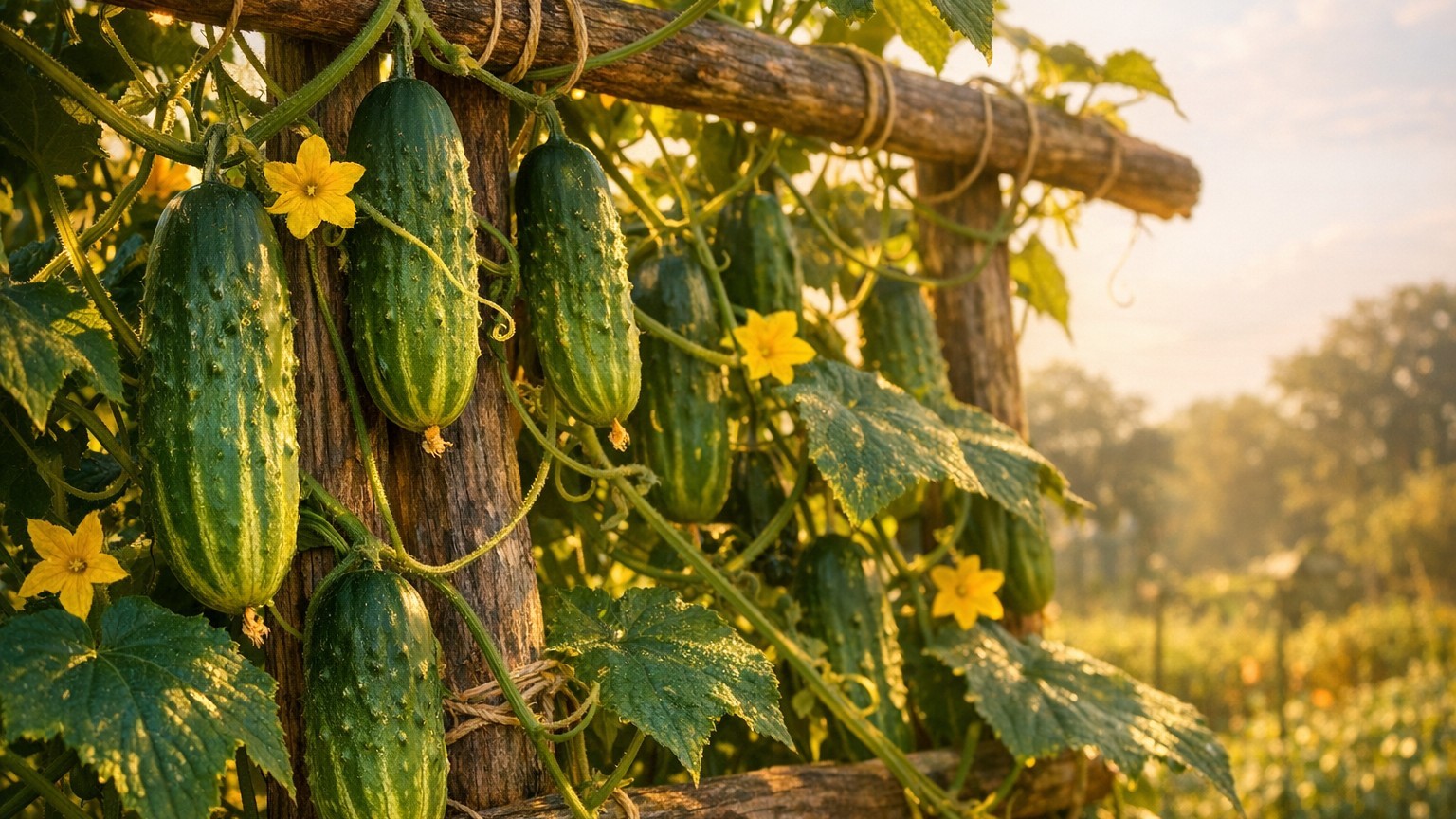

Idaho’s growing season splits sharply by elevation, so the right cucumber type depends on where in the state you garden. In the Boise valley, a frost-free window running roughly late April through mid-October favors both bush and vining types, plus pickling and slicing varieties bred for heat. Higher ground needs faster, tougher choices.
The short answer for Idaho
Start with the frost dates for the reference station in Boise: last spring frost falls between April 23 and May 7, first fall frost between October 7 and October 21. That gives the valley something close to five months of frost-free growing in a typical year, which is enough room for most cucumber types to mature and produce a real harvest before the weather turns. Everywhere else in Idaho, at higher elevation or farther north, that window shrinks, sometimes by weeks.
Inside that valley window, heat is the bigger factor shaping variety choice than cold. Boise averages 47.5 days a year at or above 90°F. Cucumbers are warm-season vines by nature, so this heat load works in their favor rather than against them, unlike crops that stall or bolt in high heat. It means slicing and pickling types bred for vigorous summer growth generally outperform anything marketed as a “cool climate” specialist here.
Vining slicing and pickling types suit gardeners with the fence, trellis or cage space to let the plant climb, and they’re the safer bet where the frost-free window runs closer to the full five months. Bush types mature in less space and work well in raised beds or containers, which matters for gardeners at higher elevation squeezing a crop into a shorter season, or for anyone gardening on a patio rather than a plot. Parthenocarpic types, which set fruit without pollination, deserve a look for anyone growing under a high tunnel or row cover early in the season, when pollinator activity is still low and open-air cross-pollinated varieties can flower without setting fruit.
Burpless types, bred for thinner skin and milder flavor, are a taste preference rather than a climate-driven choice, but they tend to be vining and benefit from the same trellis space as standard slicers.
None of this substitutes for a variety name. The type that fits Idaho’s season length and heat is one thing; a cultivar sourced for your county is another. That step belongs to your local extension office, covered further down.
Whatever type you choose, plan for consistent watering from the start. Idaho summers deliver almost no rain to work with, and cucumbers are shallow-rooted and unforgiving about drying out mid-fruit.
What will not work here

The clearest failure mode in Idaho cucumber growing isn’t the wrong variety. It’s the wrong watering schedule. Summer rainfall across June, July and August totals about 1.1 inches, and August, right when fruit is sizing up, averages just 0.17 inches. A cucumber plant watered once a week on that kind of rainfall, with 47.5 days a year pushing past 90°F, will show it: bitter fruit, blossom drop, and vines that wilt by afternoon even in soil that looked fine that morning. Cucumbers need steady, frequent moisture at the root zone, not an occasional soak, and Idaho’s dry summer air simply won’t make up the difference the way a humid-climate garden’s ambient moisture might.
Overhead watering on a schedule built for a wetter climate causes a second problem. Wetting the foliage in the evening, then leaving it damp overnight, invites powdery mildew even in a dry state, because the fungus needs surface moisture more than it needs humid air. Idaho’s dry summers mean less pressure from mildew than a humid Southern state, but irrigation habits, not the climate, decide whether it shows up anyway. Watering at soil level, in the morning, sidesteps most of the risk.
Season length catches out long-maturing types
A vining type bred for a long, slow finish can outrun even Boise’s roughly five-month window if it’s started late, and it has no chance at all at higher elevation, where the frost-free season is shorter. Direct-seeding too early is the other half of that mistake: soil that hasn’t warmed past the danger of a late frost between April 23 and May 7 will simply rot cucumber seed rather than sprout it, no matter how promising the type.
Finally, skipping pollination planning fails a specific subset of gardeners: anyone using row cover or a high tunnel to get an early start, with a standard open-pollinated variety that depends on bees to set fruit. Without airflow for pollinators or a parthenocarpic type instead, that early protection produces flowers and no cucumbers.
What changes across Idaho
Idaho is not one climate, and its official hardiness zone range makes that plain: the USDA Plant Hardiness Zone Map places the state anywhere from zone 3b to zone 7b. That’s an enormous spread for one state to carry, four and a half zones’ worth of difference in average annual extreme minimum temperature, which is the single measurement the USDA system tracks. It means a planting calendar tuned to Boise, sitting toward the warmer end of that range, tells a gardener in the mountains or in the northern panhandle very little about their own risk of frost.
The frost dates and heat-day count come from one reference station in Boise. They describe the valley. They do not describe a garden at altitude, where the growing season compresses from both ends, opening later in spring and closing earlier in fall, or a garden in the colder pockets of the state where a 3b or 4b rating is closer to reality than anything resembling Boise’s roughly five-month window.
What that means practically: a gardener at higher elevation should plan around a shorter season by favoring bush types or fast-finishing vining types over anything bred for a long slow harvest, and should expect to start plants under cover or transplant rather than direct-seed, simply to buy back some of the days a colder zone takes away. A gardener in the warmer, lower valleys closer to Boise’s own conditions can lean into the full range of types, vining included, with more confidence in the frost-free window holding.
Which zone number applies to an individual yard is a separate question. That’s a job for the map itself, not a paragraph. The USDA Plant Hardiness Zone Map is the tool built for that lookup, using the same average annual extreme minimum temperature data behind the 3b-7b figure cited here.
Where to check this for your own county
University of Idaho Extension is the state’s land-grant extension service, and it’s the source that can narrow a statewide range down to a number that actually applies to your county.
Two things are worth looking for specifically once there. First, a county-level planting calendar, if the local office publishes one, which will reflect the actual frost dates and season length for that county’s elevation rather than the Boise valley numbers. A gardener in a mountain county with a genuinely shorter season needs that local calendar far more than a statewide estimate built around one low-elevation station. Second, look for any list of cucumber varieties the office has trialled or recommended for that county specifically. That’s the resource that can put an actual cultivar name behind the types described here, tested against real local conditions rather than general climate reasoning.
This distinction matters more than it might seem. A state-level answer is built to be useful everywhere in Idaho and precise nowhere in particular. A county-level answer, from the extension office covering your specific ground, has already accounted for your elevation, your frost risk, and often your soil, in ways a state page covering everything from 3b to 7b cannot. If University of Idaho Extension’s county office has a recommendation that differs from what’s written here, follow theirs. That’s exactly what the more local resource is for.
Checking this against your own garden
Dates and averages describe a typical year at one weather station. Your own garden, checked directly, tells you what’s actually happening this year, and that observation should override anything on a calendar when the two disagree.
Soil warmth is the first check, and it needs no instrument beyond a hand. Push a finger a couple of inches into the bed where you plan to seed or transplant. Cold, damp soil that feels uninviting to the touch is still uninviting to a cucumber seed, regardless of what the calendar date says; warm, slightly dry-on-top soil that’s comfortable to leave your hand in for a few seconds is a much better sign the ground has actually caught up to spring.
The first flush of flowers is the second check, and it tells you something specific: cucumbers typically produce male flowers before female ones, so an early wave of blooms with no small swelling at the base isn’t a problem, it’s the plant’s normal sequence. Watch for the female flowers, the ones with a tiny cucumber-shaped bulge behind the petals, to know pollination and fruit-set are actually starting.
The first true leaves, the serrated, cucumber-shaped ones that follow the rounder seed leaves, mark the point where the plant has shifted from surviving off its seed reserves to growing on its own. A slow, stunted appearance of true leaves in a stretch of warm weather usually points to a root problem, uneven watering or compacted soil, rather than a climate one. That’s your own plot talking, and it’s worth listening to over any date on a calendar.