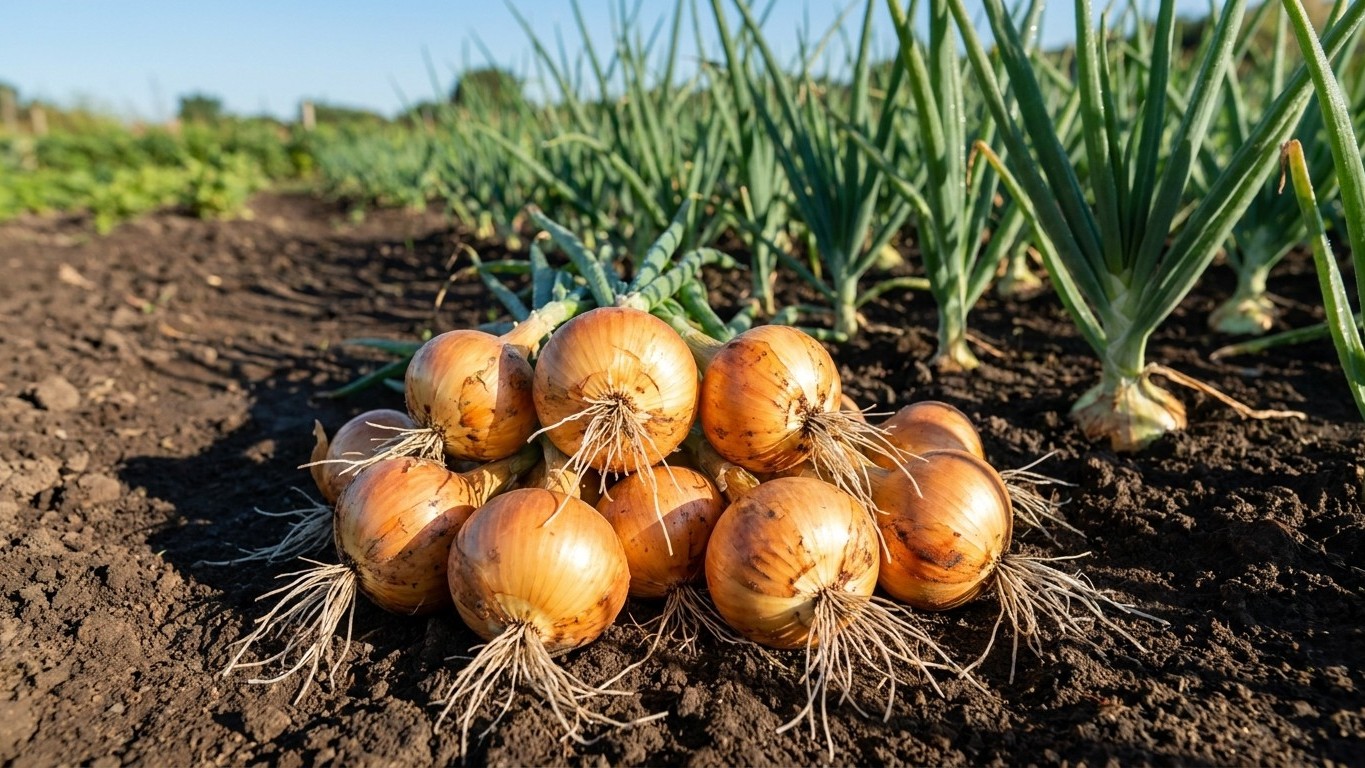

Lift onions when roughly half the tops have fallen over and the necks have gone soft. Cure them in a dry, airy spot until the necks are tight and the skins turn papery. Only then do they go into storage, and the target there is 45 to 55 °F with 50 to 60 percent humidity. How long they last depends mostly on the variety: pungent onions keep through winter, sweet ones need to be eaten first.
Keeping them, and for how long
Storage starts in the field, because a bulb that goes into a bin with a wet neck is already on its way to rot. Cured onions keep for months. Uncured ones start breaking down within weeks, usually from the neck down.
How do you know when onions are ready to lift?
Watch the tops. As the bulb finishes growing, the green leaves yellow and flop over at the neck. When about half of them are down, the crop is close. When most have fallen and the necks feel soft and pinchable, pull them. Waiting for every last leaf to go brown gives you little extra size and leaves bulbs sitting in soil where rain can start rot.
Pick a dry spell if you can. Loosen the soil with a garden fork and lift each bulb by hand rather than yanking on the tops, which tears the neck and opens a door for rot organisms. Bulbs with bruises, thick green necks or cuts are the ones to eat first. Bulbs chewed by pests rot first as well, and the guide to What Eats Onion in Idaho, and When explains which damage to look for in the field.
How do you cure onions?
Spread the bulbs in a single layer, tops still attached, somewhere warm, dry and shaded with good air movement. A covered porch, a screened-in space or a garage with the door cracked open all work. Direct sun can scald the outer layers, and a damp spot defeats the purpose. Curing usually takes a couple of weeks or more, depending on the weather.
The test is simple. The neck should be tight and dry, with no give when you squeeze it. The outer skins should rustle and cling to the bulb. Once that happens, trim the roots and cut the tops to about an inch, or braid the tops if you plan to hang them.
How long do onions keep, and what are the right conditions?
Clemson Cooperative Extension’s Home & Garden Information Center puts the ideal storage conditions at between 45 °F and 55 °F, with 50 to 60 percent humidity. That is a dry range. Carrots, beets and other roots want the opposite, cold and damp, so one cellar cannot hold both well. Onions kept in a humid space sprout and rot, and the moisture will also spread to anything stored beside them.
Any storage duration is a ceiling under those ideal conditions. A warm spell or a damp corner shortens it, and so does one soft bulb left in the bin.
The variety sets the upper limit. The University of Missouri Extension (G6355) says it plainly: “As a rule, ‘sweet’ onions do not store as well as the more pungent types.” The reason is chemical. The bite of an onion comes from volatile sulfur compounds, and those same compounds help protect the bulb while it sits in storage. A sweet variety has fewer of them, which makes it better raw and worse in March. No amount of careful curing turns a sweet onion into a keeper.
Day length lines up with this. Short-day onions begin bulbing at about 12 hours of daylight (Clemson Extension) and run sweeter. Long-day types wait for 14 to 16 hours and keep longer. Boise, the reference city for Idaho climate data, sits at 43.57 degrees north and gets 15 h 15 of daylight on the longest day. That is enough for long-day onions to bulb well, which is why a northern garden can grow onions that feed you into March. The Idaho panhandle lies several degrees farther north and the southern edge of the state a little south, so check your own latitude before choosing. For picking types that cure and keep well here, see The Best Onion Varieties for Idaho, and for the bigger picture, Onions in Idaho.
Where in the house that actually is
The range of 45 to 55 °F sounds easy until you start walking through a house looking for it. Most rooms miss it in one direction or the other.
The refrigerator is too cold. It runs below the bottom of that range, and the crisper drawer is humid, which is the wrong direction for onions. Whole cured onions also absorb moisture and soften there. A heated living space or kitchen cabinet is too warm. Bulbs kept at room temperature on a counter will sprout earlier and soften sooner. A garage is the usual compromise people try, and it swings with the weather. In Idaho that means a hard freeze on a January night and heat in a closed garage on an autumn afternoon. Frozen bulbs turn glassy and mushy when they thaw.
The closest match in most homes is an unheated interior space that stays cool without freezing: a basement corner away from the furnace, a closet or pantry on an inside wall of an unheated room, or an enclosed back porch in a mild stretch. Basements deserve a second look because many are damp, and humidity above 60 percent works against you even when the temperature is right.
Whatever space you choose, put a min-max thermometer and a small hygrometer there for a week before you load it. Skipping that check is how a whole crop ends up soft by Christmas, because a spot that feels cool to your hand may sit near 60 °F in the afternoon or swing past the humidity range overnight. Check the reading at different times of day, and again after the first hard freeze when the house settles into winter.
Once you have a space, use containers that let air through: mesh bags, slatted crates, shallow baskets or old nylon stockings with a knot between bulbs. Keep layers shallow, and sort out any bulb with a soft neck before binning. Check the stored onions every couple of weeks and pull out any that feel soft or smell sour, since one rotting bulb contaminates its neighbors quickly.
Common questions
Can sweet onions be stored through winter?
Not for long. They have fewer of the sulfur compounds that protect pungent bulbs, so they soften and sprout sooner even under good conditions. Cure them like any other onion, then use them first, within the first weeks or so after curing. Pungent types are the ones to plan for winter.
Can onions and carrots share the same cellar?
Rarely well. Onions want 50 to 60 percent humidity, and carrots keep best in cold, damp conditions. If you only have one cool space, give the onions a dry shelf as far as you can from the damp crops, and expect to compromise on one of them.
What if it rains while the onions are curing?
Move them under cover. A covered porch or garage with the door open is fine, as long as air can move around the bulbs. If they got wet in the field, spread them out and let them dry fully before the cure begins. Wet skins in a pile are an invitation to mold.
Which onions should I use first?
Eat the ones with thick, green or soft necks, any with bruises or cuts, and any sweet type. Those will not last. Keep the tight-necked, hard, pungent bulbs for late winter, and check them every couple of weeks as you go. A sprouted onion is still edible, though the center turns hollow and a little bitter.