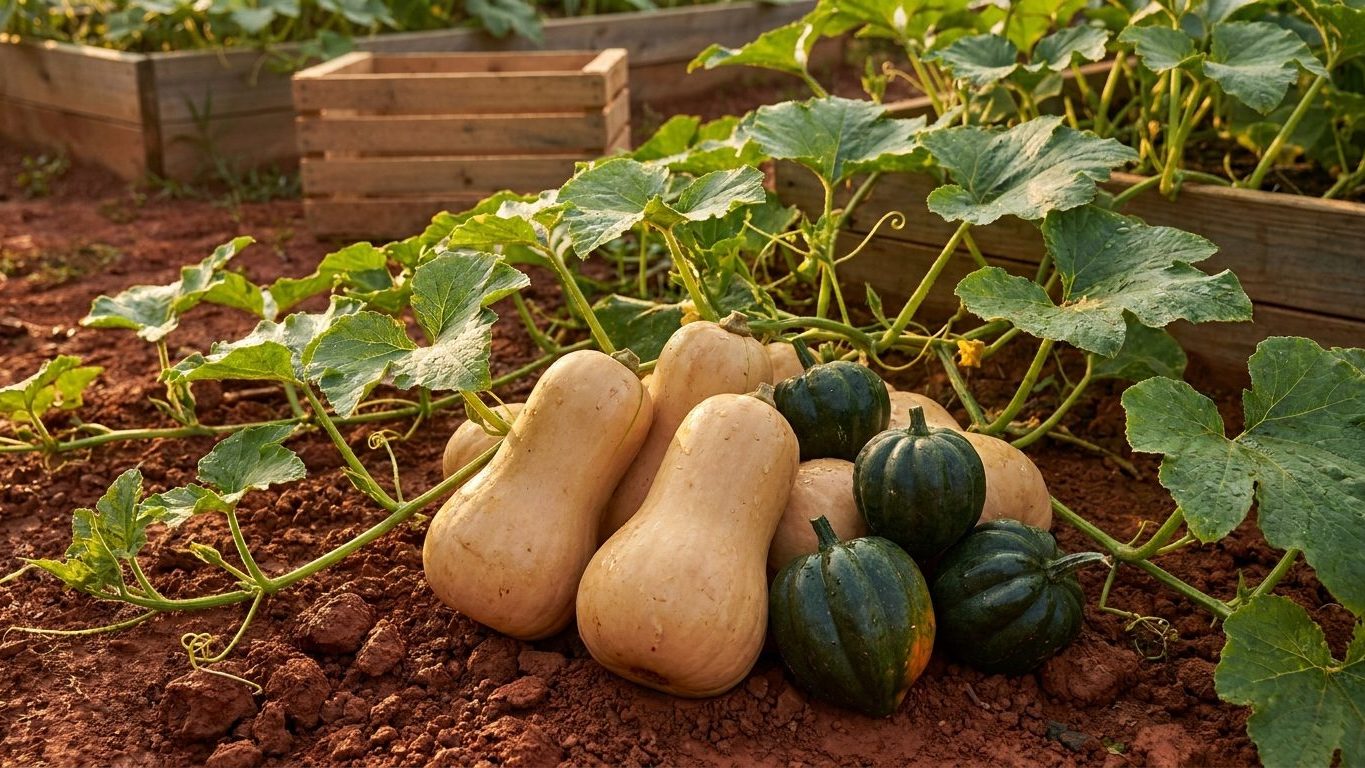

Indiana’s frost-free window runs long enough for almost any Winter Squash to finish, but not long enough to gamble on the slowest ones without a plan. The safest bets statewide are the 80-to-100-day types: acorn, delicata, spaghetti. Butternut fits too. Giant Hubbard and some kabocha strains need a head start or a lucky fall.
The short answer for Indiana
Start with the numbers rather than a variety list. At the Indianapolis reference station, the last spring freeze falls between April 9 and April 21, and the first fall freeze between October 21 and October 30 (NOAA NCEI 1991-2020 Climate Normals). Read those two dates at their tightest, safest reading, from April 21 to October 21, and Indiana’s frost-free season runs 183 days. Read them at their loosest, from April 9 to October 30, and it stretches to 204 days. Either way, that’s a wide enough window for the entire winter squash category, because even the slowest widely grown types (Hubbard, some kabocha) mature in 100 to 120 days from seed.
So why does variety choice still matter here? Because 183 days is the frost-free window, not the growing window. Nobody sows squash the day the freeze risk ends. Soil needs to warm past the mid-50s first, which in central Indiana usually pushes direct seeding into mid-to-late May regardless of the calendar frost date. That trims the practical season to something closer to 140 to 150 days in an average year, before you even account for a cool, wet spring that delays planting further.
Against that trimmed window, the 80-to-100-day group (acorn, delicata, spaghetti squash) has slack to spare. It can absorb a late planting, a cool stretch in June, or an early frost scare in October and still ripen fully on the vine, which matters because winter squash picked underripe stores poorly. Butternut, typically 100 to 110 days, still clears the bar comfortably in most years but has less room for a bad spring.
The 110-to-120-day group is where the math gets tight. Purdue’s own caution is worth repeating here: even after the published spring frost date, there remains roughly a 10% chance of a 32°F event, which means gardeners who plant on the early edge of that April 9-21 window need row cover ready. Stack a late-spring cold snap on top of a slow-maturing Hubbard and the fall freeze can arrive before the fruit has set its final rind hardness, the trait that actually determines whether a squash stores through winter or rots in the shed.
Heat is not the limiting factor here the way it is farther south. Indianapolis averages just 14.6 days a year at or above 90°F, a moderate heat load that neither accelerates fruit set dramatically nor stresses the plants into dropping blossoms the way a Deep South summer can. That’s one variable working in Indiana’s favor, which shifts most of the risk calculation back onto the calendar and onto moisture, covered next.
What will not work here
The clearest failure mode in Indiana is planting a 110-to-120-day giant squash on the same schedule as an 85-day acorn and expecting both to finish. Do that in a year where the last frost lands on the late end of the April 9-21 range, or where a cool June delays germination, and the giant type is still sizing fruit when the first fall freeze arrives between October 21 and 30. A squash caught mid-ripening at frost doesn’t just stop, it often rots at the stem end within weeks in storage, because the rind never fully hardened.
The second failure is a spacing decision, not a variety decision. Indiana’s summer rainfall runs about 12.6 inches across June, July, and August (43.6 inches for the year), spread fairly evenly at 4.95 inches in June, 4.42 in July, and 3.2 in August. That’s not drought territory. It’s humidity territory. Winter squash planted at tight spacing to save bed space traps moisture in the canopy after each rain, and combined with Indiana’s typical summer humidity, that’s exactly the setup powdery mildew needs. A mildew infection that hits in July, before fruit has sized up, can shut down the plant’s leaf area for the rest of the season, and squash finishing on a defoliated vine produce thin-walled, poor-keeping fruit regardless of variety.
The third failure is assuming the season’s rainfall means the garden never needs a hose. August, the driest of the three summer months at 3.2 inches, is also the month when most winter squash are sizing fruit and thickening rind, the stage most sensitive to inconsistent water. A gardener who waters on a fixed weekly schedule through a dry August, rather than watching the soil, can end up with fruit that stalls mid-size or splits when a heavy rain finally breaks the dry spell. Sandy soil compounds this because that same 3.2 inches drains through in a day rather than holding a week’s reserve.
None of this rules squash out of Indiana gardens. It rules out treating every winter squash the same way, on the same calendar, at the same spacing, with the same watering habit.
What changes across Indiana
Indiana is not one climate for squash-growing purposes. The USDA Plant Hardiness Zone Map (2023, built on 1991-2020 normals) places the state across zones 5b to 7a, a spread built on a single measure, the average annual extreme minimum temperature, but one that tracks closely with how much earlier or later the growing season opens and closes from north to south.
The frost dates cited above are anchored to Indianapolis. Purdue’s own guidance flags that southern Indiana runs earlier in spring and later in autumn than the northern part of the state by a fortnight or more. That’s not a rounding error for winter squash. A gardener near the Ohio River working with a growing season two weeks longer on each end than Indianapolis, closer to 210 to 220 days of frost-free ground, has real room to run a 110-to-120-day Hubbard or a large kabocha to full maturity without transplanting. A gardener in the far north, working with a season two weeks shorter than Indianapolis on each end, closer to 150 to 155 days, is better served sticking to the 80-to-100-day types and treating anything slower as a transplant-only crop.
This isn’t a case where the state has one answer with minor local flavor. It’s a case where the zone range itself, 5b to 7a, spans enough climate difference that “Indiana’s growing season” is really shorthand for two different growing seasons depending on which end of the state a garden sits in.
The map for figuring out exactly where a given garden falls on that spread is the USDA Plant Hardiness Zone Map itself, not a description in this article. Anyone reading this who wants their own zone, rather than the state’s range, should look it up directly rather than guess from county name recognition, since zone boundaries in Indiana don’t track county lines cleanly.
Where to check this for your own county
Everything above is a state-level answer, built from a single reference station in Indianapolis and a statewide hardiness zone range. That’s useful for deciding which category of Winter Squash to plant, but it is not a substitute for what Purdue’s own county-level trial data and planting calendars say about a specific location.
Purdue Extension is the land-grant authority for Indiana, and its site is extension.purdue.edu. Two things there are worth checking before locking in a planting date or a variety. First, the local planting calendar for the reader’s own county office, which adjusts the general frost-date range given above to what’s actually been observed nearer that garden, since a fortnight of difference between the north and south of the state matters more than any variety choice discussed here. Second, the variety trial results Purdue publishes periodically for vegetable crops, which show which winter squash cultivars have actually performed well in Indiana field conditions, including yield and disease resistance data that a national seed catalog description won’t mention.
A county extension office recommendation will always outrank a state-level article like this one, because it accounts for local soil, local microclimate, and local pest pressure in a way a statewide frost-date range cannot. This page has done the useful part of that job, narrowing winter squash choice down by season length and heat load using verified climate normals. The remaining, more precise step, matching a specific cultivar to a specific county’s conditions, belongs to Purdue’s county offices and their published trial data, not to a general cluster article.
Calling the local office directly is also worth doing, particularly for gardeners near the state’s edges, where the Indianapolis-based frost dates cited here are least representative of what’s actually happening in the ground.
Checking this against your own garden
Every date and range above describes an average across thirty years at one station. A reader’s own garden will run ahead of or behind that average depending on slope, soil type, and how much sun the bed gets, and three simple observations settle the question faster than any calendar.
The first is soil warmth by feel, checked by pushing a hand a few inches into the planting bed in the morning before the sun has warmed it. If the soil still feels cold and heavy rather than merely cool, squash seed sown into it will sit and rot rather than germinate, regardless of what the calendar frost date suggests. Waiting until it feels closer to room temperature is a better signal than counting days from April 21.
The second is the first flush of male flowers, which typically appears well before any female flowers or fruit set. Male flowers opening on schedule with what a garden usually sees confirms the season is tracking normally; a noticeably early or late flush signals the local microclimate is running warmer or cooler than the county average that year, which is useful information for deciding how much slack to leave before the first fall freeze.
The third is the appearance of the first true leaves, the second set that emerges after the rounded seed leaves, since squash growth rate from that point forward is a fair proxy for how much heat and light that specific bed is actually receiving. A slow transition from seed leaves to true leaves in a spot that gets partial shade for part of the day suggests that plot alone, not the whole garden, may need faster-maturing varieties even if the rest of the yard could handle something slower.
None of these require a thermometer or a soil probe, just attention paid at the same time each morning, and together they tell a gardener more about their own plot’s timing than any regional frost-date range can.