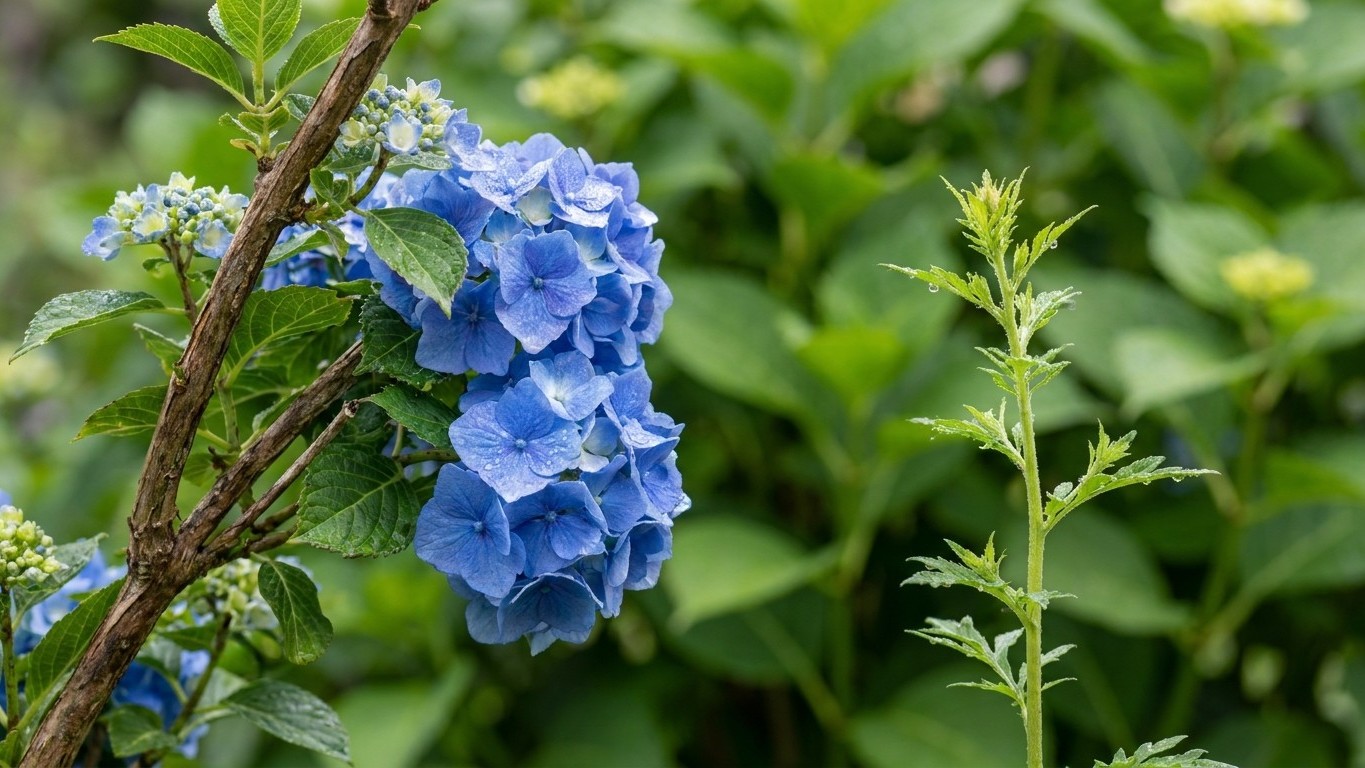

Hydrangeas bloom pink in Iowa because most of the state’s soil is neutral to alkaline, and in that soil the aluminum a bigleaf hydrangea needs for blue flowers stays locked up. Lowering the soil pH frees the aluminum, and the flowers shift toward blue over a season or two. Here is how the chemistry works, how to run the change in your own yard, and which mistakes undo it.
What this comes down to in Iowa

In Des Moines, the reference city for Iowa frost dates, the last spring frost typically falls between April 12 and April 24, and the first fall frost between October 14 and October 25. That window matters for color because soil-acidifying treatments work only while roots are active, so they belong between spring leaf-out and the first fall freeze. Iowa State Extension county records run about 4 days later in spring and 10 days earlier in fall than the Des Moines numbers, so treat Des Moines as the optimistic end of the range.
Why do hydrangeas turn pink in alkaline soil?
Aluminum is present in nearly every soil. Whether the plant can take it up depends on pH. In acidic soil the aluminum dissolves and moves into the roots, then travels up to the flower buds, where it binds with the pigment and shifts it from pink to blue. In soil at or above neutral, aluminum turns into forms the roots cannot absorb, and the pigment stays pink.
Iowa’s glacial till, windblown loess and prairie-derived soils often contain free carbonates, which hold pH up. Hard well water and city tap water carry dissolved bicarbonates that push it higher with every watering. A hydrangea planted beside a concrete foundation also gets a steady supply of lime leaching from the cement.
Which hydrangeas can actually turn blue?
Only bigleaf hydrangeas (Hydrangea macrophylla) and, to a lesser degree, mountain hydrangeas (Hydrangea serrata) respond to soil chemistry. Smooth hydrangeas, panicle hydrangeas and oakleaf hydrangeas will not turn blue, whatever you put on the ground. Panicle types do fade from white to pink as the blooms age, and that is a seasonal change that has nothing to do with pH.
| Soil pH | Typical flower color on bigleaf types |
|---|---|
| About 5.2 to 5.5 | True blue |
| About 5.5 to 6.0 | Purple, or a mix of blue and pink on one plant |
| 6.0 and above | Pink to deep rose |
White-flowered bigleaf varieties stay white. They lack the pigment that responds to aluminum, so there is nothing to turn. If you are looking at a plant tag, a pink or blue photo means the variety can swing either way.
Working it out for your own garden
Start with a soil test. Guessing at pH is how people overdose their shrubs. A lab test through your county extension office tells you the actual pH and often the phosphorus level. Pull samples from the top 6 inches of soil around the drip line, not from right against the trunk. If the number is 6.5 or higher, expect pink flowers until you change it.
The target for blue is a pH of roughly 5.2 to 5.5. Two tools get you there, and they work at different speeds.
- Aluminum sulfate acts quickly and supplies aluminum directly. The standard home recipe is about 1 tablespoon per gallon of water, poured around the root zone of an established shrub, after the soil has been watered well.
- Elemental sulfur works slowly, because soil bacteria have to convert it to acid. Apply it in early spring or fall and give it months. It lowers pH more gently and lasts longer.
- Mulch and rainwater help at the margins. Pine needles and shredded oak leaves are mildly acidic, and collected rainwater lacks the bicarbonates in hard tap water.
When should you apply aluminum sulfate in Iowa?
Work from the frost window. The first dose goes on as new leaves open, which in central Iowa is usually around the April 12 to April 24 range for the last frost, and often a little after it. Repeat every three to four weeks through early summer for a total of three applications. Counting that forward from a late April start puts the last dose in late June, well before the October 14 to October 25 range for first fall frost.
Stopping early matters. Pushing a flush of tender growth late in the season leaves it exposed to the first freeze. If you garden in a colder county, shift every date later in spring and earlier in fall, since the county records run later in spring and earlier in fall than Des Moines.
How can you tell if the change is working?
Color shows only on buds that form after the chemistry shifts. Expect the first purple tinge in the first season and a cleaner blue in the second. Retest the soil in the fall. If pH has not moved, the problem is often the water. Watering with tap water from a limestone aquifer will undo a lot of the acid you applied.
A potted bigleaf is the fastest route. You control the potting mix, usually an acidic, peat-based one, and the pH holds steady far better than in the ground. Many Iowa gardeners keep a blue hydrangea in a container and leave the in-ground plantings pink.
What changes across the state
Iowa is not one soil. The pH varies from county to county, and so does how hard it is to push it down.
Across much of the north and west, soils formed from glacial till and windblown loess tend to hold lime near the surface. Those yards are the hardest places to produce blue, because the soil keeps rebuffing every acid treatment you give it. The Des Moines region sits in between, and soil there can differ from one neighborhood to the next, depending on how much fill, construction rubble and lime-based landscaping the yard has seen.
Southern Iowa leans the other way. Older, more weathered and more leached soils there are often naturally closer to acidic, and a gardener may need only a modest nudge to get blue, or none. Some southern yards actually need lime for other plants and have to be careful not to overdo it near the hydrangeas.
Cold shifts things as well. The USDA hardiness zone map, which uses the average annual extreme minimum temperature, places Iowa in zones 4b to 6a, so winter bud survival is a bigger question in the north than the south. Bigleaf hydrangeas flower on buds formed the previous summer, so a hard winter or a late spring freeze can strip the blooms in any color. For the dated advice here, use Des Moines as the reference and adjust for your own county. For bud protection, see Protecting Hydrangeas Through a Iowa Winter.
The mistakes this state punishes

Overdoing aluminum sulfate comes first. A stronger mix does not turn flowers bluer faster. It burns roots and can leave brown leaf edges. Mix it by the label or the standard tablespoon-per-gallon rate and apply it to moist soil, never to a dry root zone in midsummer heat.
The second error is feeding the wrong fertilizer. A high-phosphorus formula binds aluminum in the soil and keeps blooms pink even when the pH is right. Choose a fertilizer low in phosphorus, with more potassium, and keep lawn fertilizer from drifting into the bed.
Third, people treat the wrong plant. A panicle or smooth hydrangea will never go blue. If the shrub is a white-flowering type, or one that has been in the yard for years without a color history, check the variety first.
Fourth, applying acid too early. Soil in March or early April is cold, roots are barely working, and a late freeze inside the April 12 to April 24 range or after it can still hit new growth. Wait for leaf-out. Likewise, skipping the cutoff and feeding into October invites frost damage on soft new shoots.
Last, pruning at the wrong time removes the buds you were trying to color. Since bigleaf types bloom on old wood, see When to Prune Hydrangeas in Iowa before you cut anything back.
Checking this against your county
A statewide pattern is a starting point. Your own soil pH, your water source and your local frost dates decide the result. Your county office at Iowa State University Extension can tell you how to submit a soil sample and which local conditions to expect. For the rest of the growing basics, including siting, soil prep and care, read the guide to growing hydrangeas in Iowa.
Common questions
Can I turn a pink hydrangea blue in one season?
You may see some purple in the first season, but a clean blue often takes a second. Color appears on new buds, so the buds already set before you treated the soil stay pink.
Will baking soda or lime turn hydrangeas pink?
Garden lime raises soil pH and pushes bloom color toward pink. Do it only if a soil test shows the soil is acidic, and keep it away from plants you want blue. A plant in alkaline Iowa soil is usually pink already.
Do coffee grounds make hydrangeas blue?
Used grounds are close to neutral and have little effect on pH. They are fine in a compost pile, but they will not shift color on their own. A soil test and sulfur or aluminum sulfate do the work.
Why is my hydrangea blue one year and pink the next?
The soil pH has drifted, usually from hard water, lime leaching out of nearby concrete, or fertilizer high in phosphorus. A test in early spring and again in fall shows the change. Correct it with sulfur in the off-season and aluminum sulfate during active growth.