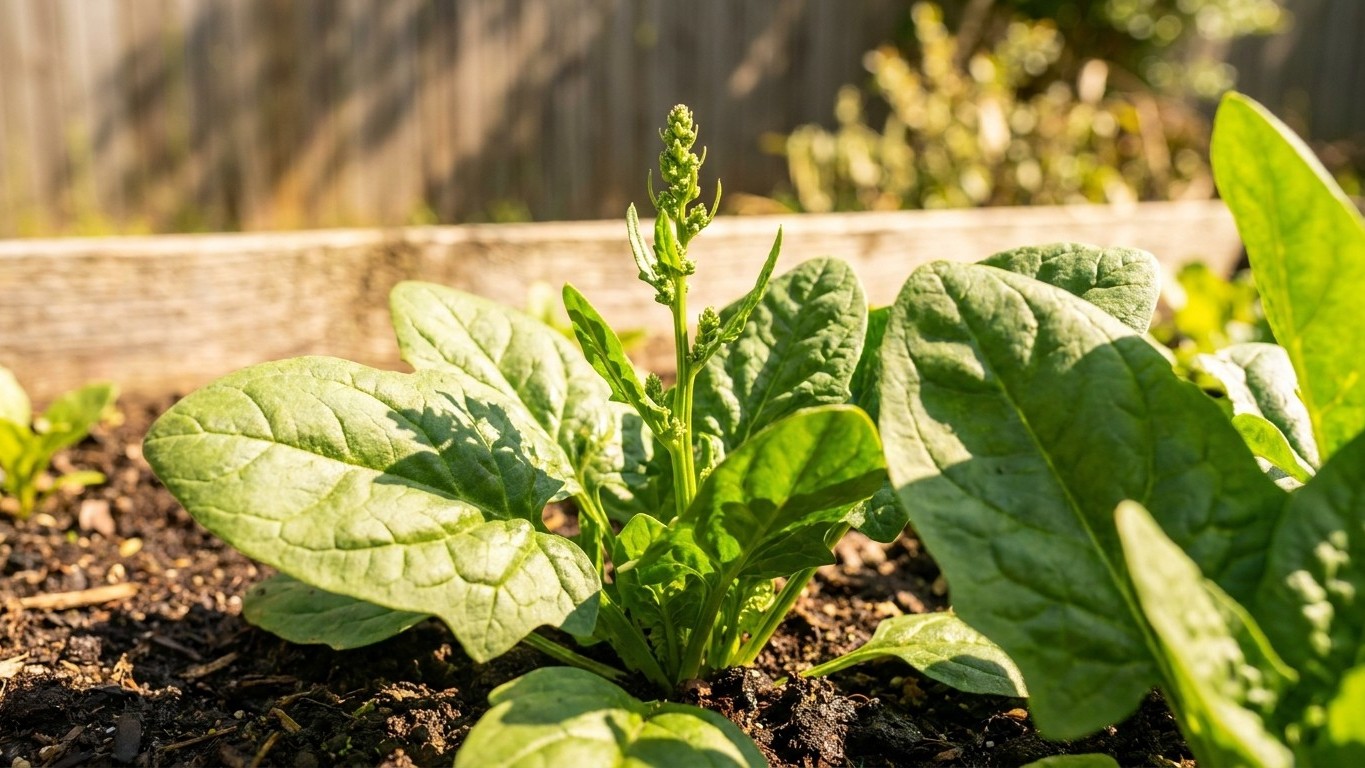

Cut spinach when the rosette has leaves big enough to eat and the center is still a flat tuft, before a stalk starts to rise. For Iowa gardens, sow in spring once the last frost has passed and in fall early enough to mature before the first frost. After cutting, spinach keeps best at 32°F and very high humidity, and even then UC Davis puts a ceiling of about two weeks on it. A home fridge runs warmer, so where you put the bag matters.
When spinach is ready in Iowa
Watch the plant before you watch the calendar. A spring crop is ready when the outer leaves are a usable size and the center has not started to stretch. Once a stalk begins to climb, the best eating is behind you. Leaves on a bolting plant turn narrow and pointed, and the flavor goes bitter.
Two things push spinach toward that stalk. Utah State University Extension reports that spinach bolts during long days and warm temperatures, and that it grows best where temperatures stay at or below 75 F. The longest day of the year at the Des Moines reference station runs 15 h 01 of daylight, so a cool June does not buy extra weeks. Spring sowings race against lengthening days. Fall sowings grow into shortening ones, which is why autumn spinach is the more forgiving crop. Heat adds to the squeeze: the Des Moines normals show 18.4 days a year at 90 F or higher, and 75 F is both the point where growth slows and the point where leaves turn bitter.
When can you cut spinach in spring and fall?
For spring, start from the frost dates. NOAA NCEI climate normals put the typical last spring freeze at the Des Moines station between April 12 and April 24. Iowa State Extension county records run about four days later, so gardens away from the city should lean toward the late end. Spinach is sown as soon as the ground can be worked, often around those dates, and the cutting comes in May and early June, ahead of the first stretch of 80-degree weather.
Fall works backward from the harvest you want. Utah State University Extension says to plant early enough that the crop matures before the heat of summer. The same normals put the first fall freeze between October 14 and October 25, though Iowa State Extension county records run about ten days earlier. Counting back from those dates points to sowing in early August through early September.
Soil temperature complicates that. Seed germination drops once the soil is above 80 F, and an Iowa August can hold the ground warmer than that. The fall window opens when the soil cools, which in a hot year may be late August or early September. Waiting for the soil costs a few weeks of growth, but the seed you sow actually comes up.
How do you cut spinach?
Use scissors or a sharp knife. For a longer harvest, take the outer leaves and leave the center to keep producing. When heat or a rising stalk says the crop is finished, cut the whole plant just above the soil. Cut in the morning while the leaves are cool, because leaves harvested on a warm afternoon go into storage already warm. If holes show up before you get there, What Eats Spinach in Iowa, and When covers who is likely responsible.
Keeping it, and for how long
The UC Davis Postharvest Technology Center, which studies how produce holds up after picking, lists spinach at an optimum temperature of 0°C (32°F) and an optimum relative humidity of 95 to 98%. That is nearly saturated air at the temperature where water freezes. Those are the conditions under which the leaves lose the least water and slow down the most.
How long does fresh spinach last?
UC Davis calls spinach highly perishable and says it will not maintain good quality for more than two weeks. Wilting, yellowing and decay are likely to increase once storage runs past 10 to 14 days. Read that as a ceiling reached under ideal conditions. It is no schedule to plan a week around. A bag of spinach cut on Saturday should be on the table well before the second weekend, and the sooner the better.
What happens when it is warmer than 32°F?
The same source notes that spoilage runs faster at common distribution conditions of 5 to 10°C (41 to 50°F), the range that most produce spends its life in on the way to a grocery store. A kitchen fridge sits in or near that range, and its door sits at the warm end. At those temperatures spinach yellows within days, well short of the 10 to 14 day mark.
The humidity number matters as much as the temperature. Dry fridge air pulls moisture out of thin leaves quickly. A limp bunch is mostly a dehydrated one, and the wilting UC Davis lists as the first sign of decline starts there. Garden spinach has one advantage over the store kind. You control how fast it moves from the row to the cold, so the clock starts later and the leaves start cooler. Cut early in the day, get the leaves out of the sun, and refrigerate them within the hour.
Where in the house that actually is
A household fridge is built to stay above freezing so milk and eggs do not ice over, so it cannot hit 32°F. Your job is to find the spot that comes closest. That spot is rarely where the spinach goes by habit.
Which fridge shelf is best for spinach?
The door is the worst place. It swings open, catches warm air and light, and sits above the range the leaves can tolerate. The upper shelves near the front are only a little better. Put spinach on the back of the bottom shelf, where cold air settles and the door’s temperature swings do not reach. Skip that step and a bag that could have lasted several days can start yellowing in two or three.
A cheap appliance thermometer placed there for a day tells you what you are working with. If it reads inside the 41 to 50°F range, expect yellowing in days and use the spinach first. Crisper drawers on many fridges sit low, but they are not always the coldest spot, so check before you assume.
How do you get high humidity at home?
You make it yourself. A loosely closed plastic bag holds in the moisture the leaves give off, and a damp paper towel tucked inside adds to it. The leaves should feel damp, not dripping, because standing water on the leaf surface invites decay. If you cut whole plants with the base intact, you can stand the cut ends in an inch of water, like flowers, and loosely cover the tops with a bag. Both setups aim at the 95 to 98% humidity UC Davis lists, which the dry air of an open shelf will never supply.
Check the bag every day or two and pull out any leaf that has gone slimy or yellow. One bad leaf speeds up the rest. For the whole growing picture from seed to harvest, see Growing Spinach in Iowa.
Common questions
Can I keep cutting the same spinach plants?
Yes, until the plant bolts or the heat arrives. Take the outer leaves and leave the center so the plant keeps making new ones. Once the center starts to stretch upward, cut the whole plant. The signs are covered in Will Spinach Bolt Early in Iowa?.
Why is my spinach bitter?
Warmth is the usual cause. The 75 F ceiling that slows growth is also the point where leaves turn bitter, and a bolting plant tastes worse still. Bitter spinach from a hot week is a signal to cut the remaining plants and sow again for fall.
How late can I sow fall spinach?
Count back 50 to 75 days from the date you want to harvest, and wait for the soil to cool below 80 F, since warm soil cuts germination. The fall freeze dates at the Des Moines station run from October 14 to October 25, and county records run earlier. Your county extension office can tell you where your own ground falls.
Does the variety change when I cut?
Utah State University Extension recommends choosing a variety suited to your local conditions. Any of them follows the same signals, a full rosette and a flat center. The seed packet and your county extension office can tell you more about how each one behaves locally.