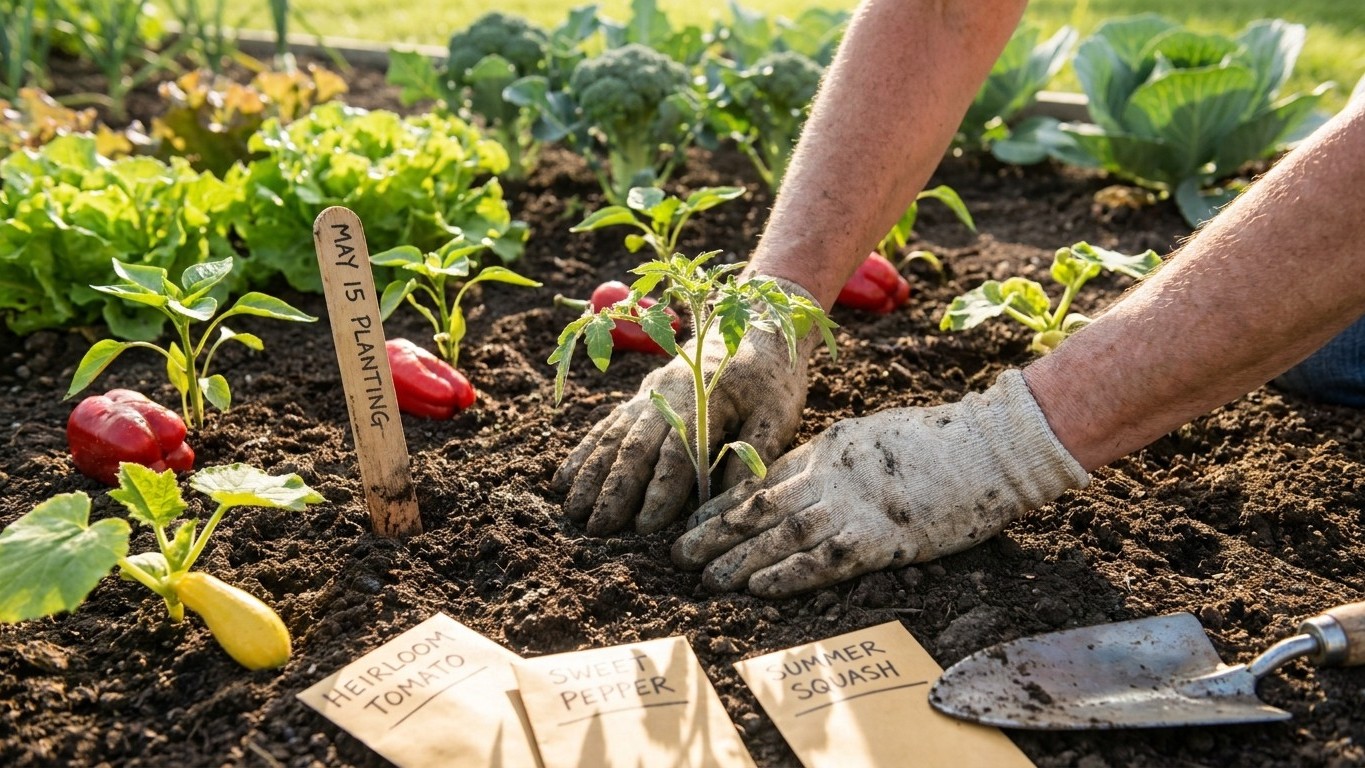

Iowa’s planting calendar turns on soil temperature, not the calendar page. Statewide frost data puts the last spring freeze between April 12 and April 24 at the reference airport station, with county-level records running about four days later. By May, most of Iowa has cleared that threshold, which is why this month marks the shift from cold-hardy crops to tender ones. Potatoes and onions go in early; tomatoes, peppers and squash wait for soil to actually catch up.
What goes in the ground in May

The frost window itself, April 12 to April 24 at the airport station and roughly four days later by county, has mostly closed by the time May opens. That gives the first half of the month to cold-hardy crops that shrug off a cool night, and the second half to the tender stuff once nighttime lows stop flirting with freezing.
Early in the month, the ground is workable and safe for seed potatoes (chitted a couple weeks earlier indoors), onion sets or transplants, carrots, beets, radishes, spinach, lettuce, peas if they didn’t already go in during April, and brassica transplants like cabbage, broccoli, cauliflower and kale. These crops tolerate a light frost and actually grow better in cool soil than they would in the heat of summer.
Once the frost window has closed with a margin, typically the back half of May, it’s time for bush and pole beans direct sown once soil has warmed past the cold-soil danger zone, and sweet corn once the ground has lost its early-spring chill. Tender transplants, tomatoes, peppers, eggplant, cucumbers, squash and melons, go out after hardening off, not before.
The state’s hardiness range of 4b in the north to 6a in the south (USDA Plant Hardiness Zone Map, using average extreme minimum winter temperature) matters here too. Gardeners near the Minnesota border are closer to zone 4b and should treat the later end of the frost window as the realistic one. Gardeners near the Missouri border, closer to 6a, can often push a week earlier than the state-wide range suggests.
What to start under cover
Most of the classic transplants, tomatoes and peppers, should already be growing by the time May starts; if they aren’t, buying started plants beats sowing seed this late. But a few crops still benefit from an indoor head start counted backward from the frost window rather than forward from a date on the wall.
Melons, winter squash and, for gardeners wanting a size jump, cucumbers do well started indoors three to four weeks before they go into warmed soil. Since the frost window at the airport closes by April 24 and the county figure runs about four days behind that, seeds started indoors during the first one to two weeks of May land outside around the start of June, which still leaves enough of the season before the fall frost window (October 14 to October 25) to mature a 90 to 100 day crop.
Two things wreck this math. Starting too early means trays of leggy, rootbound seedlings waiting on soil that hasn’t warmed up yet, and a head start that turns into a setback. Starting too late means winter squash and melons run out of warm days before the fall frost window closes on them.
Basil, along with warm-season flowers like zinnias and cosmos, also does well started indoors this month for transplant once the soil has warmed. A second indoor sowing of lettuce or other greens keeps a supply of transplants ready for gaps that open up in the bed later in the season.
What is ready to pick
Established asparagus beds start throwing spears in May, and rhubarb stalks are usually ready to pull by mid-month. Both are perennial and don’t care what the frost window did this particular spring; they run on soil warmth and root reserves built up over previous seasons.
Kale, collards and spinach that survived winter under mulch or row cover often resume growth before anything newly planted catches up, and they’re worth checking first for an early harvest. Radishes sown in April are usually ready within 25 to 30 days of sowing, and baby lettuce leaves, green onions and chives are all fair game by the back half of the month.
Root cellars and pantries deserve a look too. Potatoes, onions and winter squash held over from the previous fall are aging out by this point in the year. Potatoes that have started sprouting eyes, onions gone soft at the neck, and squash softening near the stem end should move to the front of the meal plan before they’re lost to rot.
The jobs that matter this month
Soil that’s dry enough to crumble rather than clump is ready for compost worked into beds destined for warm-season crops; working wet soil compacts it and undoes months of structure-building. Mulch goes down once the ground has warmed, holding that warmth in and keeping moisture from evaporating as May temperatures climb.
Staking and support structures belong in the ground before plants need them, not after they’ve flopped over. Pea trellises, tomato cages and bean poles set up now save a scramble later when the plants are already sprawling and harder to corral without snapping stems.
Watering rhythm shifts this month from occasional to regular, especially for new transplants establishing roots. Deep, infrequent watering builds deeper root systems than frequent shallow sprinkling. Succession sowing, a new row of lettuce, radishes or beans every two to three weeks, keeps harvests coming instead of arriving all at once and then stopping.
Pest scouting starts in earnest as the weather warms: flea beetles show up on brassica transplants, cutworms take down newly set seedlings at the soil line (a paper collar around the stem stops them cold), and asparagus beetles appear on the new spears. Hardening off tender transplants over seven to ten days, gradually increasing their outdoor exposure, prevents the sunscald and wind damage that undoes weeks of indoor growing in a single afternoon.
What not to do in May
The most common mistake is planting tomatoes, peppers or other warm-season crops because the air finally feels warm, while the soil six inches down is still cold. Warm air doesn’t mean warm soil, and roots sitting in cold ground stall out, turn purple from stress and become an easy target for disease even if the plant eventually survives.
A related mistake follows a stretch of unusually warm days: pulling mulch and row covers off too early, assuming the frost risk is over. Given that the frost window itself runs to April 24 at the airport station and later still by county figures, a warm early-May spell doesn’t guarantee the last frost has actually happened, particularly in the northern part of the state. Covers are cheap insurance against a cold snap that shows up right after a warm one.
Heavy nitrogen applied too early on tomatoes and peppers produces lush green leaves and very little fruit, because the plant puts its energy into foliage instead of flowers. Holding off on nitrogen until after the first fruit sets solves this, letting an early dose of balanced fertilizer at transplant time do the initial work instead.
Checking this against your own county
A state-wide frost window is a starting point, not an instruction for a specific yard. Elevation, local terrain and simple north-south position move Iowa’s frost dates by more than a week in either direction, and the gap between the airport-based figures and county-level records already runs about four days on its own.
The most reliable next step is checking local data directly through Iowa State University’s Extension service, which publishes county-specific planting guidance that accounts for these differences far better than any state-wide range can.
Common questions
Is it safe to plant tomatoes in Iowa in May?
It depends on where in the month and where in the state. Given a frost window running to April 24 at the airport station and about four days later by county, the back half of May is generally safer than the front half, especially in northern counties closer to zone 4b.
When is the last frost date in Iowa?
NOAA climate normals put it between April 12 and April 24 at the reference airport station, with Iowa State University’s county-level records running roughly four days later in spring. Treat the airport figure as the optimistic end of the range, not the guaranteed one.
What vegetables can I direct sow in Iowa in May?
Potatoes, onion sets, carrots, beets, radishes, spinach, lettuce and peas early in the month; beans and sweet corn once the soil has warmed and the frost window has closed with a margin.
Can I still start seeds indoors in May for an Iowa garden?
Yes, for crops with a shorter runway to transplant, like melons, winter squash and cucumbers, started three to four weeks before soil is warm enough for them outside. Tomatoes and peppers started this late will lag behind plants already growing.