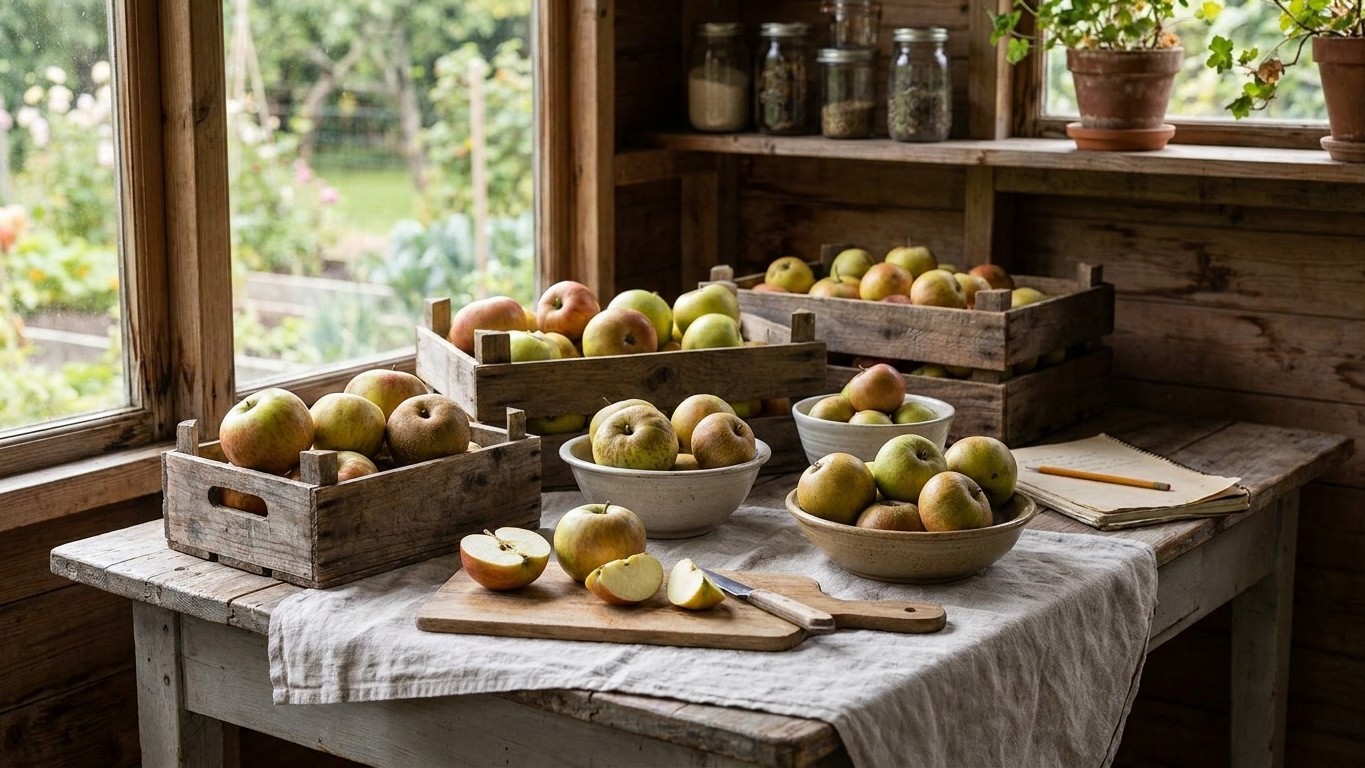

Kansas apple harvest runs from late August through mid-October, staged by variety rather than a fixed date, and how long each apple lasts afterward depends more on which one you picked than on how you store it. Early varieties bruise and soften within weeks; late-season ones, picked after the fruit hardens against the first cool nights, can hold for months in the right cold, humid space.
When apples are ready to pick in Kansas
Harvest date isn’t really a calendar question. It’s a stage question, and the stage is set by bloom, which in turn is set by frost. At the Wichita reference station, NOAA’s 1991-2020 Climate Normals put the last spring freeze (32°F) in the window of April 4 to April 18, and the first fall freeze in the window of October 23 to November 2. Everything an apple tree does in Kansas happens inside that stretch: bud break, bloom, fruit set, ripening.
Winter hardiness is a separate filter from bloom timing, and it’s worth keeping the two apart. The mean daily minimum of the coldest month at Wichita is 22.5°F, per the same NOAA dataset. That’s a mild figure by apple-tree standards. Nearly every commercially available apple variety is rated hardy well past that mark, so surviving a Kansas winter isn’t usually the problem. The problem, when there is one, is bloom timing colliding with a late frost, or fruit set struggling through a hot, dry Kansas summer after bloom has already happened safely.
Reading the stage off your own tree
Early-season varieties typically flower first and ripen first, often within four to five months of bloom. Mid-season varieties add a few more weeks on the tree. Late-season varieties, the ones bred for storage, hang on until nights turn consistently cool, sometimes into the first half of October in this region, close to that October 23 to November 2 frost window at the reference station.
The Wichita figures are airport-station numbers. Gardens in suburban low spots or rural bottomland commonly see the last spring frost arrive later and the first fall frost arrive earlier than the airport does, sometimes by a week or two, and more where elevation rises, as it does moving into western Kansas. If your county sits east toward the Ozark foothills or west onto the High Plains, treat the Wichita window as a starting point, not a guarantee, and check timing against your own site.
The practical test for picking, regardless of the calendar: skin color fills in, the background turns from green to its variety’s mature shade, and a lifted apple separates from the spur with a gentle twist instead of tearing. Taste one. If the flesh is still starchy and hard-tart, give it another week.
Which ones keep, and which must be eaten
Not every apple is built to sit in a bin until January. Storage life is mostly a function of when in the season a variety ripens and how dense its flesh is at harvest, and the two usually travel together.
Early-season apples, the kind ready in late summer, tend to have softer, more open flesh and higher moisture content. They’re picked to be eaten, baked, or turned into sauce within a couple of weeks, because their cell structure starts breaking down almost as soon as they leave the tree. Push them past their window and they go mealy or bruise from their own weight in the bag.
Late-season apples are a different animal. They ripen closer to that first fall frost window, after cool nights have slowed the tree’s metabolism and let sugars and firmness build gradually. Their flesh is denser, their skin thicker, and their respiration rate after picking is slower, which is the whole reason they last. A well-grown late-season apple, handled right, can hold for months rather than weeks.
A rough guide by ripening group
| Ripening group | Typical harvest timing relative to Kansas frost windows | Realistic storage life |
|---|---|---|
| Early-season | Well before first fall frost, often by early-to-mid September | 1 to 3 weeks |
| Mid-season | Mid-to-late September | 4 to 8 weeks |
| Late-season | Late September into the run-up to the October 23-November 2 frost window | Several months in cold, humid storage |
If you’re planting with storage in mind, the variety label matters more than anything you do afterward. No amount of careful handling turns a soft early apple into a five-month keeper. Ask before you buy, or check with a nursery that grades varieties by keeping quality rather than just by taste.
Storing them through a Kansas winter
Once apples are off the tree, the goal is slowing them down, not sealing them up. Apples keep by staying cold, staying humid, and staying away from each other’s ethylene.
The target range most keepers work toward is around 32°F to 40°F with high humidity, close to saturated air, so the fruit doesn’t shrivel. A refrigerator crisper drawer gets you into that range reliably and is the simplest option for smaller amounts. A perforated plastic bag inside the drawer helps hold humidity without trapping so much moisture that mold sets in.
Root cellars and unheated spaces
For larger harvests, an unheated basement, cellar, or insulated garage can work, but Kansas winters complicate that math. With the coldest month’s mean daily minimum sitting at 22.5°F at the Wichita reference station, an uninsulated outbuilding can swing well below freezing on cold nights, cold enough to freeze fruit solid and ruin it. A cellar dug into the ground buffers those swings because soil temperature lags the air by weeks; a garage or shed does not, and needs some form of insulation or a thermometer check on the coldest nights to avoid a frozen batch.
A few habits matter regardless of where the apples sit:
- Store only unbruised, unblemished fruit; one soft or damaged apple accelerates spoilage in everything around it.
- Keep apples away from potatoes and other ethylene-sensitive produce, since apples give off ethylene as they ripen further.
- Check the stash every couple of weeks and pull anything going soft before it spreads.
- Layer fruit rather than piling it deep, so air can move and pressure bruising stays minimal.
K-State Research and Extension (ksre.k-state.edu) is the land-grant extension service for the state and the right first call for county-specific storage or variety questions; this article draws on the frost-date and temperature figures cited above rather than on any specific storage bulletin, and where a reader needs guidance tailored to their county’s soil or microclimate, that office is where to ask.
What goes wrong here
The most common failure in this region isn’t winter cold killing the tree. It’s timing mismatches around bloom and fruit set.
In most of Kansas, winters are cold enough to satisfy the chill requirement of nearly every apple variety, so a shortage of winter chill is rarely what limits an orchard here the way it does much farther south. But in the state’s milder pockets, sheltered valleys or south-facing slopes in south-central counties, for example, a run of unusually mild winter nights can let a low-chill variety break dormancy early. That’s a poor trade in this climate specifically: earlier bloom lands closer to, or even before, the April 4 to April 18 frost window at the Wichita reference station, and a freeze hitting open blossoms can erase the whole year’s fruit set in one night. Given that the 32°F freeze dates cited here fall in a 30 to 70 percent probability band, meaning a freeze in that window is a near-coin-flip most years, the safer choice across most of Kansas is a variety with a higher chill requirement and a later bloom date, even though it demands more accumulated cold to wake up. Arriving late to bloom is the more forgiving mistake here.
The other recurring problem is Kansas summer heat stress after bloom has already succeeded. Long stretches of high heat and low rainfall through July and August can cause fruit drop, sunscald on exposed apples, and undersized fruit, independent of anything that happened at bloom. Mulching to hold soil moisture and avoiding pruning that strips shade from the fruit both help, though neither is documented here with a specific figure, so treat that as general orchard practice rather than a sourced number.
Hail is a Kansas-specific risk worth naming plainly: a single storm can scar or knock down a season’s fruit in minutes, and no variety choice protects against it. Beyond siting trees away from the most exposed, open ground, there’s no documented mitigation for it in the sources behind this page.
Common questions
Do I need to worry about winter cold killing my apple tree in Kansas?
Generally no. With the coldest month’s mean daily minimum at 22.5°F at the Wichita reference station, most apple varieties are hardy well beyond what Kansas winters typically deliver. The bigger risk to the crop is a late spring frost hitting open blossoms, not the tree itself freezing.
How do I know if my county’s frost dates differ from Wichita’s?
The April 4 to April 18 and October 23 to November 2 windows come from the Wichita airport weather station. Rural and suburban sites, especially low-lying ones or those at higher elevation toward western Kansas, commonly see later spring frosts and earlier fall frosts than that station records, sometimes by a week or two. K-State Research and Extension (ksre.k-state.edu) is the resource to check for anything county-specific.
Why did my apples ripen but then go soft within a week or two?
That’s most likely a variety issue rather than a storage mistake. Early-season varieties are built for fresh eating, not keeping, and their flesh softens fast regardless of how they’re stored. Late-season varieties are the ones bred to hold for months.
Can I store apples in an unheated garage all winter in Kansas?
Only with caution. Air temperatures in an uninsulated space can drop well below the 22.5°F mean minimum on the coldest nights, cold enough to freeze fruit outright. A dug root cellar buffers temperature swings far better than an above-ground shed or garage does.