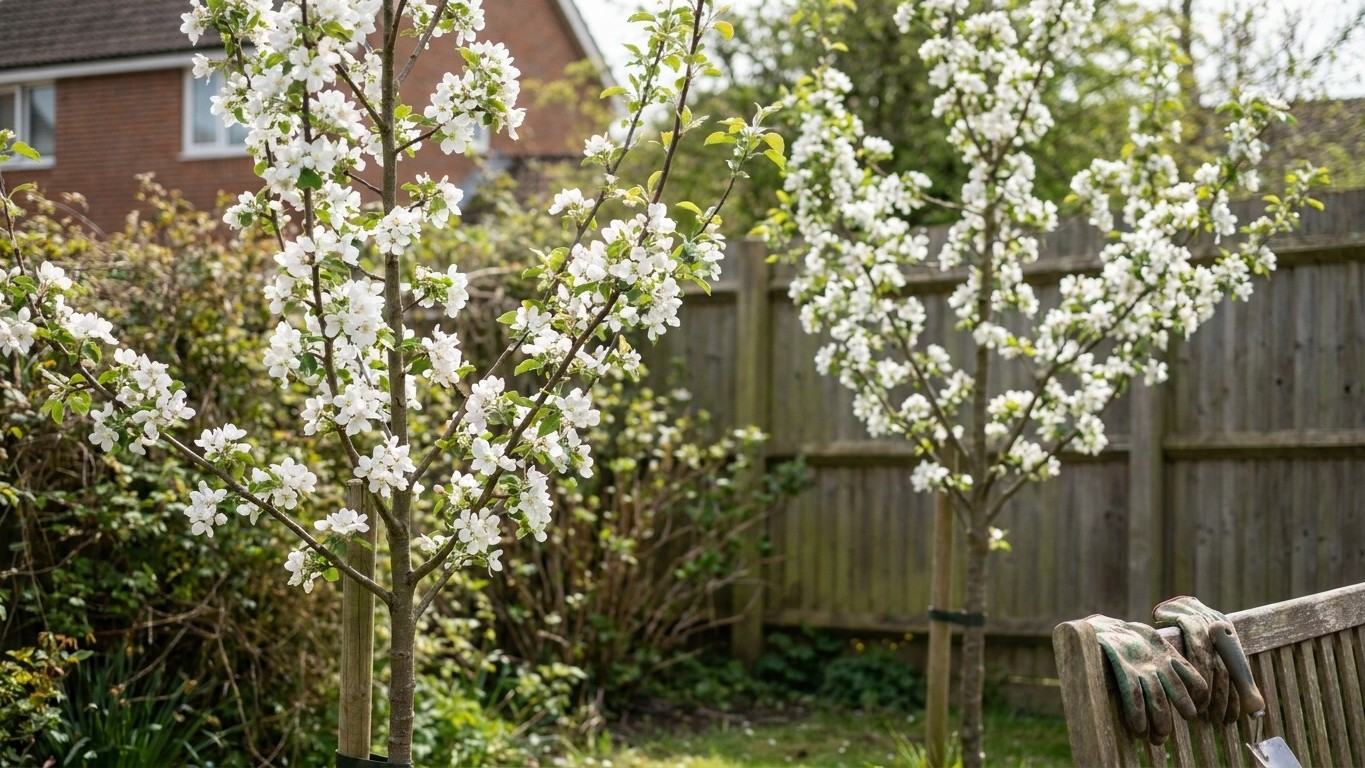

In the Louisville area, early-season apples come off the tree by late summer, mid-season varieties come down in September, and late-season keepers hang on the branch until just ahead of the first fall frost, which arrives between November 2 and November 12. How long the fruit lasts afterward depends almost entirely on which of those three groups it belongs to: days for the earliest apples, months for the last.
When apples are ready to pick in Kentucky
The calendar tells you almost nothing here. What matters is the stage the fruit is at, and that stage is set by two dates: the last spring frost and the first fall frost. At the Louisville reference station, the last spring frost typically falls between March 24 and April 4, and the first fall frost lands between November 2 and November 12, based on NOAA’s 1991-2020 climate normals. That gives a growing season of roughly seven months to work with, and every apple variety fits its harvest window somewhere inside that stretch.
Early-season varieties, the kind that ripen soft and bruise easily, are usually off the tree well before midsummer ends. Mid-season varieties need the full heat of July and August to build sugar and typically come off in September. Late-season varieties, the dense, thick-skinned types bred for storage, hang on the longest and are usually picked in October, sometimes pushing right up against that early-November frost window. Fruit still on the tree when the first hard freeze hits can suffer bruising and softened flesh that shortens its shelf life before it ever reaches a shelf.
Rather than watching the calendar, growers read the fruit itself. The background color under the blush shifts from green to a paler yellow or cream. The flesh gives slightly to a gentle squeeze instead of feeling rock-hard. A ripe apple twists free from the branch with the stem intact, rather than tearing. Cutting one open and checking the seeds is the most reliable home test: pale seeds mean wait, dark brown seeds mean the fruit is ready.
Why the frost window shifts by location
The Louisville station sits in an urban setting, and the local National Weather Service office notes that it runs later in spring and earlier in fall than the surrounding rural parts of Jefferson County. A grower on a rural property a few miles outside town should tighten that window on both ends, expecting the frost risk to close later in spring and open earlier in fall than the numbers above suggest. Elevation and cold-air drainage matter too: an orchard in a low hollow will frost before one on a ridge a half-mile away, even on the same night. For county-specific guidance and variety recommendations, University of Kentucky Cooperative Extension is the closest thing to a local source, since no statewide chill-hour dataset broken down by county is published here.
Which ones keep, and which must be eaten
Not every apple is built for the same job. The trait that decides whether a piece of fruit lasts through winter or needs eating within the week comes down to skin thickness, flesh density, and how much natural acid it holds. Early-season apples tend to be thin-skinned and softer at harvest, which is part of why they taste so good fresh off the tree and part of why they turn mealy on the counter within days.
Late-season apples are the opposite. Their skins are tougher, their flesh denser, and many were bred, in some cases over a century ago, specifically to survive months without refrigeration. Varieties like Granny Smith, Rome, Arkansas Black, and Fuji fall into this group, and they’re the ones worth setting aside for storage rather than eating out of hand the week they’re picked.
| Harvest group | Typical timing | Best use |
|---|---|---|
| Early-season | Mid to late summer | Eat fresh, cook, or process within days |
| Mid-season | September | Good for a few weeks refrigerated |
| Late-season | October, ahead of the first fall frost | Cold storage for months |
Handling makes the difference too
Mid-season varieties sit in between. They’ll hold in a refrigerator crisper drawer for several weeks without much trouble, but they aren’t the ones to bank on for a pie in January. If the goal is a stash that lasts into the cold months, the fruit needs to be picked at full maturity, handled without bruising, and sorted before storage. One bruised or nicked apple in a batch will spoil faster than the rest and, left in contact with sound fruit, can speed up their decline too.
Fresh-eating enjoyment for the earliest apples of the season is worth planning around rather than fighting. Growers who want both a July harvest for eating and an October harvest for the pantry are better off planting one tree from each category than expecting one variety to do both jobs.
Storing them through a Kentucky winter
Good apple storage comes down to three conditions: cold, humid, and dark. The ideal range sits just above freezing, cold enough to slow ripening to a crawl without freezing the fruit outright, with humidity high enough to keep the flesh from shriveling but enough airflow to prevent mold. A basement, a root cellar, or an unheated space that never fully freezes all work. A kitchen counter or a warm pantry does not; apples held at room temperature lose crispness and flavor far faster than apples held cold.
What Kentucky’s cold snaps do to unprotected fruit
This is where the region’s own winter numbers matter. At the Louisville reference station, the coldest month’s average daily low is 27.8 degrees Fahrenheit, based on NOAA’s 1991-2020 climate normals. That’s a mean, not a hard limit, which means individual nights routinely drop well below it. An unheated garage or a detached shed can freeze solid on the coldest nights of January, and apples stored there without insulation can freeze along with the building, turning soft and mealy once they thaw. A cellar or basement, where the surrounding earth buffers the swings, is a far safer bet than an outbuilding for anyone without a dedicated cold room.
Keeping the crate from turning into a loss
Wrapping apples individually in newspaper or packing them in single layers, rather than piling them into one bin, slows the spread of rot from any single fruit that starts to go. Checking stored apples every couple of weeks and pulling any that have softened or developed soft brown spots keeps one bad apple from taking down a whole crate, which is where that old saying actually comes from. Apples also pick up odors from things stored nearby, so keeping them away from onions or potatoes preserves their flavor.
Late-season varieties handled this way can realistically stretch from an October harvest well into the winter months, sometimes past the new year, provided the storage space stays consistently cold rather than swinging between freezing and mild on a warm afternoon. That inconsistency, more than any single low temperature, is usually what shortens storage life in home setups.
What goes wrong here
The most common failure isn’t disease. It’s timing at the wrong end of the season: a late frost hitting open blossoms in spring. Since the last spring frost at the Louisville station typically runs from March 24 to April 4, any bloom that opens before that window closes is exposed to freeze damage that can wipe out a season’s fruit before it ever sets.
The trade-off with mild winters
This is where the trade-off with mild winters becomes real. Low-chill apple varieties break dormancy and flower earlier because they need less accumulated cold to do so, which sounds like an advantage in a region without brutally severe winters. But earlier flowering means blooming closer to, or even inside, that late-March-to-early-April frost window. In Kentucky, given how late that spring frost risk extends, the safer choice is a variety with a longer chill requirement that flowers later, after the frost risk has mostly cleared, rather than a low-chill variety chasing an earlier start.
Disease pressure and harvest mistakes
Humid summers bring their own pressure. Fungal diseases and fire blight both find favorable conditions in warm, damp weather, and growers here should expect them as a recurring management task rather than an occasional nuisance. No specific incidence data for Kentucky orchards is published here, so it’s better to treat pest and disease pressure as a standing seasonal risk to plan for rather than a one-time event.
On the harvest end, the two most common mistakes are picking too early, which locks in low sugar and poor flavor that never improves off the tree, and picking too late, which leaves fruit vulnerable to that first fall frost between November 2 and November 12. Either mistake shortens storage life before the apple even reaches the cellar. Bruised fruit from careless picking is the other quiet culprit: a dropped or twisted apple looks fine on the outside but breaks down from the inside within days, taking neighboring apples with it in storage.
Common questions
What month do apples ripen in Kentucky?
It depends on the variety rather than a fixed month. Early-season apples are typically ready by mid to late summer, mid-season varieties in September, and late-season keepers in October, close to the first fall frost window of November 2 to November 12 at the Louisville reference station.
Can you grow apples in every part of Kentucky?
Standard apple varieties are hardy well beyond what Kentucky winters require; the coldest month’s average low of 27.8 degrees Fahrenheit at Louisville is well within their tolerance. The bigger variable across the state is the timing of the last spring frost, which shifts with elevation and local terrain, so growers should check conditions on their specific site rather than assume the whole state behaves the same way.
How long do stored apples last over a Kentucky winter?
Late-season, thick-skinned varieties stored cold, humid, and dark can last several months, sometimes into the new year. Early and mid-season varieties are better used within days to a few weeks, since they weren’t bred for long storage.
What’s the biggest threat to a home apple crop in Kentucky?
A late spring frost hitting open blossoms is the most damaging single event, since it can happen anytime up to early April at the Louisville station. Humid-weather fungal disease and fire blight are the recurring, lower-grade threats that need ongoing attention through the growing season.