
Azalea lace bugs show up in Kentucky as soon as azaleas push new leaves each spring, usually by mid-to-late April, and stay active clear through September with several overlapping generations. The University of Kentucky Extension Entomology doesn’t publish a dedicated calendar entry for this species, so the working window comes from the same late-March-through-September season the extension uses for landscape pests generally.
The weeks to watch

The short answer: watch new azalea growth from late March through September, with feeding pressure building steadily as the season warms. University of Kentucky Extension Entomology does not name azalea lace bug specifically in its EF447 shade tree and woody ornamental pest calendar. That document tracks Eastern tent caterpillar, bagworm, fall webworm, Japanese beetle, and several vegetable-garden pests with named windows, but azalea lace bug isn’t one of them. The overall season those entries fall within, late March through September, is the reasonable frame to use here as well, since it reflects when Kentucky’s woody landscape plants are actively growing and vulnerable to sucking insects in general.
First activity in spring
Lace bugs overwinter as eggs tucked into the tissue on the underside of azalea leaves. Nymphs hatch as soon as new leaves expand in spring, which lines up with the front end of that late-March window. This is the stage most gardeners never see coming, because the damage on old leaves from the prior year is often already visible before anyone notices new nymphs feeding.
Later generations through summer
Lace bugs are known to produce multiple generations in a single growing season wherever azaleas hold leaves long enough to support repeated feeding cycles. Without a Kentucky-specific count from the extension service, the safest statement is that populations build through summer and remain active into September, meaning a plant that looks fine in May can look ragged by August without a single new control step taken in between.
Reading the calendar from your last frost

The one date most Kentucky gardeners already track is the last spring frost, which the National Weather Service climate data puts at March 24 to April 4 across the state’s central climate stations. That date matters here not because the insect itself cares about frost, but because it marks roughly when azaleas break dormancy and start producing the new leaves lace bugs need to feed on.
- Start with the local last-frost window: March 24 to April 4.
- Add the few weeks it typically takes for azalea foliage to flush out and expand, which pushes the first visible feeding into a window running from mid-to-late April into early May.
That NOAA range is built from an urban weather station, and the National Weather Service in Louisville has noted that surrounding rural Jefferson County tends to run later in spring and earlier in fall than the city station shows. A rural garden should treat this window as tighter than the printed dates suggest, not wider. This isn’t a date to circle on a calendar so much as a normal to plan around, since a cold, slow spring pushes everything back by however long the chill lasts.
What it attacks, and what the damage looks like

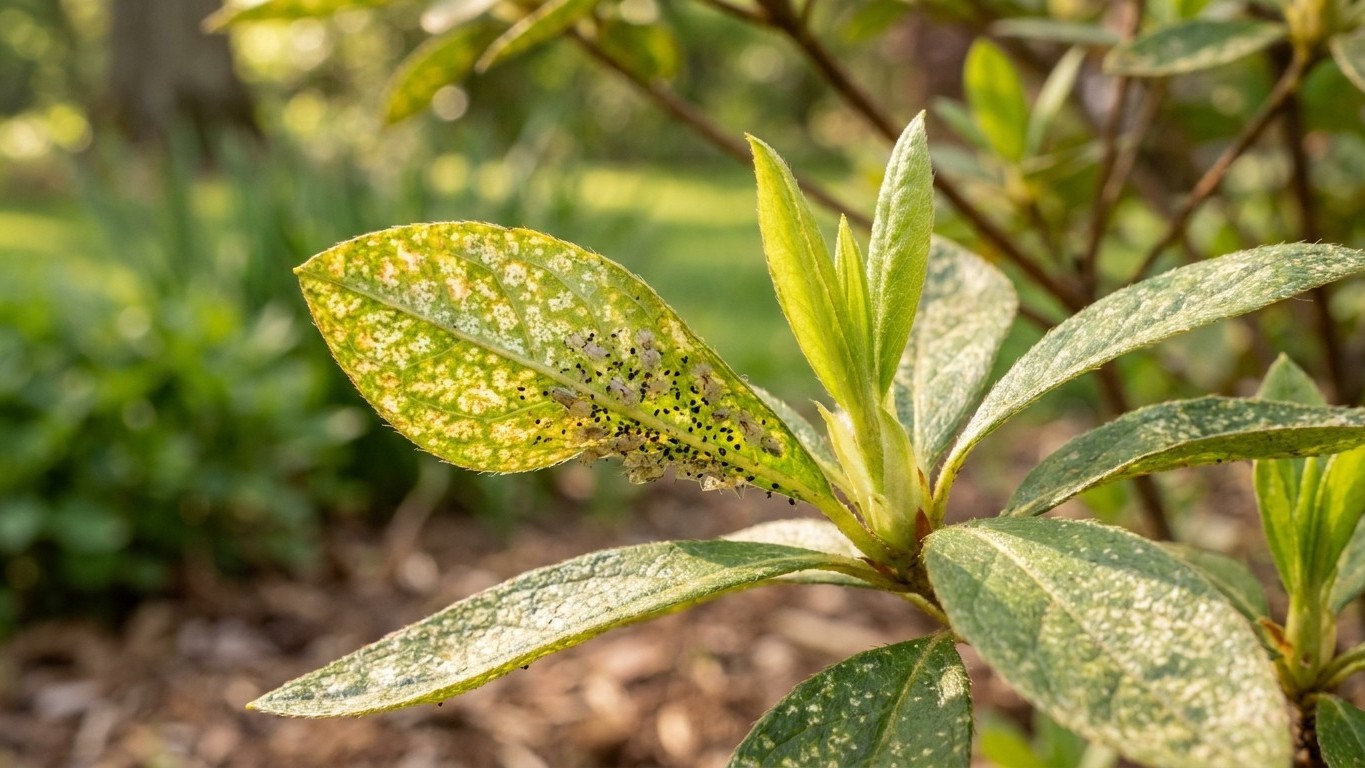
Most gardeners spot the damage long before they spot the insect. Leaves develop a stippled, bleached, almost dusty-looking pattern on the top surface, as if someone had lightly sandpapered the green out of them. Flip the leaf over and the underside often shows small dark, varnish-like specks, which is excrement left behind by feeding insects, sometimes alongside the pale, spiny nymphs or the lace-winged adults themselves. Heavily hit leaves can look silvery or almost bronze from a distance well before individual stippling is visible up close.
Both nymphs and adults do the damage, using piercing-sucking mouthparts to draw chlorophyll out of leaf tissue from the underside. Nymphs tend to matter most simply because there are more of them at any given time, and because they’re concentrated in the same generation-driven waves described above. This matters for treatment timing: once feeding has already bleached a leaf, that damage is permanent on that leaf, and control at that point is about protecting new growth rather than reversing what’s already there.
Plants at risk in Kentucky landscapes include:
- Evergreen azaleas, which tend to take the worst damage, especially in sunny locations
- Deciduous azalea varieties, generally less affected
- Rhododendron
- Mountain laurel and other closely related broadleaf evergreens in the same plant family
How Kentucky sits in this pest’s range

This site currently documents azalea lace bug in one territory, Kentucky, so there’s no cross-state comparison available yet within this content network to say whether pressure here runs heavier or lighter than in neighboring states. That’s a gap in this site’s coverage, not a claim about the insect’s actual range, which biologically extends across most of the eastern and southern United States wherever azaleas are grown in the ground.
What can be said plainly is that University of Kentucky Extension Entomology doesn’t break this pest out with its own named window the way it does for tent caterpillar or bagworm, which suggests it’s treated as a routine, widespread landscape nuisance rather than a pest requiring county-by-county tracking. For a home gardener, that translates into a practical takeaway: the exact week feeding starts will shift a little from one Kentucky county to the next depending on how early azaleas leaf out locally, but the presence of the pest itself isn’t in question anywhere azaleas are planted in the state.
What actually works against it

- Plant azaleas in part shade rather than full sun. Lace bug populations are consistently worse on plants growing in hot, sunny spots, so siting is the cheapest and most durable form of prevention available before a plant ever goes in the ground.
- Choose resistant varieties where replacing plants is an option. Some azalea types tolerate lace bug feeding better than others, and gardeners dealing with repeat infestations often have better luck swapping a chronically damaged evergreen azalea for a less-susceptible deciduous type.
- Check leaf undersides starting in spring, and hose off nymphs with a strong water spray. This works while nymphs are small and clustered on new leaves; a forceful spray dislodges them before they mature enough to disperse and lay the next generation’s eggs.
- Prune out and dispose of heavily stippled leaves. This removes both current feeding sites and, later in the season, some of the eggs inserted into that leaf tissue for overwintering.
- Clean up fallen azalea leaves in autumn. Eggs overwinter inside leaf tissue, so leaf litter left under the shrub through winter carries next spring’s population forward.
- Avoid routine broad-spectrum insecticide use on azaleas. Lace bugs have natural predators, including lacewings and predatory mites, and treatments that wipe those out tend to make repeat infestations worse rather than better over successive seasons.
None of these steps do much once nymphs have already matured into adults and moved on to new foliage; at that point the damage on affected leaves is locked in, and the practical goal shifts to protecting the next flush of growth rather than undoing what’s already stippled.
Common questions
Does azalea lace bug kill the plant? Established azaleas usually survive infestations, even repeated ones, but chronic feeding weakens the plant over several seasons, reduces flowering, and makes it more vulnerable to other stresses like drought.
Can azalea lace bug spread to other shrubs in the yard? It feeds mainly on plants in the same family, so rhododendron and mountain laurel nearby are at higher risk than unrelated shrubs, though it doesn’t typically move onto plants outside that group.
Is the damage on old leaves a sign of a current infestation? Not necessarily. Stippling on last year’s leaves can be leftover damage from a previous season; the leaf underside, checked for live nymphs or fresh dark specks, is a better indicator of whether feeding is happening right now.