
Japanese beetles start showing up across Kentucky in late May, with populations exploding into full-blown lawn and garden problems by mid-June. The window when they’re actively feeding runs roughly six to eight weeks, tapering off by early August in most of the state. Knowing that timeline matters more than any single treatment, because the products and tactics that work change depending on whether you’re dealing with grubs underground or adults chewing through your rose bushes.
Kentucky sits squarely in the beetle’s established range, and it’s not going anywhere. The insect has been a fixture in the Ohio Valley and Bluegrass region since spreading south from its original East Coast foothold decades ago. What varies year to year isn’t whether they’ll show up, but how bad the damage gets, and that depends heavily on rainfall patterns from the previous summer and how mild the winter was.
The Japanese Beetle Timeline in Kentucky

Grubs overwinter several inches deep in the soil, below the frost line, and start moving upward as ground temperatures climb past the mid-50s. In central Kentucky, that usually happens in April. By late May, mature grubs pupate, and adults emerge over a two-to-three week stretch that pushes into early June.
Western Kentucky, around Paducah and the Purchase region, tends to warm up faster in spring. Beetle emergence there can start a week or two ahead of Lexington or Louisville. Eastern Kentucky’s mountain counties run cooler and see delayed emergence, sometimes not hitting peak activity until the Fourth of July. That regional lag is worth remembering if you’re timing a preventive treatment based on a neighbor’s report from a different part of the state.
Peak adult activity, the stretch when you’ll see the most beetles clustered on plants, generally falls between mid-June and mid-July statewide. Females lay eggs in turf throughout this period, favoring moist, sunny lawns over shaded or dry ground. Each female can lay 40 to 60 eggs over her lifespan, which is why one bad season with wet July weather often sets up a worse grub problem the following spring.
Adult feeding declines through August as the beetles die off naturally. By September, what’s left in your yard is next year’s grub population, quietly feeding on grass roots and building toward another emergence cycle.
What Japanese Beetle Damage Actually Looks Like
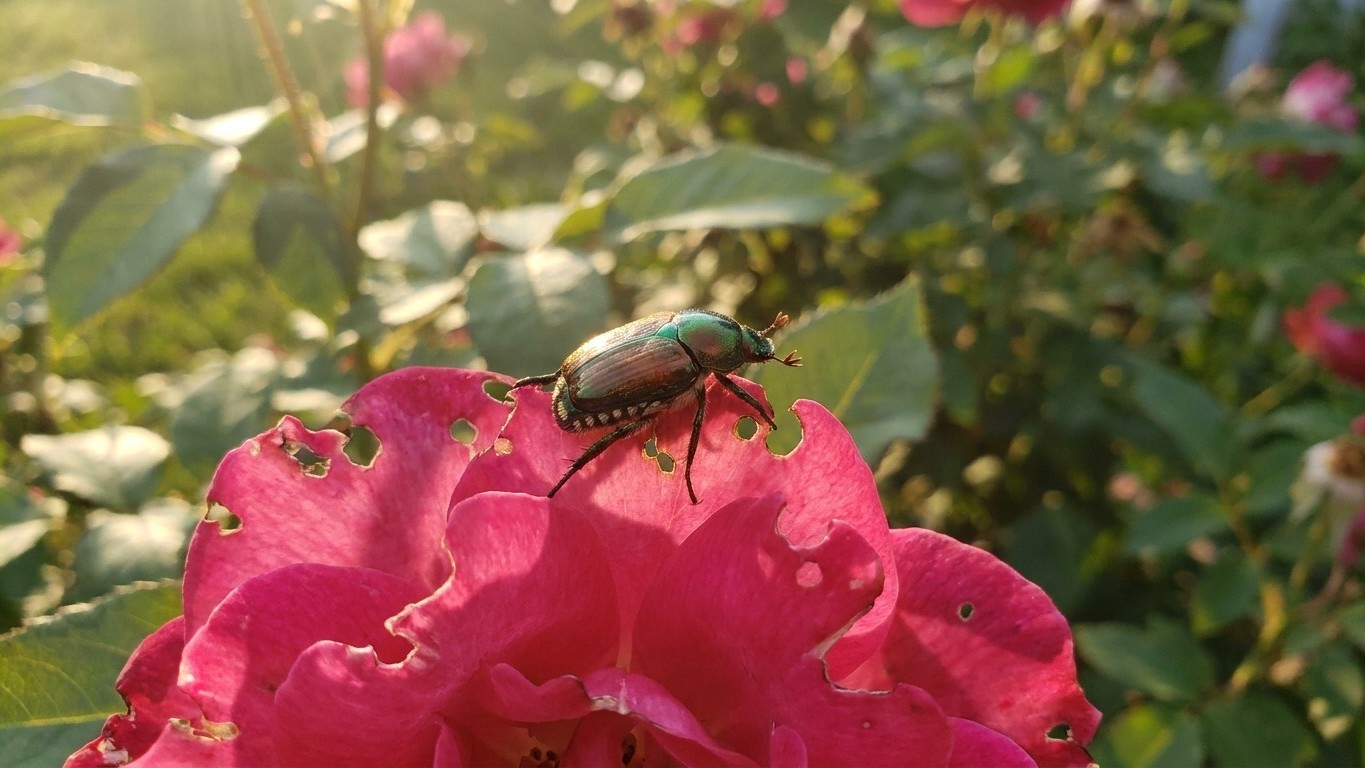
The adult beetle is easy to identify once you’ve seen one: about three-eighths of an inch long, metallic green head and thorax, copper-colored wing covers, with small tufts of white hair along the sides of the abdomen. They’re not subtle. Neither is the damage.
Adults feed in groups, which means you rarely find one beetle on a leaf, you find a dozen. They skeletonize foliage, eating the tissue between veins and leaving a lace-like pattern behind. Roses are a favorite target across Kentucky gardens, along with linden trees, grapevines, raspberries, crape myrtles, and Virginia creeper. A heavily infested rose bush can lose most of its leaves within two weeks if left unchecked.
Below ground, the grub stage causes a different kind of damage that homeowners often misdiagnose. Grubs feed on grass roots from late summer through fall, and again briefly in spring before pupating. Lawns with a heavy grub infestation develop irregular brown patches that peel back like a loose carpet when tugged, because the root system has been eaten away. This kind of turf damage typically shows up in September and October, well after the adult beetles are gone, which is why so many people blame drought or disease instead of the actual culprit.
Plants Japanese Beetles Tend to Avoid
Not every plant in a Kentucky yard is on the menu. Beetles generally leave boxwood, holly, magnolia, dogwood, red maple, and most conifers alone. Gardeners dealing with recurring damage sometimes shift ornamental plantings toward these less-favored species rather than fighting the beetles every summer on the same vulnerable shrubs.
What Actually Stops Japanese Beetles
Pheromone traps are the first thing a lot of people buy, and they’re also one of the least effective tools available. Research from multiple land-grant universities has consistently found that these traps attract more beetles to a property than they actually capture, often making nearby plant damage worse rather than better. If you’re going to use one, place it far from anything you want to protect, not next to your rose bed.
Hand removal works surprisingly well on a small scale. Beetles are sluggish in early morning, and knocking them into a bucket of soapy water before 9 a.m. can meaningfully reduce numbers on a handful of prized plants. It’s tedious, but it’s free and it doesn’t harm pollinators.
For chemical control on adults, products containing pyrethrin or carbaryl provide fast knockdown but need reapplication every few days during peak activity, since new beetles keep flying in from neighboring properties. Neem oil and insecticidal soap offer a gentler option with less residual killing power, better suited to light infestations or gardeners trying to protect bees and other beneficial insects.
Grub control is where timing separates success from wasted money. Systemic insecticides like those containing imidacloprid work best when applied in July, before eggs hatch and while young grubs are still small and vulnerable near the soil surface. Apply the same product in September, after grubs have matured, and you’ll get noticeably weaker results. Products with chlorantraniliprole have a wider application window and remain effective even against older grubs, which makes them a better fit for anyone who missed the July deadline.
Milky spore bacteria (Bacillus popilliae) gets mentioned often as a natural alternative, but it’s worth setting expectations correctly. It can take two to four years to build an effective spore concentration in soil, and results in Kentucky’s heavy clay soils have historically been inconsistent compared to the sandier soils where the product was originally studied. It’s a long-term investment, not a quick fix.
Beneficial nematodes, applied to moist soil in late summer, offer another biological option for grub suppression. They need consistent soil moisture to survive and move through the soil profile, so a dry August can undercut their effectiveness even when applied correctly.
Long-Term Prevention for Kentucky Yards
Lawn watering habits play a bigger role in Japanese beetle populations than most homeowners realize. Female beetles seek out moist soil for egg-laying, which means heavily irrigated lawns during July often become beetle nurseries. Allowing turf to go slightly drier during peak egg-laying weeks, without stressing it into dormancy, can reduce the number of eggs that survive to hatch.
Healthy, deep-rooted turf also tolerates grub feeding better than a stressed lawn. Grass mowed at three inches or higher, on a regular fertilization schedule appropriate for Kentucky’s tall fescue and bluegrass mixes, can withstand moderate grub populations without showing visible dieback. This matters because a certain number of grubs per square foot is considered a normal, tolerable background population rather than a treatment threshold. Extension entomologists generally recommend treating only when digging up a one-square-foot section of turf reveals eight to ten or more grubs, not simply reacting to a few discovered while planting bulbs.
Rotating insecticide classes from year to year helps slow resistance buildup, a growing concern with some of the older pyrethroid products used against adult beetles. It’s the same logic that applies to antibiotic resistance: relying on one chemical tool repeatedly gives the survivors an evolutionary advantage.
Fall is the underrated season for beetle management in Kentucky. Because grubs are actively feeding and near the soil surface in September and October, this is often the most cost-effective window for a targeted lawn treatment, catching the population before it burrows deeper for winter. Skip this window, and you’re stuck waiting for the July preventive application the following summer, giving the population an extra six months to establish itself.
One detail that surprises a lot of homeowners: a mild, wet winter followed by a warm spring almost always predicts a rougher beetle season in Kentucky. Grub survival rates climb when frost doesn’t penetrate deep enough to kill overwintering larvae, which is exactly the kind of winter the state has seen more often over the past decade.