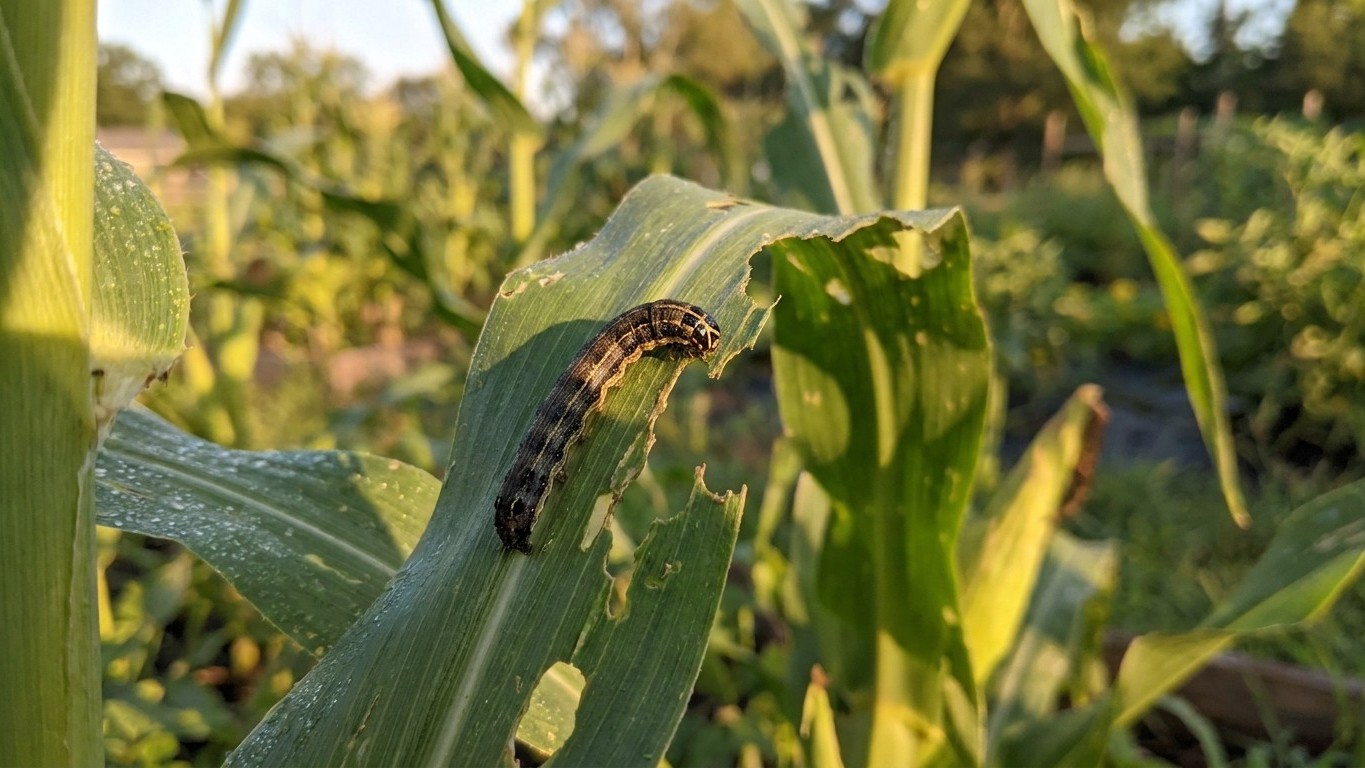

Louisiana’s growing season runs nearly all year, and that includes the pests. Fall armyworm doesn’t get its own published window from LSU AgCenter, but the state’s mild winters and long warm stretches keep caterpillar pressure possible for months at a stretch. Here’s what the local data says about timing, what the damage looks like in a garden bed, and which low-tech defenses hold up once the worms are already feeding in the whorl.
When Fall armyworm turns up in Louisiana

LSU AgCenter’s vegetable and ornamental insect guides, Publication 1838-E and Publication 2341, don’t name a specific seasonal window for fall armyworm the way they do for some other pests.
What LSU does say is broader: Louisiana’s growing seasons run long enough that home gardening happens almost year-round, and the same warmth that lets a gardener plant in nearly every month also lets insect populations reproduce and build numbers continuously. There’s no hard reset the way a northern freeze delivers each winter.
The publications do give windows for pests LSU tracks closely. Pickleworm and squash vine borer run heavier late in the season. Leaf-footed bugs hit tomatoes and peppers hardest in late summer and early fall. Fall armyworm isn’t named alongside them, but it shares the same general biology: a warm-season caterpillar that follows heat and host-plant availability rather than a fixed calendar date.
Practically, a Louisiana gardener should treat fall armyworm as a running risk that peaks whenever conditions line up, meaning warm soil, tender new growth, and moths flying in from wherever they overwintered. Watching for worn-out lower leaves is the safer bet, since the record LSU keeps for other pests doesn’t extend to this one. If corn, sorghum, or turfgrass shows feeding damage during a stretch of warm weather in late summer, that’s the moment to check the whorls, not a date circled on the calendar.
Reading the calendar from your last frost
Louisiana gardeners plan around one number more than any other: the last spring frost. NOAA’s 1991-2020 Climate Normals put that date at January 18 to February 8 for the station used here, a wide window and a telling one. A 32-degree freeze only shows up in 86.8 percent of years at that station, meaning roughly one winter in seven skips a freeze entirely. Treat that range as a normal, not a promise, and remember it describes conditions closer to south Louisiana; north Louisiana freezes more often and more reliably.
Fall armyworm doesn’t read a frost date at all. It answers to soil warmth and to whatever host plants are already up and growing. An early spring pushes activity earlier; a cool, dragged-out one delays it. That’s a real difference from a pest with a fixed hatch date, and it’s the reason a fixed treatment calendar doesn’t hold up well here.
For row covers, that means the cover needs to go on as soon as seedlings are set out, while the soil is still cool enough to slow larvae down, and it needs to come off before flowering crops need pollinators, since a cover that stays on too long blocks bees along with the worms. First damage tends to show up early, while transplants are still tender and low to the ground, which is exactly when a physical barrier does the most good. Once the plant has hardened off and set its own defenses, the same cover matters less.
What it attacks, and what the damage looks like
Fall armyworm feeds on corn first, especially sweet corn, and also takes sorghum, hay grasses, and lawns planted in bermudagrass or ryegrass. In a home garden, sweet corn is usually where it shows up first, followed by turf edges bordering a vegetable bed.
The damage announces itself before the worm does. Young leaves show small, ragged holes that follow the leaf’s fold pattern, sometimes called “windowpane” feeding because light passes through the thin membrane left behind. As the larvae grow, the holes turn into torn, chewed margins, and a pile of sawdust-like frass collects down in the whorl, the tightly rolled cluster of new leaves at the center of a corn plant. On turf, the symptom looks different: patches of grass thin out and brown almost overnight, as if drought had hit one section and skipped the rest.
| Crop or planting | What shows first |
|---|---|
| Sweet corn | Windowpane holes on new leaves, frass in the whorl |
| Sorghum and hay grasses | Ragged leaf edges, thinning stands |
| Lawn turf (bermudagrass, ryegrass) | Fast-browning patches that look like drought stress |
The caterpillar, not the moth or the egg, does every bit of the damage. Eggs hatch into tiny larvae that feed lightly at first, then move through several growth stages, feeding harder and hiding deeper in the whorl as they get bigger. That matters for timing a response: a small larva feeding on the leaf surface is exposed and easy to catch, but a larger one has usually worked down into the whorl or the stalk, where it’s protected from anything applied to the leaf surface. By the time frass is piled up and visible, the worm doing the damage is already past the easiest stage to stop.
How Louisiana sits in this pest’s range

On this site, fall armyworm is documented in two territories so far. That’s a narrow count, and it puts Louisiana near an edge of what’s currently covered rather than in the middle of a long, well-mapped range. A wide count across many territories would mean the real story is timing, the same pest showing up everywhere but at different points in the year. A count this small means less can be said with confidence about how the pattern shifts from one territory to the next.
LSU AgCenter is the local source behind everything specific to Louisiana here, and its guides don’t rank the state’s fall armyworm pressure against any other territory, high or low. There’s no published comparison to lean on, so any claim about Louisiana being worse or milder than a neighboring state would be guessing dressed up as fact.
What can be said honestly: Louisiana’s climate, with long warm seasons and only a partial, unreliable freeze even in an average year, fits the general profile of places where a warm-season caterpillar like this one can stay active for a long stretch rather than getting knocked back hard each winter. That’s a description of conditions, not a severity ranking. As more territories get added to this site’s coverage, the picture of how Louisiana compares should get clearer. For now, the local guide names the pest and the general conditions, and stops there.
What actually works against it
Cheapest defense first, then the rest of the options in rising order of effort.
- Timing: getting corn and other host crops in early, so plants are past the tender seedling stage before warm, humid stretches peak, means fewer soft new leaves for small larvae to feed on when moth flights are heaviest. This doesn’t eliminate risk, it just narrows the window when a planting is most vulnerable.
- Row covers: they work by physical exclusion, stopping the adult moth from laying eggs on the leaf surface in the first place, but that only works before eggs are laid. Once a cover goes on over a plant that already has eggs or young larvae on it, the cover traps the problem inside rather than keeping it out. Covers also have to come off before flowering on crops that need pollinators, since blocking moths blocks bees too.
- Hand-picking: it works while larvae are small and feeding on the exposed leaf surface, where they’re visible and slow enough to catch. Once larvae have moved down into the whorl of a corn plant, or bored into a stalk, hand-picking stops being useful, since there’s nothing left to pick off the surface, and the worm is physically out of reach of anything applied to the leaf.
- Crop rotation and debris clearing: these work on the next generation rather than the current one. Fall armyworm larvae pupate in the soil, and clearing plant debris and tilling lightly after harvest disturbs that pupation site, cutting down on how many moths emerge nearby to start the next round. Rotating away from corn, sorghum, or grass-family crops in the same bed removes the host plant the next generation would otherwise feed on immediately.
Neither rotation nor debris clearing does anything for larvae already feeding on a plant right now; they’re a bet placed on the next planting, not a fix for the one showing damage today. Checking the whorl of young corn regularly, before frass and torn leaves pile up, remains the simplest way to catch a small, still-treatable population before it moves out of reach.
Common questions
Does fall armyworm survive winter in Louisiana?
LSU AgCenter’s published guides don’t address that directly for this pest. What is documented is that a 32-degree freeze shows up in only 86.8 percent of years at the NOAA station used for Louisiana’s normals, meaning roughly one winter in seven sees no freeze at all in south Louisiana. North Louisiana freezes more reliably. That’s a description of local winter conditions, not a claim about where the insect actually survives from year to year.
What’s the fastest way to tell fall armyworm from other corn pests?
Look at the whorl before anything else. Sawdust-like frass packed down in the tightly rolled center leaves of a young corn plant, paired with ragged windowpane holes on the surrounding leaves, points to fall armyworm feeding rather than surface chewing from a beetle or a light aphid infestation.
Do row covers protect corn all season?
No. They only work before moths lay eggs on the leaves, and they have to come off once corn starts tasseling, since covering the plant at that point blocks the pollinators the crop needs. A cover left on too long, or put on after eggs are already present, stops doing its job either way.