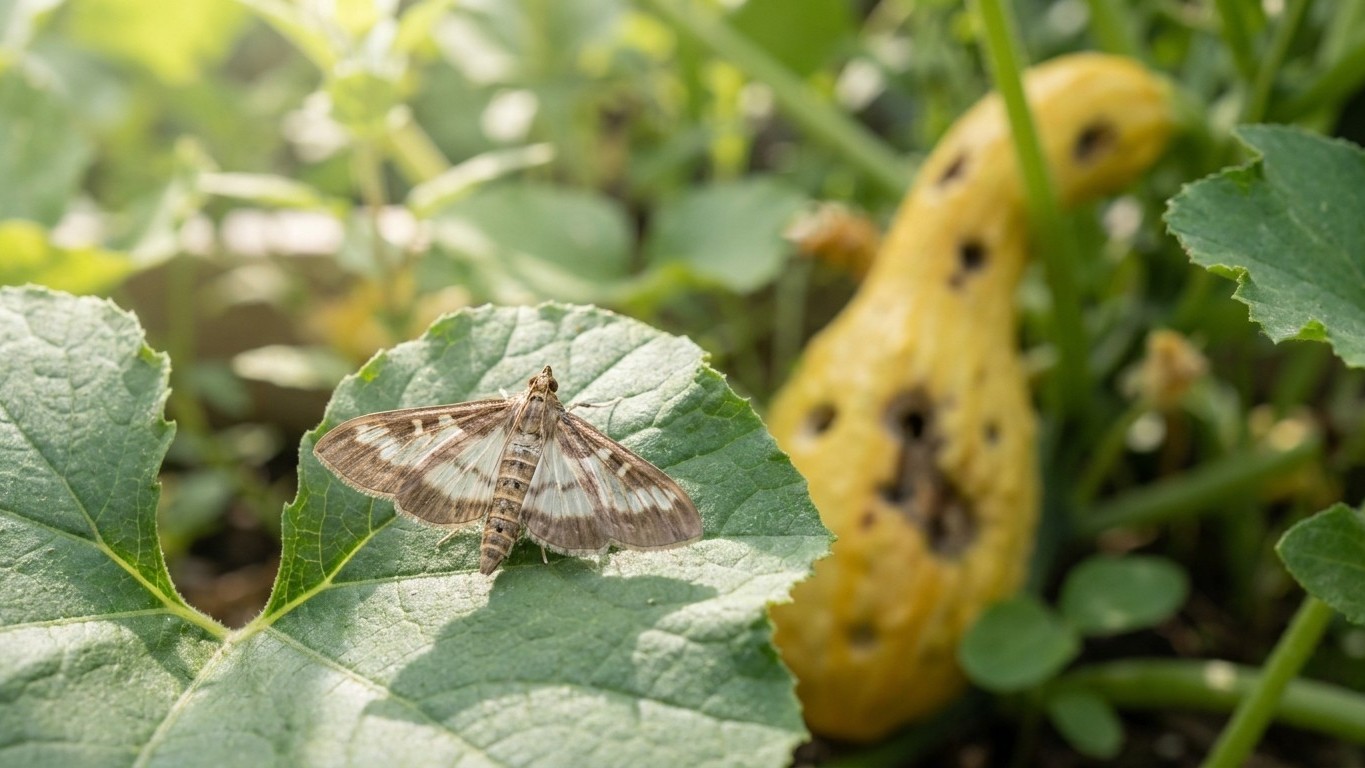

Pickleworm shows up in Louisiana every year without ever spending a winter here. The moth migrates in from warmer overwintering grounds, arrives by early to mid-summer, and does most of its damage between August and the first frost. Stopping it comes down to three things done well: timing your planting so fruit matures before the population peaks, scouting blossoms before larvae bore into fruit, and hitting the worms with Bt or an appropriately timed insecticide while they’re still exposed instead of tunneled inside a squash.
Why Louisiana Gets Pickleworm Every Summer Without It Overwintering Here

The pickleworm moth, Diaphania nitidalis, can’t survive a hard freeze. Its permanent range is limited to south Florida, the Rio Grande Valley of Texas, and parts of the Caribbean, where temperatures never drop low enough to kill overwintering pupae. Louisiana isn’t part of that year-round zone, which is why gardeners here don’t deal with pickleworm in April or early May.
What happens instead is a slow migration. As spring warms up, adult moths ride prevailing winds and expanding populations northward out of those southern refuges. By the time they reach Louisiana, they’ve already gone through at least one generation somewhere else. This is the same pattern seen with several other subtropical moths that recolonize the Gulf South annually rather than surviving winter in place.
Because the moths have to travel and rebuild numbers each year, pickleworm pressure in Louisiana starts light and builds steadily. A field that looks clean in June can be swarming with larvae by September, simply because three or four generations have had time to stack on top of each other in the warm months.
The Pickleworm Calendar: When Louisiana Growers See Damage
In warm weather, a pickleworm can go from egg to adult moth in roughly a month. That short generation time means Louisiana’s long growing season allows for three to four overlapping generations before cold weather shuts things down. Southern parishes closer to the Gulf tend to see moths arrive a little earlier than the northern part of the state, simply because they’re closer to the migration source.
Spring-planted squash and cucumbers, harvested in June and early July, usually escape with minimal damage. The moths haven’t built up numbers yet. The real trouble hits the fall crop: cucurbits planted in July for a September or October harvest run headfirst into peak pickleworm populations. This is the single most useful fact for home gardeners and small-scale growers in Louisiana: if you’re going to lose a crop to pickleworm, it’s almost always the late-summer planting, not the spring one.
Damage typically climbs through August, peaks in September, and tapers off only when nighttime temperatures start dropping into the 40s, which finally slows larval development and kills off the remaining adult moths.
What Gets Damaged and How to Recognize It
Pickleworm doesn’t attack every cucurbit equally. Summer squash, especially yellow crookneck and other soft-skinned types, gets hit hardest. Cantaloupe and other muskmelons come next. Cucumbers see moderate damage. Watermelon is rarely touched, and butternut squash and some hard-shelled pumpkins tend to escape serious injury because of their thicker rind and different fruit chemistry.
The early feeding stage is easy to miss. Newly hatched larvae feed first on blossoms and young terminal growth, leaving damage that looks minor and is often mistaken for routine flower drop. The real problem starts once larvae mature and bore into the fruit itself, usually entering near the stem end or through a spot where two fruits touch. Once inside, they feed protected from most contact insecticides, leaving behind a telltale plug of greenish-brown frass at the entry hole. Secondary rot organisms move in through that wound, and by the time it’s visible, the fruit is already unmarketable.
Because the damage is hidden until it’s too late to fix, catching pickleworm at the blossom stage matters more than trying to treat fruit that’s already been bored into.
What Actually Stops Pickleworm in Louisiana
Timing Beats Everything
The single most effective control most Louisiana growers can use costs nothing: plant early. A spring crop set out in March or April and harvested by late June or early July largely dodges the pickleworm buildup that hits in August and September. If a second planting is unavoidable, pushing it as early into summer as soil temperature allows, rather than waiting until late July, shortens the window of exposure to peak moth populations.
Growers who insist on a fall crop can shift some risk by favoring less-preferred hosts. Butternut squash, hard pumpkins, and watermelon tolerate late planting far better than yellow squash or cantaloupe simply because moths lay fewer eggs on them and the fruit rind resists larval entry.
Scouting and Sanitation
Checking blossoms every few days during July and August catches larvae while they’re still small and exposed, before they move into fruit. Any blossom or growing tip showing small holes, webbing, or frass should be removed and destroyed rather than left on the plant or dropped nearby, since larvae can survive and complete development even after the flower falls.
Sanitation between plantings matters more than most gardeners realize. Pickleworm larvae and pupae can survive in crop debris, in volunteer cucurbit vines, and in wild relatives like wild balsam apple that grow along fence lines and ditches throughout Louisiana. Disking under old squash and cucumber vines promptly after harvest, and clearing wild cucurbit vines near the garden, removes a bridge population that would otherwise feed the next generation of moths.
Some growers plant a small border of a highly attractive variety, like yellow squash, around the edge of a less-preferred main crop. Moths concentrate their egg-laying on the border rows, which are then scouted and treated more aggressively, effectively pulling pressure off the main planting.
Biological and Chemical Control That Works
Once larvae have tunneled into fruit, almost nothing reaches them. That’s why every effective treatment targets the exposed stage, meaning eggs and small larvae still feeding on blossoms and terminal growth.
Bacillus thuringiensis (Bt), applied directly to blossoms and growing points, works well against young larvae and has the advantage of leaving pollinators unharmed, which matters because cucurbits depend on bee visits to set fruit. Spinosad-based insecticides are another option labeled for pickleworm on cucurbits and tend to give somewhat longer residual control than Bt in hot, humid conditions.
Timing the spray matters as much as the product. Pickleworm moths are most active at dusk and through the night, and that’s also when females lay eggs on blossoms. Applying treatments in late afternoon or early evening puts the material in place before that activity window while minimizing contact with bees, which are most active earlier in the day. During peak flight in August and September, growers monitoring blossom damage closely often need to repeat applications every four to seven days rather than relying on a single spray to carry through the season.
Floating row covers can exclude adult moths from young plants, but they have to come off once flowering starts so bees can reach the blossoms, which limits their usefulness to the pre-bloom stage only. Once flowers open, row covers stop being practical and scouting takes over as the main line of defense.
Louisiana’s pickleworm problem is really a math problem: the moths need time and warmth to build numbers, and every week a crop sits in the ground during August and September is another chance for that population to catch up to it. Growers who get squash and melons harvested before the calendar turns to late summer sidestep most of the fight before it even starts.