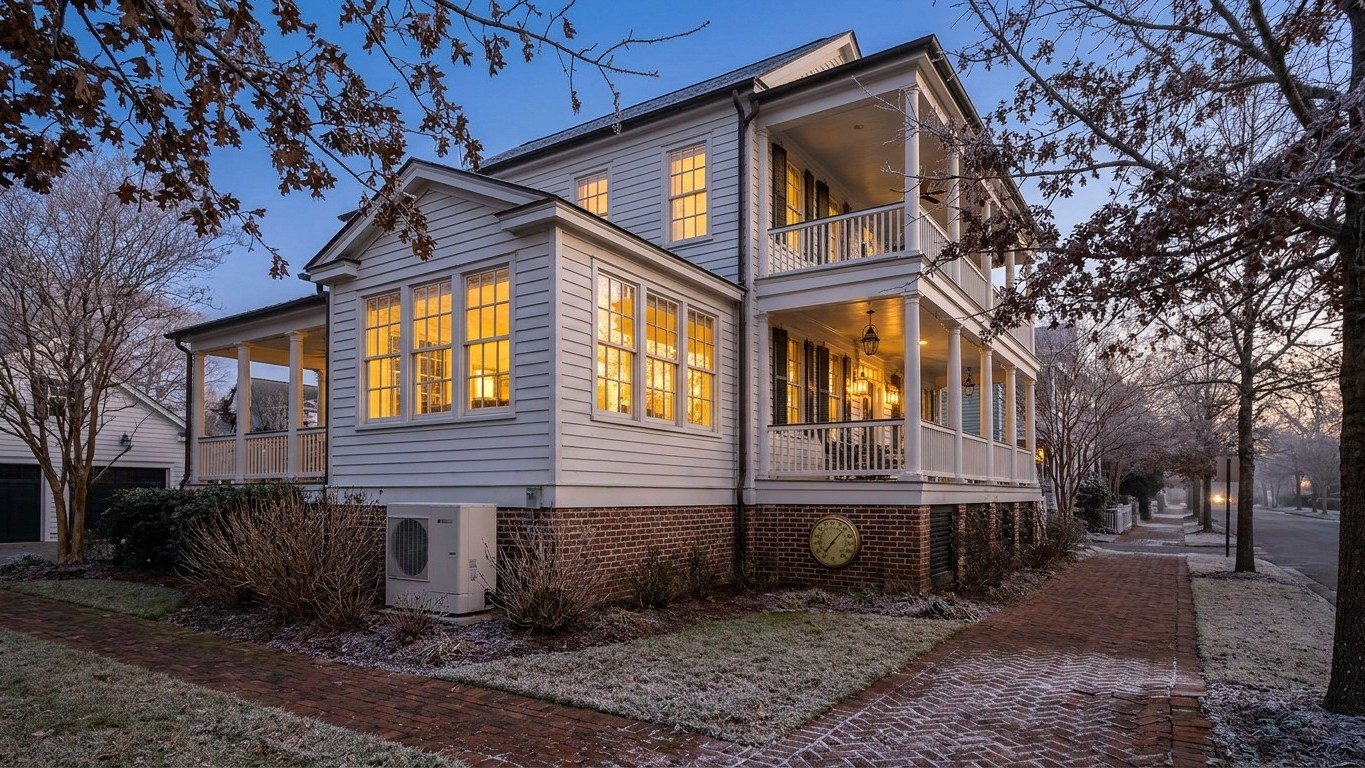

Winters here rarely turn brutal, but “mild” doesn’t mean “free.” Charleston’s coldest month averages a nightly low of 38.9°F, which sounds gentle until you’re paying to keep a house comfortable for months at that edge. What heating actually costs depends less on how cold South Carolina gets and more on how long that chill hangs around.
How cold it gets, and for how long

The reference number is 38.9°F, the mean daily minimum of the coldest month at Charleston, per NOAA’s 1991-2020 Climate Normals. That’s not a record low and not a monthly average. It’s the temperature a house typically wakes up to on an ordinary cold morning, night after night, for the worst stretch of the year.
That single figure tells you something about the shape of a South Carolina winter: shallow, not sharp. A furnace or heat pump here isn’t fighting off a two-week arctic blast that bottoms out near zero. It’s cycling on and off through a long stretch of nights hovering just above or below freezing, from roughly December into February, sometimes bleeding into early March in the Upstate.
That distinction matters for how a household actually experiences the bill. A place that drops far below freezing for two months needs equipment sized for extreme peak load, insulation that stops rapid heat loss during a hard freeze, and a backup plan for pipes. A place that sits near freezing for a longer season needs steady, efficient output more than raw capacity. Oversizing a furnace for a South Carolina winter often wastes money twice: once on the equipment, once on the short-cycling that comes from a unit too big for the load it’s actually asked to carry most nights.
It also changes the math on supplemental heat. A wood stove or fireplace insert that would barely dent a Minnesota winter can meaningfully offset a Carolina heating bill, because it’s covering a mild, sustained load rather than trying to match a furnace during a deep freeze. That’s the backdrop for the next question homeowners here actually ask: if I’m burning wood, how much am I really getting for a cord?
What a cord of wood is worth here
A cord is a volume, not a weight, and that’s the detail that trips up most first-time buyers. By definition it’s a stack measuring 4 feet by 4 feet by 8 feet, which works out to 128 cubic feet of space, bark, gaps, and all. Two loads that both get called “a cord” can hold very different amounts of actual wood mass depending on how tightly they’re stacked and which species filled the truck bed.
| Measurement | Value |
|---|---|
| Cord dimensions | 4 ft x 4 ft x 8 ft |
| Total volume | 128 cubic feet |
| Heat content, well-seasoned hardwood | about 20 million BTU per cord |
That 20-million-BTU figure comes from Michigan State University Extension, and it’s an average for hardwood that’s actually dry, not a promise attached to any specific load. MSU frames it in terms a homeowner can use directly: one well-seasoned cord carries roughly the heat of 145 gallons of #2 fuel oil, or 215 gallons of LP gas. Given a South Carolina heating season that’s long but shallow rather than short and severe, a cord or two of good hardwood can realistically carry a household through a meaningful share of the mild nights described above, especially paired with a furnace or heat pump handling the rest.
None of that holds if the wood is green. Seasoning is the variable that decides whether 20 million BTU is anywhere close to what you actually burn, which is exactly why it gets its own section.
How long wood takes to dry in South Carolina
Seasoning time isn’t a fixed number stamped on firewood everywhere. It’s set by climate: humidity, summer heat, and airflow around the stack all decide how fast water leaves the wood. MSU Extension puts the target at 20 percent moisture or less for burning, against green wood that can start above 60 percent. That’s a lot of water to drive off before the wood gives you any heat at all.
Split green wood typically reaches that 20 percent mark after one full summer, provided it’s split and stacked so air moves freely through the pile. Rounds left whole, or wood stacked tight against a wall with no airflow, dry far slower than that timeline suggests. South Carolina’s hot, humid summers can work in a burner’s favor if the wood is properly split and elevated off the ground, but the same humidity punishes anything stacked poorly or left uncovered through a wet season.
Red oak is the named exception worth remembering. Its cell structure holds moisture longer than most hardwoods, so it needs more time than a single summer to reach burnable dryness, according to MSU. Assuming a red oak load is “ready” on the same schedule as ash or hickory is a common way to end up burning wood that isn’t.
Burning too soon isn’t just a minor inefficiency. Every bit of that trapped moisture has to boil off before the fire produces usable heat, which means green wood delivers noticeably less warmth per stick than the 20-million-BTU figure implies. The byproduct of that wasted energy is worse: more creosote condensing in the flue, and a chimney that needs sweeping sooner than it would with properly dried fuel.
Where to check before you buy
South Carolina stretches from sea-level coastal plain to Blue Ridge foothills in the Upstate, and the figures above describe Charleston, the reference city behind the NOAA data used here. A homeowner near the mountains should expect colder nights and a longer heating season than the coast, even though both sit in the same state.
That range in elevation and exposure is exactly why local guidance matters more than a statewide average. Clemson University’s Extension service is the place to check on which firewood species are actually available and well-suited to your specific county, since availability shifts across the state’s different growing regions.
It’s also the right source for burn restrictions, and this is worth saying plainly: those rules are set locally, not statewide, and they change from year to year based on air quality and drought conditions. What was allowed last winter in a given county isn’t guaranteed this winter. Checking with the local extension office or county fire authority before stocking up, rather than assuming last season’s rules still apply, saves a headache once the cold nights actually arrive.