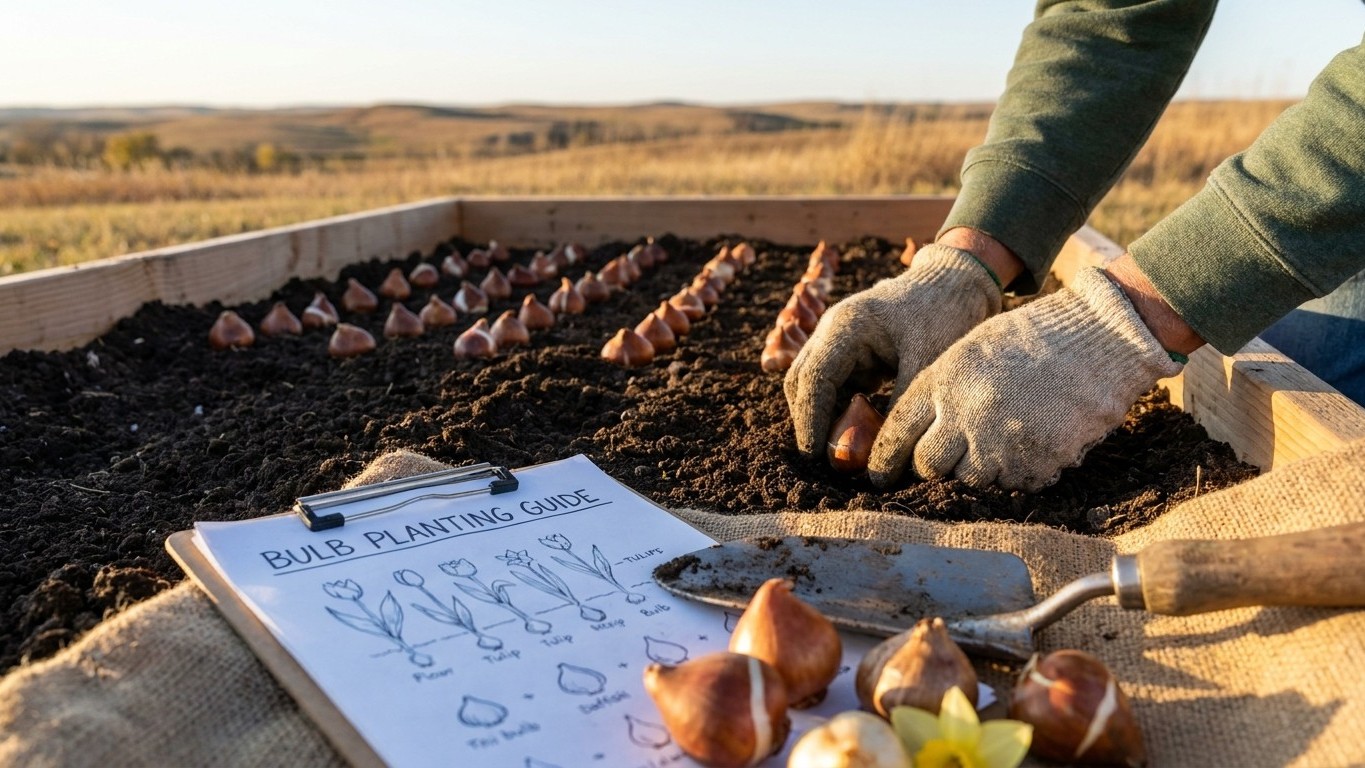

South Dakota gardeners can grow a solid range of spring-flowering bulbs, but the state’s winter cold cuts both ways: it easily satisfies the chilling that tulips and daffodils need, yet it kills off anything rated for warmer zones. The short answer is to plant in fall, choose bulbs hardy to at least USDA zone 5b, and skip anything marketed for southern gardens. Gardeners without in-ground space can still get the same results by Growing Spring Bulbs in Containers in South Dakota, provided the pots are insulated enough to survive the same deep winter cold.
When to plant bulbs in South Dakota

Spring bulbs go into South Dakota soil once the ground has cooled from summer heat but before it locks up hard for winter. That window sits roughly six weeks ahead of the average first fall frost, which for the Sioux Falls area (station USW00014944) falls between September 24 and October 4, based on NOAA’s 1991-2020 climate normals. Working backward from that date puts the practical planting window in mid-September through late October for most of the state, with earlier planting favored in the colder western counties and later planting workable in the milder southeastern corner.
Plant too early, while soil is still warm from summer, and a bulb wakes up. It pushes tender green shoots above ground weeks before it should, and those shoots freeze solid the first hard cold snap. The bulb survives underground, but it has burned energy it needed for spring bloom, and the display suffers. Plant too late, after the ground has already gone cold and hard, and the opposite problem shows up: the bulb never has time to grow the root system it needs before frozen soil stops all growth. A bulb that goes in without rooting either sits weak and undersized in spring or fails to come up at all.
The frost date is an average, not a guarantee
It’s worth being blunt about what “first fall frost” actually means. The September 24-October 4 window is a statistical average pulled from three decades of data, not a promise. By definition, roughly half of all years bring frost earlier than that range, and half bring it later. A gardener who plants right on the calendar date and gets an early, sharp cold snap two weeks ahead of schedule has just planted into ground that’s already colder than planned. Building in a buffer, and watching the extended forecast rather than a fixed date, matters more than memorizing a single day.
Whether your winter is cold enough
Every spring bulb needs a long stretch of cold before it will flower. The standard requirement across tulips, daffodils, hyacinths, and most crocus is twelve to fourteen weeks with soil temperatures below about 45F. Skip that chilling period and the bulb doesn’t die, but it doesn’t perform either: it sends up leaves with no flower bud, or a flower bud on a stem too stunted to see above the foliage. Gardeners who want blooms well ahead of the outdoor season, or who’d rather control the chilling period themselves, can get the same cold requirement met in a refrigerator by Forcing Spring Bulbs Indoors in South Dakota, which lets tulips and daffodils flower on a windowsill in the dead of winter. That number, twelve to fourteen weeks below 45F, is the yardstick every gardener needs, no matter where they garden or what bulb they’re holding.
South Dakota clears that bar by a wide margin. The coldest-month mean minimum in Sioux Falls sits at 8.5F, and soil across most of the state stays well below 45F from mid-November through March, a stretch that runs closer to five months than the twelve-to-fourteen-week minimum. That’s not a marginal pass. It’s a comfortable overshoot, and it means gardeners here never need to pre-chill Spring Bulbs in a refrigerator before planting, a workaround that gardeners in mild-winter states rely on constantly. Buy the bulb, plant it in fall, let the ground do the rest.
The catch runs the other direction. Because South Dakota winters deliver far more cold than the chilling requirement calls for, the real risk here isn’t insufficient chill, it’s excess cold killing bulbs that were never built to survive it. A bulb rated for zone 7 or 8 gets all the chilling it could want in South Dakota and then freezes to death in the same soil, because its tissue simply can’t tolerate an 8.5F coldest-month minimum. Chill and hardiness are two separate questions, and this state answers the first one easily while failing the second for a long list of popular varieties.
| Bulb | Weeks of cold needed | What South Dakota delivers | Verdict |
|---|---|---|---|
| Tulips | 12-14 weeks below 45F | ~20+ weeks below 45F | Ample margin, no pre-chill needed |
| Daffodils | 12-16 weeks below 45F | ~20+ weeks below 45F | Ample margin, no pre-chill needed |
| Hyacinths | 13-15 weeks below 45F | ~20+ weeks below 45F | Ample margin, no pre-chill needed |
| Crocus | 8-15 weeks below 45F | ~20+ weeks below 45F | Ample margin, no pre-chill needed |
| Alliums | 8-10 weeks below 45F | ~20+ weeks below 45F | Ample margin, no pre-chill needed |
Which bulbs suit South Dakota
Bulbs rated hardy to USDA zone 5 or colder cover South Dakota’s own 3b-5b range comfortably, and the following handle the state’s winters without special protection in most sites:
- Daffodils (Narcissus), hardy zones 3-9
- Darwin hybrid tulips, hardy zones 3-8
- Siberian squill (Scilla siberica), hardy zones 2-8
- Grape hyacinth (Muscari), hardy zones 3-8
- Crocus, hardy zones 3-8
- Snowdrops (Galanthus), hardy zones 3-7
- Alliums, hardy zones 3-8 depending on species
Hardiness ranges are guidelines, not hard lines. A bulb rated to zone 3 in a sheltered spot against a south-facing foundation, under a thick layer of mulch, often outperforms the same bulb planted in an open, wind-scoured bed a few miles away where snow cover is thin. Microclimate matters as much as the zone map.
Some popular garden-center bulbs will disappoint here, and it’s worth knowing exactly how before spending the money:
- Ranunculus, hardy zones 8-10, rots in wet South Dakota winters or freezes outright
- Anemone coronaria, hardy zones 7-10, rarely survives a single winter outdoors
- Dutch iris, hardy zones 5-9, marginal at best and often fails in exposed sites even where zone 5b technically applies
The common failure pattern with these three isn’t a poor first bloom, it’s a good first-year display that never comes back. The bulb flowers on stored energy the first spring, then dies over the following winter, leaving a gap in the bed the next year that gets blamed on everything except the real cause: a bulb planted well outside its cold tolerance.
What digs them up here
Squirrels and voles aren’t random about which bulbs they raid. The difference comes down to chemistry. Daffodils and members of the onion family contain compounds that make them bitter or mildly toxic, so rodents learn to leave them alone. Tulips and crocus contain nothing of the sort, and both rank among the most reliably raided bulbs in any bed where squirrels or voles are active.
Of the bulbs recommended above, several are effectively rodent-proof by nature:
- Daffodils (Narcissus)
- Alliums
- Snowdrops (Galanthus)
Others on that same list are prime targets and need protection:
- Tulips
- Crocus
- Grape hyacinth (Muscari)
The one method that consistently works is physical, not chemical: lay galvanized wire mesh or hardware cloth flat over the planting site, pin it down, and leave it in place until the ground freezes solid, at which point digging becomes impossible anyway. Repellent sprays and granules sold for this purpose wash off with the first rain or snowmelt and need constant reapplication, which makes them unreliable over a planting season that runs weeks long. Wire mesh, by contrast, sits there and does its job without maintenance.
Where to check for your own county
South Dakota stretches across several degrees of latitude and spans USDA zones 3b through 5b, and every figure in this guide, the frost dates, the coldest-month minimum, all trace back to the Sioux Falls reference station. A gardener in Rapid City or up along the North Dakota border is working with a meaningfully different climate than one in Sioux Falls, and a planting window built around the state’s southeastern corner can run two to three weeks off at either edge of the state.
The most reliable local source is South Dakota State University Extension, the state’s land-grant extension service, at extension.sdstate.edu. County extension offices there track local frost data, soil conditions, and variety performance specific to their own patch of the state, and that local read matters more than any statewide average when the goal is bulbs that actually bloom next spring.