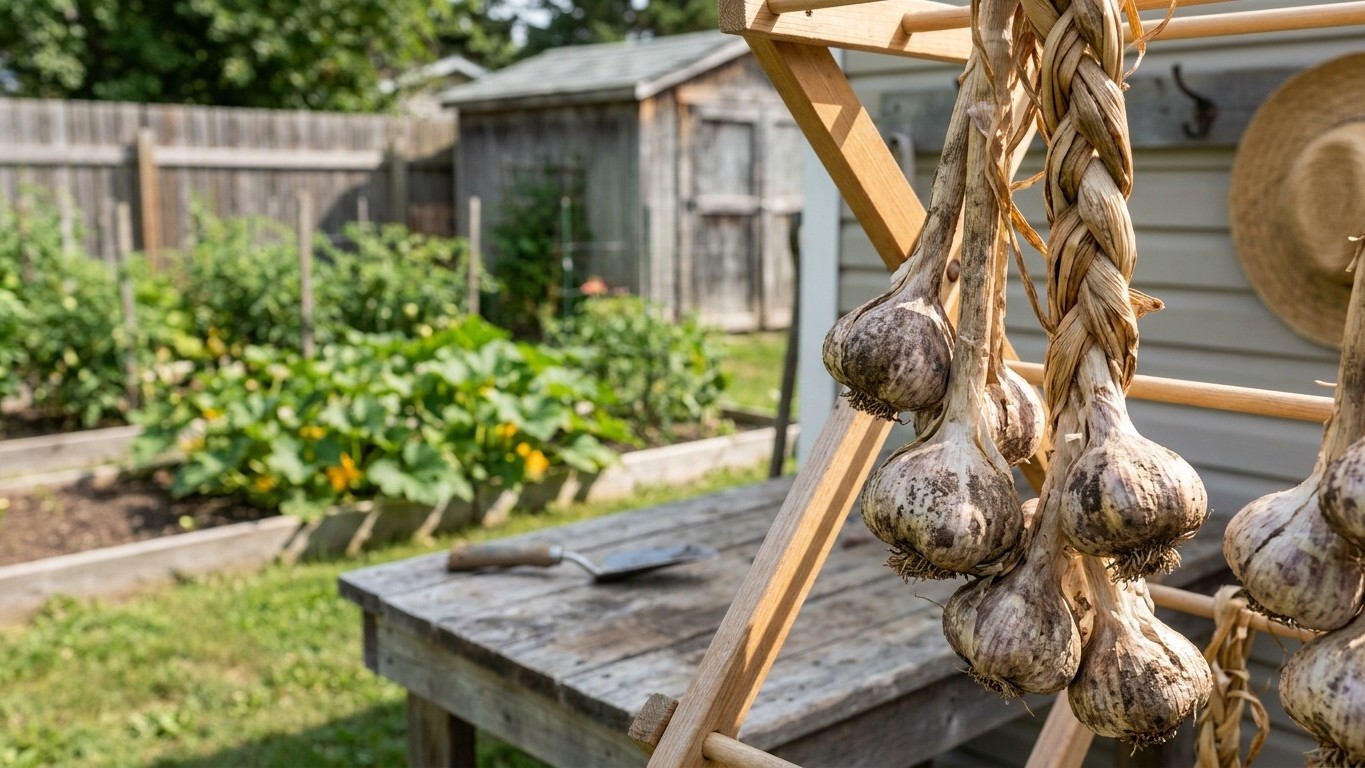

Almost any garlic will make it through your winter here — hardneck or softneck, the cold in the ground is never the problem. What actually decides your harvest is when you get those cloves into the soil and how you plan to use them once they’re cured. So set them out in early September, before the ground turns cold, and let storage life and flavor guide which variety you reach for. Get the timing right first; the rest is just picking what you like to cook with.
The short answer for Manitoba

Plant garlic in early September across Manitoba, whether you choose a hardneck or a softneck. That window is anchored to Environment and Climate Change Canada’s Canadian Climate Normals for 1981-2010, which put the mean first fall frost at Winnipeg Richardson International Airport at September 22. Cloves set a few weeks ahead of that date have time to root before the soil turns cold, without pushing up green growth that a hard freeze would kill.
Treat September 22 as a midpoint, not a deadline. The normal is built from thirty years of data, and by definition the actual frost lands later than the mean in about half of those years. A grower who waits for a calendar date instead of watching conditions can lose a week of rooting time to a mild fall, or get caught out by an early one. The safer habit is to plant on the early side of the window and mulch heavily, rather than aim for the average.
Manitoba can carry the full range of garlic types because of how much sustained cold the ground delivers, not because of how mild any part of the winter is. The University of Georgia Extension’s bulletin C854 lists six to eight weeks of soil below 40°F as what a clove needs to divide into a full bulb instead of staying a single round. Manitoba’s cold season runs 30.4 weeks below that mark, measured at the same reference point, nearly four times the minimum. The open question here is never whether the garlic gets cold enough. It is whether the crop gets planted early enough, and deep enough, to survive delivering that cold to the clove intact.
| Variety | Type | Planting window |
|---|---|---|
| Early Red Italian | Softneck | Early September |
| Inchelium Red | Softneck | Early September |
| Italian Late | Softneck | Early September |
| Lorz Italian | Softneck | Early September |
| Bavarian Purple | Hardneck | Early September |
| Blue Music | Hardneck | Early September |
| Chesnok Red | Hardneck | Early September |
| Duganski | Hardneck | Early September |
| Fall Festival | Hardneck | Early September |
| Georgian Crystal | Hardneck | Early September |
| Georgian Fire | Hardneck | Early September |
| German Red | Hardneck | Early September |
| German White | Hardneck | Early September |
| Ivan | Hardneck | Early September |
Working it out for your own garden
The reason every variety above shares the same setting date is arithmetic, not habit. Winnipeg’s mean first fall frost of September 22 leaves roughly two to three weeks between the start of the early September window and the date the ground typically turns cold enough to matter. That gap is enough for a clove to push new roots without also pushing green shoots above the soil line, which is the growth a hard freeze actually kills. When to Plant Garlic in Manitoba: Counting Back From the First Frost works through that count week by week if you want more detail than the range above.
Redo the math for your own site
A single airport reading cannot describe a whole province, and Manitoba’s growing conditions shift over short distances. If your garden sits in a low spot where cold air pools overnight, or on open prairie with no windbreak, your own first frost will tend to arrive ahead of Winnipeg’s normal, and you should move your planting date toward the earlier end of the window rather than the later one. If your soil is heavy clay that holds summer warmth into the fall, or your garden sits close to Lake Winnipeg or Lake Manitoba, the water’s stored heat can push your effective frost date back by a week or more, and the same early September window still applies but with less urgency behind it.
Elevation works the same way in reverse. Ground that sits higher, such as the slopes near Riding Mountain, cools faster in the evening than the flat river valley around Winnipeg, so a grower there is working against a frost that arrives sooner than the reference normal suggests. None of this changes which varieties will survive the winter. It changes only how much margin to build into the planting date, and margin here means planting early and mulching well rather than waiting for a forecast to confirm the cold has arrived.
The planting date answers only one question, when to set cloves in the ground. Depth, spacing and the mulch layer that gets a clove through a Manitoba winter are covered in Growing Garlic in Manitoba, and skipping that half of the job is what turns a correctly timed planting into a thin stand come spring.
What changes across Manitoba
The Red River Valley around Winnipeg, where the reference frost date is measured, has among the longest growing seasons in the province, thanks to flat land and heavy clay soils that hold summer heat into the fall. A garlic bed here can lean on the full early September window without much adjustment, and hardnecks such as German Red and Duganski are common choices precisely because the season gives them enough time to finish without a rushed fall planting.
The Interlake region, between Lake Winnipeg and Lake Manitoba, sits close enough to open water that the lakes moderate both spring and fall temperatures, sometimes delaying the first hard frost past the Winnipeg normal. Growers there can pick up a few extra days of rooting time before winter, though the same lakes can also hold damp, cool spring air near the ground, which matters more for disease pressure later in the season than for the fall planting date itself.
The Parkland region near Riding Mountain, and any higher ground west of the valley, cools faster than the reference station because elevation drops air temperature and drains cold air more slowly overnight. A grower there should treat early September as a target to beat, not a comfortable middle date.
Northern Manitoba runs a different growing season altogether. Winter arrives earlier and stays longer than anything the Winnipeg normal describes, and a planting date built on a southern reference station will run too late for northern soil. Growers north of the main agricultural belt need a locally observed frost record, not this one, before locking in a calendar date for cloves.
The mistakes this climate punishes
The most common failure in Manitoba is planting too late, or too shallow, for the cold that follows. A clove that goes in after the ground has already begun to cool will not build a root system before winter, and even a hardneck bred for cold, like Duganski or German White, needs live roots underground to survive freezing rather than surviving on the cold alone. Set cloves at least two inches deep and cover with mulch heavy enough that frost heave cannot lift them once the freeze-thaw cycles of an open prairie winter start.
Disease pressure builds in the same cool months that suit garlic
UC IPM’s Pest Management Guidelines for Onion and Garlic, UC ANR Publication 3453, list the temperature ranges that let four major garlic pathogens establish, and Manitoba’s growing season overlaps two of them more than a grower might expect. White rot, caused by the fungus Sclerotium cepivorum, occurs in soil between 50 and 75°F, and the mean air temperature at the reference station falls inside that range in four months of the growing season, including one month right at the pathogen’s optimum. Fusarium basal rot, caused by Fusarium oxysporum f. sp. cepae, has a wider published range of 59 to 90°F that overlaps two summer months, right around when bulbs are sizing up before harvest.
- These are air temperature averages from one reference station, not the soil temperature the pathogens actually respond to.
- A monthly mean hides plenty of days on either side of it, both warmer and colder.
- A month outside the published range means the disease is less likely to establish, never that it is absent.
The practical response is not to avoid a month, it is to buy certified disease-free seed garlic and keep the bed out of onions and garlic for several years running, since both pathogens persist in soil far longer than one winter kills off. The other mistake specific to this climate is choosing a softneck like Italian Late or Early Red Italian for looks or storage life without checking the planting got enough cover. Softnecks are not bred for cold the way Georgian Crystal or Blue Music are, and in an open winter with thin snow, a shallow softneck row is the one most likely to show gaps in spring.
Checking this against your county
Every date and figure comes from one station near Winnipeg, and Manitoba Agriculture is the place to check how your county compares. A grower more than an hour from Winnipeg should confirm the local frost record before locking in a planting date built on those numbers. Visit Manitoba Agriculture for regional detail, particularly if you garden in the Interlake, the Parkland, or anywhere north of the main grain belt where the season runs noticeably shorter than the reference normal used here.
Common questions
Can I plant garlic in spring instead of fall in Manitoba?
You can, but the University of Georgia Extension’s figure for splitting a clove into a full bulb calls for six to eight weeks of soil below 40°F, and a spring-planted clove in Manitoba misses most of that cold period. Spring-planted garlic here tends to bulb small or stay a single round, so fall planting on the schedule above gives a far better crop.
What if I miss the early September window?
Plant as soon as you can rather than waiting for next year. Garlic set later into September can still root before the ground freezes hard, especially since Winnipeg’s September 22 mean frost is only a midpoint and the real freeze often lands later. Add extra mulch to compensate for the shorter rooting window.
Can I plant grocery store garlic instead of a named variety?
You can try, but most grocery garlic is a softneck grown for a mild climate and is rarely sold with any disease-testing record, which matters given the white rot and fusarium pressure covered above. A named, certified seed stock like the varieties listed above gives you a known neck type and a known planting date to work from.
Do I need to pull the mulch off in spring?
Pull the bulk of it back once new green shoots push through and the hardest freezes have passed, but leave a thin layer to hold soil moisture. Mulch left too thick and too late can trap cold, damp air right at the base of the shoot, which is exactly the condition that favors the white rot pathogen described above.