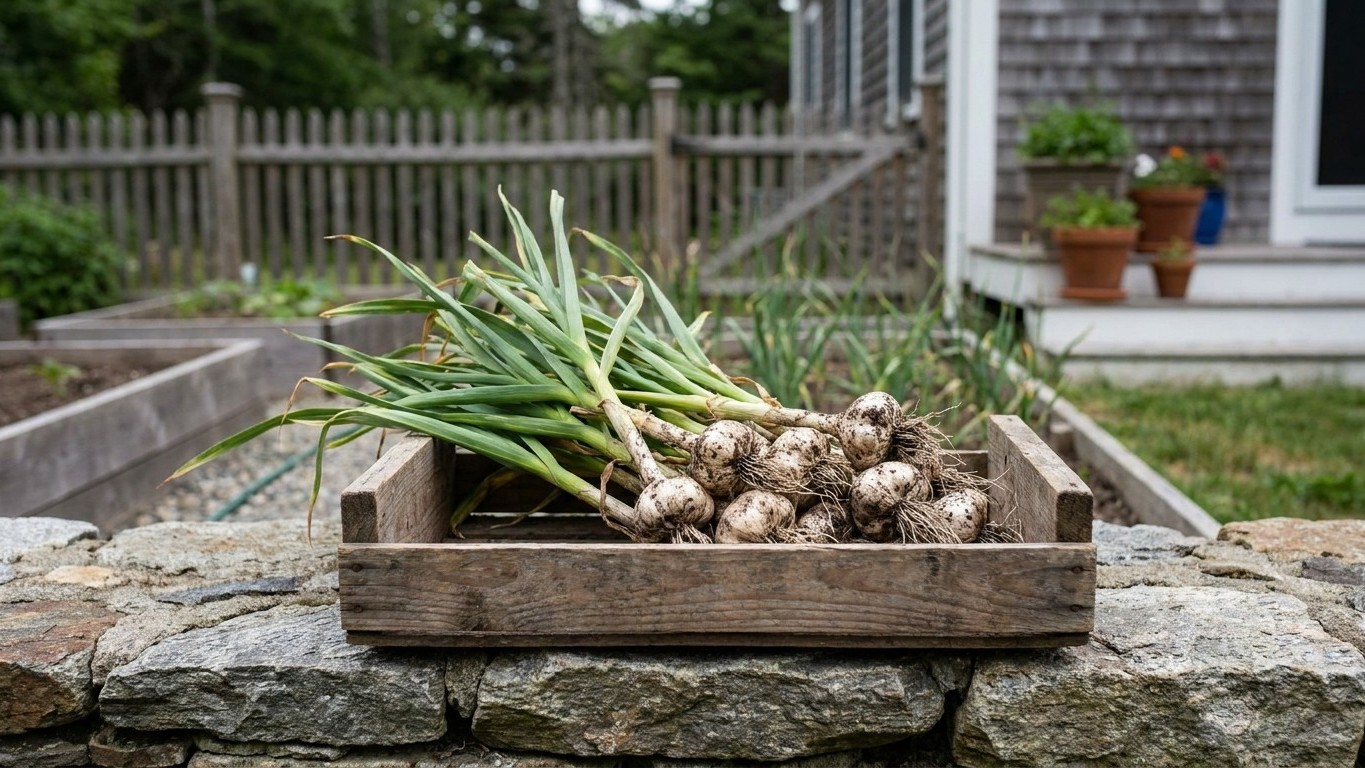

A single round bulb, no papery wrapper, no cloves to separate — that’s what a gardener finds after digging garlic that never got its cold. It’s not a disease or a bad variety, just a chilling requirement that went unmet. Maine growers rarely hit this problem; the state’s freezes arrive by mid-October most years and the cold holds for months after. The one place it can still happen is the immediate coast, where the ocean keeps things milder than the thermometer inland suggests.
Will garlic get the cold it needs in Maine

Garlic clove division depends on a genuine stretch of cold after planting. Skip that chill, and instead of a head of cloves wrapped in papery skin, the grower lifts a single round bulb that never split at all. University of Georgia Extension publication C854 sets the minimum at six to eight weeks with air temperatures below 40°F, and that figure is the one to check against first.
Maine clears it without much argument. NOAA’s 1991-2020 climate normals put Portland’s first fall freeze between October 9 and October 21, and once that freeze sets in, the state’s winters keep air temperatures below 40°F for months, not weeks, into the following spring in most years. Inland and northern Maine, where that same freeze arrives earlier in the season, clear the threshold with even more room to spare. A grower a few hundred miles north in Manitoba works with a shorter growing season on the other side of a similar cold equation, but the chilling requirement itself is rarely the limiting factor in either place.
The one exception worth naming is a narrow strip right on the immediate coast, where the ocean’s moderating effect can shave real cold down to something milder than the interior sees. A gardener there who isn’t sure the season is running long or cold enough still has two working answers. Refrigerate the cloves for several weeks before planting, holding separated cloves at refrigerator temperature to simulate the chill artificially, or plant a softneck type, which tolerates a shorter or milder cold season better than a hardneck does. Neither is a consolation prize. A softneck handled this way still produces a full head of cloves and generally stores longer in the kitchen than a hardneck would.
Growers sometimes blame a disappointing harvest on soil fertility or a weak clove when the real cause was a mild, short autumn that never delivered the chill the plant needed. If last year’s crop came up as one undivided bulb rather than a head of cloves, cold exposure during the fall and winter before is the first thing to check, ahead of the fertilizer schedule or the seed source — and it’s worth reviewing Garlic Varieties That Suit Maine Winters, since some hold up better under a marginal chill than others, along with reviewing When to Plant Garlic in Maine, the schedule gardeners follow to make sure the crop gets enough time in the ground before that cold sets in.
When to put the cloves in
Anchor this decision on the season’s first hard freeze, not on a date circled on a calendar. Cloves need roughly three to five weeks of open, workable soil to grow roots before the ground locks up, but not so much time that they push visible green growth before winter sets in. Too much top growth heading into winter leaves tender leaves exposed to hard freezes with only a mulch layer to protect them.
NOAA’s 1991-2020 climate normals put Portland’s first fall freeze at a midpoint of roughly October 15, drawn from the October 9 to October 21 window recorded there. Counting back three to five weeks from that midpoint lands planting in the second half of September for the Portland area, which lines up with the mid-September-to-late-September window given for every variety. That window is a calculation from the frost date, not a fixed rule, and it shifts with your own microclimate.
Elevation moves it earlier. A garden several hundred feet higher than the valley floor cools off sooner and should plant toward the earlier end of that range. A large lake or the immediate coast moves it the other way, holding warmth into the evening and pushing the safe window a bit later into the fall. Inland and northern Maine, which NOAA’s same normals show reaching freezing conditions well ahead of the coast, should treat the whole window as arriving earlier than it does in Portland, sometimes by two weeks or more.
Plant too early, before the soil has begun cooling, and cloves can send up several inches of leaf before the first freeze, leaving that growth to die back and setting the plant behind come spring. Plant too late, after the ground has gone cold and hard, and the clove sits without any root development until spring thaw, arriving at the growing season with a shallow, poorly anchored root system that a dry spring can stress badly. If a warm September runs longer than expected, don’t wait for a chill in the air before planting. Roots respond to soil temperature, which lags well behind air temperature, so the ground is often still warm enough to root cloves after the first cool nights show up on the forecast.
Which types suit Maine
Hardneck garlic (Allium sativum var. ophioscorodon) is a cold-climate plant by nature, sending up a curling flower stalk called a scape and forming a single ring of large cloves around a stiff central stem. Softneck garlic (Allium sativum var. sativum) skips the scape, packs in more and smaller cloves, and generally tolerates a milder winter, which is why it dominates gardens in warm-winter states. A grower down in South Carolina works from almost the opposite constraint, leaning on softneck varieties because winters there rarely deliver a hardneck’s preferred stretch of cold.
Maine runs the other way. The same long, cold season that comfortably clears the chill threshold described above rewards hardneck varieties with strong scapes and good-sized cloves. Hardneck is the safer default for most of the state, and the following are all worth planting:
- Bavarian Purple (hardneck)
- Blue Music (hardneck)
- Chesnok Red (hardneck)
- Duganski (hardneck)
- Fall Festival (hardneck)
- Georgian Crystal (hardneck)
- Georgian Fire (hardneck)
- German Red (hardneck)
- German White (hardneck)
- Ivan (hardneck)
Softneck garlic still has a place here, mainly in the kitchen. It stores considerably longer in a pantry or braided string than most hardnecks manage, which matters if the goal is garlic on hand through the winter rather than garlic pulled fresh in midsummer. Inchelium Red and Early Red Italian both grow reliably in a Maine bed, and Italian Late and Lorz Italian round out the softneck options in the same catalogue. All four use the same mid-September-to-late-September planting window as the hardnecks above.
Soil and bed preparation
Garlic spends eight or nine months in the ground here, rooting in fall, sitting through winter, then finishing its growth the following summer. That is a long time for a clove to sit in soil that drains poorly, and standing water will rot a clove over a wet winter long before any fungal disease gets the chance to. Drainage comes before fertility on the list of things to fix before planting.
Work compost into the bed a few weeks ahead of planting rather than the same day, giving it time to settle instead of leaving loose pockets of organic matter around the clove. Raised beds or ridged rows solve a drainage problem faster than any soil amendment does, and on a heavy clay site that’s often the difference between a healthy stand in spring and a rotted-out row. Avoid working in fresh manure right before planting. It carries more nitrogen than the clove needs at that stage, and it can add to the disease pressure covered next.
Getting the bed ready, step by step
- Clear the bed of the previous crop’s residue and any perennial weeds well before planting.
- Loosen soil to a full spade’s depth so roots can run down rather than sideways.
- Work in finished compost, then let the bed rest for two to three weeks.
- Rake into a slightly raised, crowned bed or row so winter rain and meltwater shed to the sides.
- Hold off on fresh manure and high-nitrogen fertilizer until spring growth resumes.
Choose the highest, best-drained spot in the garden for garlic rather than saving it for a low corner other crops don’t want. A slope, even a gentle one, does more for a Maine garlic bed than any amount of amendment, because it moves snowmelt and spring rain off the row instead of holding it against the cloves all winter. A soil test taken before planting tells you far more about pH and nutrient levels than guesswork, and it’s worth doing before committing a bed to a crop that will occupy it for most of a year.
What the climate here favours, and what it does not
UC IPM’s Pest Management Guidelines for onion and garlic (UC ANR Publication 3453) publish the temperature ranges four major garlic diseases need to develop. Comparing those ranges against the growing season’s average monthly air temperatures shows which diseases this climate tends to favor and which stay out of range for most of the year. These thresholds are published as soil temperatures, and the figures compared here are air temperatures, so a month falling inside a disease’s range shows a tendency, not a confirmed infection.
| Disease | Pathogen | Published range | Months in range, growing season |
|---|---|---|---|
| White rot | Sclerotium cepivorum | 50-75°F | 4: September, May, June, July (2 at optimum) |
| Fusarium basal rot | Fusarium oxysporum f. sp. cepae | 59-90°F | 3: September, June, July |
| Southern blight | Sclerotium rolfsii | 86-95°F (optimum) | 0 |
| Pink root | Setophoma terrestris | 75-85°F (optimum) | 0 |
White rot carries the most concern of the four here. Its range overlaps four months of the growing season, including two sitting right at its published optimum, which makes it the disease most worth watching for in a bed that has grown alliums before. Fusarium basal rot follows a similar, smaller pattern across three months. Neither count means either disease is active in your garden right now. A single monthly average blends warm afternoons with cold nights and says nothing about any one week, and one weather station cannot speak for a whole state’s worth of microclimates.
Southern blight and pink root both need temperatures well above what a Maine growing season delivers on average, with zero months landing inside either published optimum range. That does not mean either disease is impossible here. Infected planting stock carries these pathogens regardless of climate, so buying clean seed garlic from a reputable source matters more than any temperature table. White rot’s sclerotia, once introduced, can also persist in soil for years no matter what the weather does in any given season, which is why rotating garlic and onions away from a bed with a known history of the disease matters more long-term than tracking monthly averages.
Getting it through the winter
Mulch does two jobs here, and both matter given Maine’s freeze-thaw pattern. It slows the freezing and thawing cycles that heave shallow-planted cloves partway out of the ground, and it holds soil moisture through any dry stretch of fall before winter snow takes over. Straw or shredded leaves both work, laid down as soon as the cloves go in rather than weeks later, since the point is buffering the ground before its first hard freeze, not protecting a plant that’s already visible above the soil.
Plant cloves at a proper depth to begin with, since mulch is a backup, not a substitute for depth. A clove set too shallow has less soil holding it in place, and repeated freezing and thawing through a Maine winter can walk it toward the surface over several cycles, exposing the top of the clove to cold air and drying wind by late winter. A heaved clove rarely dies outright, but it often comes up smaller and later than one that stayed anchored where it was planted.
Leave mulch in place through the coldest months. Pulling it back too early, at the first mild stretch in late winter, invites exactly the freeze-thaw cycling the mulch was meant to prevent, since bare soil swings temperature far more than mulched soil does. Wait until green shoots are visibly pushing up and the coldest part of the season has clearly passed, then rake the mulch to the row middles rather than removing it outright. Left there, it keeps weeds down through summer while still letting the soil warm around the emerging shoots. Check under the mulch once in late winter for rodent activity too. Voles and mice sometimes nest in a thick, undisturbed layer over winter and can chew through a clove’s small root system without ever disturbing the mulch on top.
Harvest and curing here
Read the plant, not the calendar. Garlic signals it’s ready when the lower leaves have browned and died back while four to six leaves at the top are still green, since each leaf corresponds to a wrapper layer around the bulb, and a plant that has lost too many leaves has thin, deteriorating wrappers that won’t store well. Pulling a test bulb or two and checking whether the cloves have separated cleanly inside a still-intact wrapper is the most reliable way to confirm timing before digging the whole row.
Lift bulbs with a garden fork rather than pulling by the stalk, working from the side so you don’t stab through a bulb you can’t see. Bulbs in loose, well-drained soil sometimes come free by hand, but forcing it risks snapping the stem away from the bulb and losing the ability to braid or hang that plant later on.
Curing in a humid Maine summer
Curing, not harvest, is where most home-grown garlic actually gets lost. A bulb pulled at the right time can still rot in storage if it never dries out properly, and Maine’s humid summer air slows that drying compared to a dry inland climate. Cure in a shaded, well-ventilated spot with air moving freely, never in direct sun and never in a closed, still garage. A box fan running on low in a shady shed speeds curing noticeably during a stretch of humid weather.
Give it two to four weeks, checking the neck where the stem meets the bulb. It should feel dry and tight, not soft or cool to the touch, before you trim roots and tops and move bulbs to storage. Bulbs that go into storage with any softness left in the neck are the ones that mold a month later, after the harvest already looked safe.
Local help
Both freeze dates and cold-season length shift meaningfully as you move inland, north, or up in elevation. UMaine Extension keeps county-level planting guidance and offers soil testing that tells you far more about your particular bed than any statewide figure can. Find your county office through UMaine Cooperative Extension before finalizing a planting date or amending a bed.
Common questions
Can I Plant Garlic in spring instead of fall in Maine?
Not with any reliable result. Garlic planted in spring misses the extended cold period that triggers clove division, and a clove that never went through that chill usually bulks up into a single round bulb instead of a full head of cloves. If cloves are left over too late for fall planting, refrigerating them for several weeks before an early spring planting is a workaround, not a fix, and results tend to run smaller than a properly fall-planted crop.
What happens if I miss the fall planting window entirely?
A clove planted late into cold soil can still survive winter, but it roots poorly before the ground locks up and comes into spring behind a properly timed planting. If the ground is still workable, it’s usually better to plant late than not at all. If the ground has already frozen solid, hold the cloves in a refrigerator and plan on an early spring planting instead, accepting a smaller harvest.
Do I need to cut the scapes off my hardneck garlic?
Cutting the curling scape off a hardneck plant once it forms redirects the plant’s energy into the bulb instead of that stalk, and growers commonly report larger bulbs from plants that had scapes removed. The scape itself is edible and often used the same way as garlic in cooking, so removing it isn’t wasted effort.
Can I plant garlic bought from the grocery store?
You can, but it carries real risk. Grocery garlic is rarely labeled by variety, is sometimes treated with a sprout inhibitor that slows or stops rooting, and carries no guarantee it’s free of the soil-borne diseases discussed above, including white rot, which can persist in a bed for years once introduced. Certified disease-free seed garlic from a garlic-specific supplier costs more per clove but removes that risk from day one.
How many bulbs does one clove of garlic produce?
One clove grows into exactly one bulb, not several the way a seed potato can produce multiple tubers. That single bulb, though, holds anywhere from a handful to a dozen or more new cloves depending on the variety, which is why a modest planting of a pound or two of seed garlic in fall can feed a household through the following winter and still leave enough to save as seed stock for the next planting.