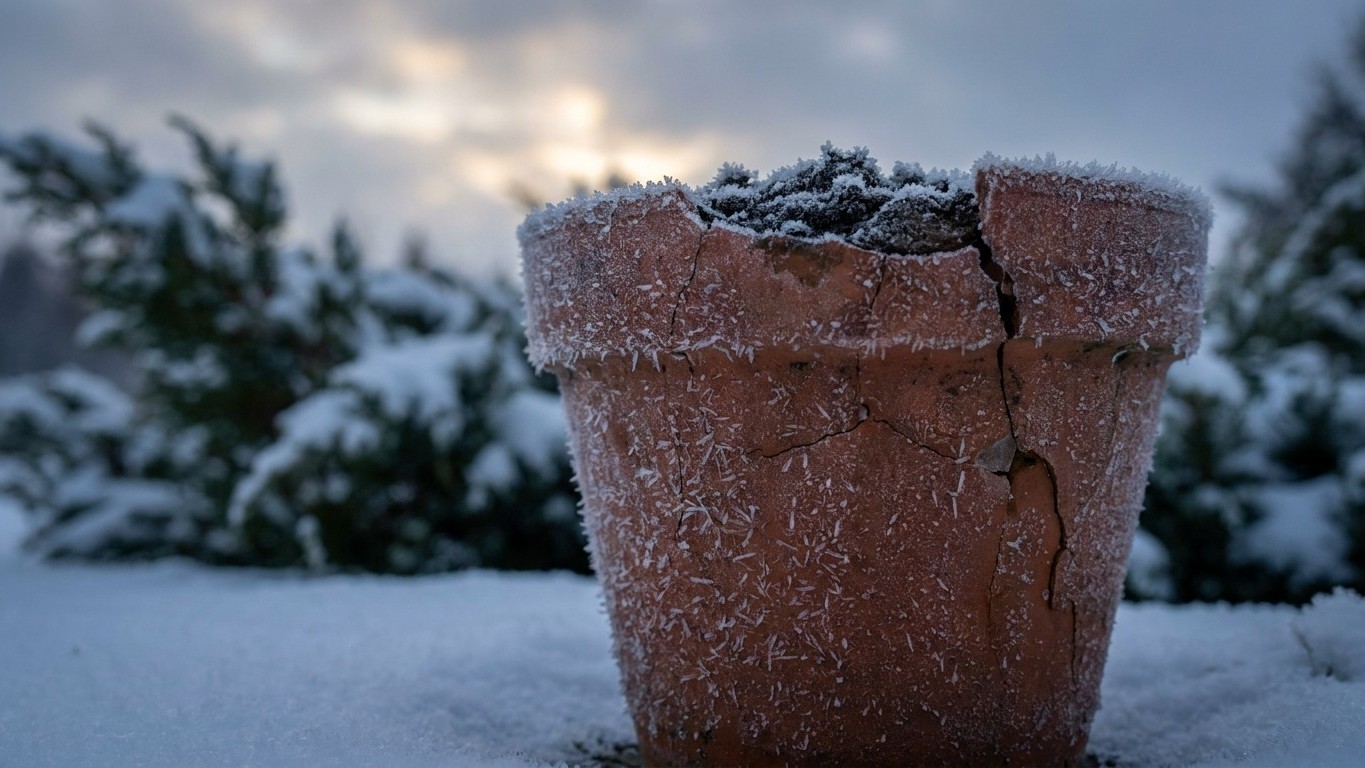

Manitoba’s winters bring a mean daily minimum of -6.6°F in the coldest month (ECCC Canadian Climate Normals, 1981-2010, Winnipeg). That’s cold enough to satisfy any spring bulb’s chilling needs many times over. The real container question here isn’t whether bulbs get cold enough. It’s whether the pot itself survives that cold intact.
Why this matters in Manitoba

Start with that -6.6°F figure. It’s not a record low, it’s the average low across the coldest month at the reference station, which means most nights in that stretch dip near or below it. A spring bulb needs roughly twelve to fourteen weeks below 45°F to break its flowering dormancy. Manitoba’s winter delivers that requirement in the first few weeks of the season and keeps going for months past it. Forcing, the practice of manufacturing artificial cold in a fridge or garage because winter won’t provide enough, simply isn’t the problem this territory faces. There’s cold to spare.
The problem is what that same cold does to a container. In a garden bed, frost bites the top several inches of soil and stops there; the mass of earth below insulates roots and bulb tissue, keeping them close to 32°F even when the air overhead sits well under zero. A pot has no such buffer. Exposed on all sides, a container left outdoors in a Manitoba winter freezes solid, roots, soil, and bulb together, at temperatures the surrounding ground would never reach at bulb depth.
That’s the distinction worth holding onto. Natural Resources Canada rates the reference city here at Canadian hardiness zone 3b (1991-2020 normals), a rating built on seven climate variables and specific to plants growing in the ground. A bulb described as hardy to that zone earns the rating because it’s insulated by soil mass on every side. Pull the same bulb into a pot and that insulation disappears. The zone number on the tag still applies to the ground; it doesn’t automatically transfer to a container sitting on a deck or a step.
So the practical takeaway splits in two directions. Anyone growing spring bulbs in containers meant to overwinter outdoors in Manitoba is dealing with a container-hardiness problem, not a chilling shortage. Anyone forcing bulbs indoors for an out-of-season bloom is doing something that would work in almost any climate, Manitoba’s cold winter included, because that cold is being supplied on purpose in a controlled space rather than relied on outdoors.
How to do it here
The steps below apply whether the goal is an indoor bloom weeks ahead of the outdoor season, or a container of bulbs meant to flower on a porch or balcony once spring actually arrives. Manitoba’s winter supplies more cold than any bulb requires; the method exists to make sure that cold reaches the bulb without freezing it to death in the process.
- Pick a pot with drainage holes and enough depth to cover the bulb by roughly two to three times its own height, plus room below for roots. A pot too shallow leaves no margin once the container is buried or insulated later.
- Plant in fall, using a well-draining potting mix rather than garden soil, which compacts and holds water against the bulb in a container.
- Decide where the twelve to fourteen weeks below 45°F will happen. An unheated garage that stays above freezing but below that 45°F line works well, as does a refrigerator’s vegetable drawer, kept away from apples, pears, or any ripening fruit, since the ethylene gas they release can damage the flower bud forming inside the bulb.
- If the container is going to spend that cold period outdoors instead, treat the pot as needing protection roughly two hardiness zones beyond what the bulb’s ground rating suggests. In practice that means sinking the pot into a trench and covering it with mulch or soil, or moving it into an unheated but frost-buffered space like a garage or shed rather than leaving it exposed on a deck.
- Check the storage spot periodically. The target range, above freezing, below 45°F, needs to hold for the full twelve to fourteen weeks; a garage that swings up into the 50s on a mild afternoon resets part of that clock.
- Once the cold period is complete, move the pot into bright, cool conditions gradually rather than straight into a warm, sunny window. A too-fast jump in temperature is one of the most common reasons a forced bulb produces a flower on a stem too short to see above the leaves.
- Water as the pot comes into growth, and expect bloom within a few weeks of that gradual warm-up.
Which bulbs are worth it
Not every spring bulb makes a good candidate for a pot, and the reasons come down to the plant itself. A bulb with a short chilling requirement forces faster and tolerates a compressed timeline better. A bulb that throws up a tall flower stalk is more likely to topple once it’s growing in a lightweight container instead of anchored by garden soil on every side.
- Crocus, short stems, one of the shorter chilling requirements among spring bulbs, well suited to a pot’s limited depth
- Grape hyacinth (Muscari), compact growth, low toppling risk
- Hyacinths, sturdy stems that hold up in a container better than most
- Paperwhite narcissus, no cold period needed at all, making them the simplest indoor option
- Species and dwarf tulips, shorter and stockier than standard tulip varieties
- Standard tall tulips (Darwin hybrids and similar), longer chilling needs and tall stems that lean or fall in a pot
- Large trumpet daffodils, tall growth prone to flopping once out of garden soil
- Fritillaria imperialis, tall, heavy flower heads and a longer cold requirement that doesn’t suit a compressed pot schedule
Tulips deserve a separate note. Most standard tulip bulbs, forced or not, rarely rebloom well the following year once they’ve been through a container cycle, so using them for forcing costs nothing in the long run. A bulb that was never going to perform a second season anyway is spent no matter how it’s used.
What goes wrong, and when you can still fix it
Leaves and no flower
This means the cold period was too short. The bulb produced enough growth to send up foliage but never finished the chilling that triggers a flower bud. There’s no fix for the bulb already in growth this season. The bulb can go back into a pot or bed for a full, uninterrupted twelve to fourteen weeks below 45°F next cycle, tracked from start to finish without a warm interruption partway through.
A flower on a very short stem
Here the cold period was completed, but the move from cold storage into warmth happened too fast. The flower bud was ready before the stem had time to elongate, so the bloom opens tucked down near the leaves instead of rising above them. That flower is what it is for this season; a slower, more gradual warm-up on the next bulb is the only adjustment that changes the outcome.
Rot in the pot
Soft, discolored bulb tissue or a moldy smell points to drainage failure, either from a pot without enough holes or a mix that held water against the bulb all winter. A bulb that’s rotted is not salvageable this season. The fix applies going forward: drainage holes that actually clear water, a mix that doesn’t compact, and, for pots left outdoors, protection from sitting in meltwater once the ground starts to thaw.