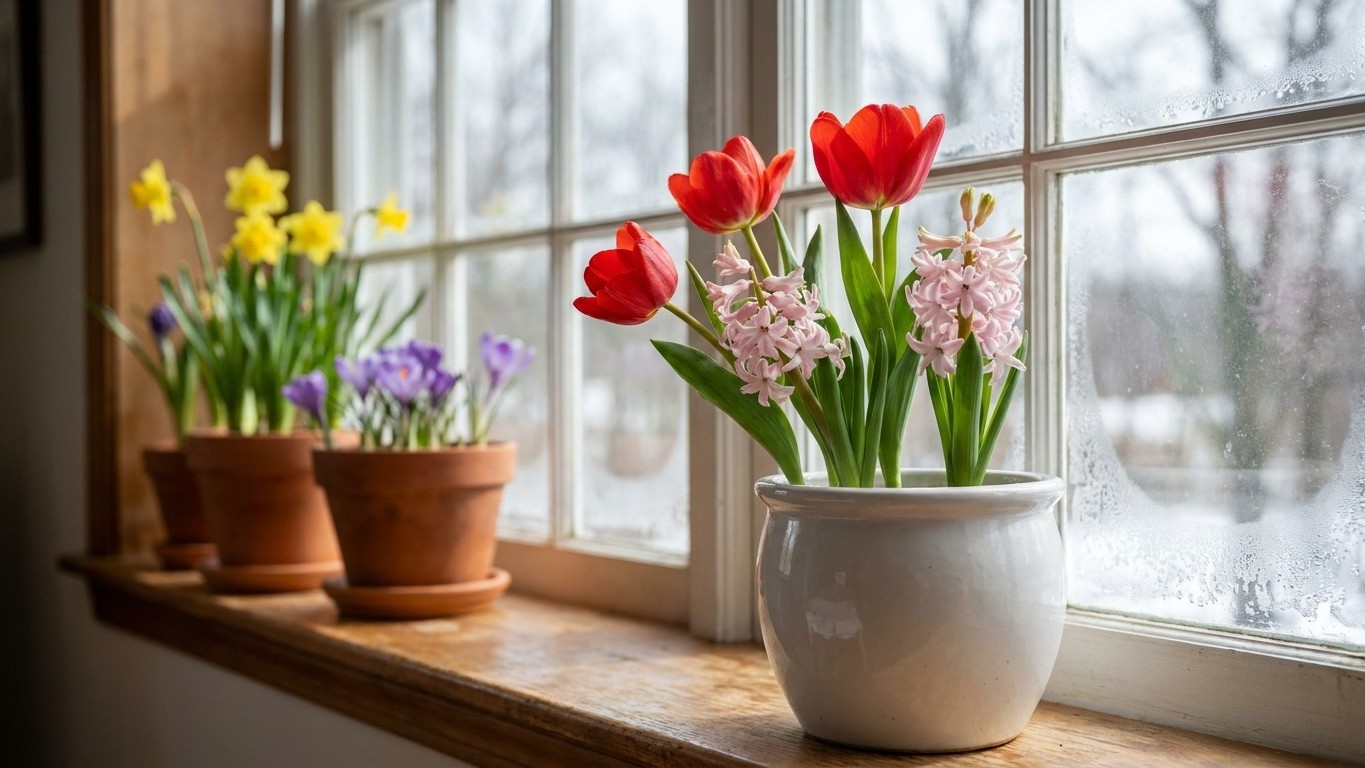

Forcing Spring Bulbs Indoors works in Maryland the same way it works everywhere: you trick a bulb built for a Mid-Atlantic winter into blooming weeks before the ground outside would let it. The technique itself doesn’t change from state to state. What changes here is why a gardener bothers, and which container choices actually survive a Maryland winter porch.
Why this matters in Maryland

The coldest month here averages a daily minimum of 25.4°F, based on NOAA NCEI Climate Normals for 1991-2020 measured at the Baltimore reference station. That figure matters more than the record low anyone remembers from a bad February: it describes how cold a typical night gets, on average, during the coldest stretch of the year, and it says winter in this part of the state is long and reliably cold, not marginal.
Ground bulbs already get enough cold
A tulip or hyacinth planted in the ground needs twelve to fourteen weeks below 45°F before it can flower. Baltimore’s winter numbers meet that requirement without any help from a gardener. The USDA Plant Hardiness Zone Map, 2023 edition, built on the same 1991-2020 normals, places Maryland across a 5b-8a range, wide enough that a bed in the western part of the state sits in a colder zone than one near the Chesapeake. Even the mildest pocket of that range still delivers more cold, for longer, than a forced bulb needs. The deficient-winter problem that drives forcing in warmer climates simply doesn’t apply to a garden bed here. Forcing indoors, in that case, is a choice rather than a rescue, done to move color onto a windowsill in the dead of winter or to grow a display where there’s no bed to plant in at all.
Containers are a different story
The situation that does bite in Maryland is the container one. A pot left outdoors on an unheated porch or patio has no surrounding soil mass to buffer the cold the way an in-ground bed does. At a coldest-month average minimum of 25.4°F, an exposed pot can freeze solid, roots and bulb together, on a below-average night, even though the identical bulb would ride out that same winter without trouble in the ground a few feet away. The zone printed on a bulb tag describes in-ground survival, not container survival, and that gap is exactly why a hardy bulb rated for a Maryland zone can still die in a pot on a Maryland porch.
How to do it here
The forcing method doesn’t change from state to state; what changes is where a Maryland gardener finds a space that holds 35 to 45°F for weeks at a stretch without freezing solid. An unheated garage, an enclosed mudroom, or a spare refrigerator each solve that problem, and the choice mostly comes down to how many pots need chilling at once.
The chilling sequence
- Pick bulbs sized for a pot, favoring a shorter, known cold requirement over the tallest daffodil or tulip in the catalog. Height and cold weeks both matter once the pot goes into storage.
- Plant in a container with drainage holes, setting bulbs shoulder to shoulder in well-drained potting mix with tips just above the surface, then water once at planting.
- Find a space that holds 35 to 45°F. An unheated garage works as long as it stays above freezing on the coldest nights; a refrigerator crisper drawer works year-round but only if it never drops below freezing either.
- Keep the pot away from ripening fruit. Apples, pears, and other ripening produce release ethylene gas, and ethylene kills the flower bud inside a chilling bulb before it ever reaches a windowsill.
- Hold the cold for twelve to fourteen weeks. Mark the calendar date the pot goes into storage; pulling it early is the single most common reason forced bulbs fail to flower.
- Check moisture every few weeks. Potting mix in a garage or fridge dries out slowly but does dry out; water lightly if the surface feels dry, and never let the pot sit in standing water.
- Bring the pot into low light first, for about a week, before moving it into full sun. This lets the stem lengthen before the leaves and flower race to catch up.
- Move to a sunny window once shoots reach two to three inches. Bloom typically follows within two to four weeks from there.
Adjusting for a container left outdoors
For a pot that stays outdoors all winter instead of moving to a garage or fridge, the container needs to be rated at least two USDA zones hardier than the bulb inside it, since a pot loses the insulating soil mass a garden bed provides for free. Where that isn’t practical, the alternative is to sink the whole pot into the ground for the winter, or to wrap it in mulch and push it against a heated foundation wall, giving the container the buffer the open ground would have supplied on its own.
Which bulbs are worth it
Forcing rewards a bulb with a short cold requirement and a stem that stays short enough for an indoor pot. A crocus that needs eight weeks of chill and grows four inches tall is a far easier candidate than a tulip that needs sixteen weeks and grows two feet. Most forced bulbs are also a one-season purchase regardless of the technique: once forced, spring bulbs are usually too depleted to bloom well again even if replanted outdoors afterward, so the trade-off costs nothing extra for a bulb that was never going to come back a second year anyway.
Bulbs that force reliably in Maryland conditions
- Paperwhite narcissus: needs no cold period at all, blooms in three to four weeks from planting, the most forgiving option for a first attempt.
- Crocus: short cold requirement, short stem, holds up well in a small pot.
- Muscari (grape hyacinth): similarly short cold need and stem height, blooms compactly.
- Hyacinth: a moderate requirement of roughly ten to twelve weeks, with a sturdy stem that stands upright indoors.
- Dwarf iris (Iris reticulata): short, early-blooming, and rarely topples.
- Short species and dwarf tulip varieties: force more reliably than tall hybrid types.
Bulbs that tend to sulk
- Tall Darwin hybrid and tall single tulips: the long stem topples in a pot before or right after opening.
- Large trumpet daffodils: height plus a longer cold requirement make timing and staking harder indoors.
- Allium: the cold requirement runs long and the mature stem is too tall for most indoor containers.
- Fritillaria: finicky about moisture and cold timing, with a low success rate even among experienced gardeners.
What goes wrong, and when you can still fix it
Leaves but no flower
Plenty of green growth with no bud, or a bud that never opens, almost always means the cold period ran short. A bulb chilled for eight or nine weeks when it needed twelve to fourteen has enough stored energy to push leaves but not enough to commit to flowering. There’s no fix for the pot in front of you this season; the bulb has already spent what it had on foliage. The lesson carries to the next batch: mark the storage date and hold the full stretch before moving anything into light.
A flower on a stem too short to see
A bloom that opens low, half hidden among the leaves, usually means the pot moved from cold storage into bright light too fast. Bulbs need that week or so in low light after chilling to let the stem stretch before the flower opens; skip it and the plant rushes straight to bloom on a stem that never lengthened. This can’t be reversed once the flower has opened. Next time, give the low-light transition its full week before the pot reaches a sunny window.
Rot in the pot
A soft, discolored bulb or a moldy smell in the potting mix points to standing water, usually from a container without drainage holes or a saucer left full during the storage weeks. Once a bulb has gone soft, it won’t recover this season or any other; the tissue that would produce roots and a flower is already breaking down. The fix applies to the next planting: drainage holes, a well-drained mix, and no saucer left standing full of water for weeks at a time.
Related guides
- Growing Spring Bulbs in Containers in Maryland
- Forcing Spring Bulbs Indoors in Massachusetts