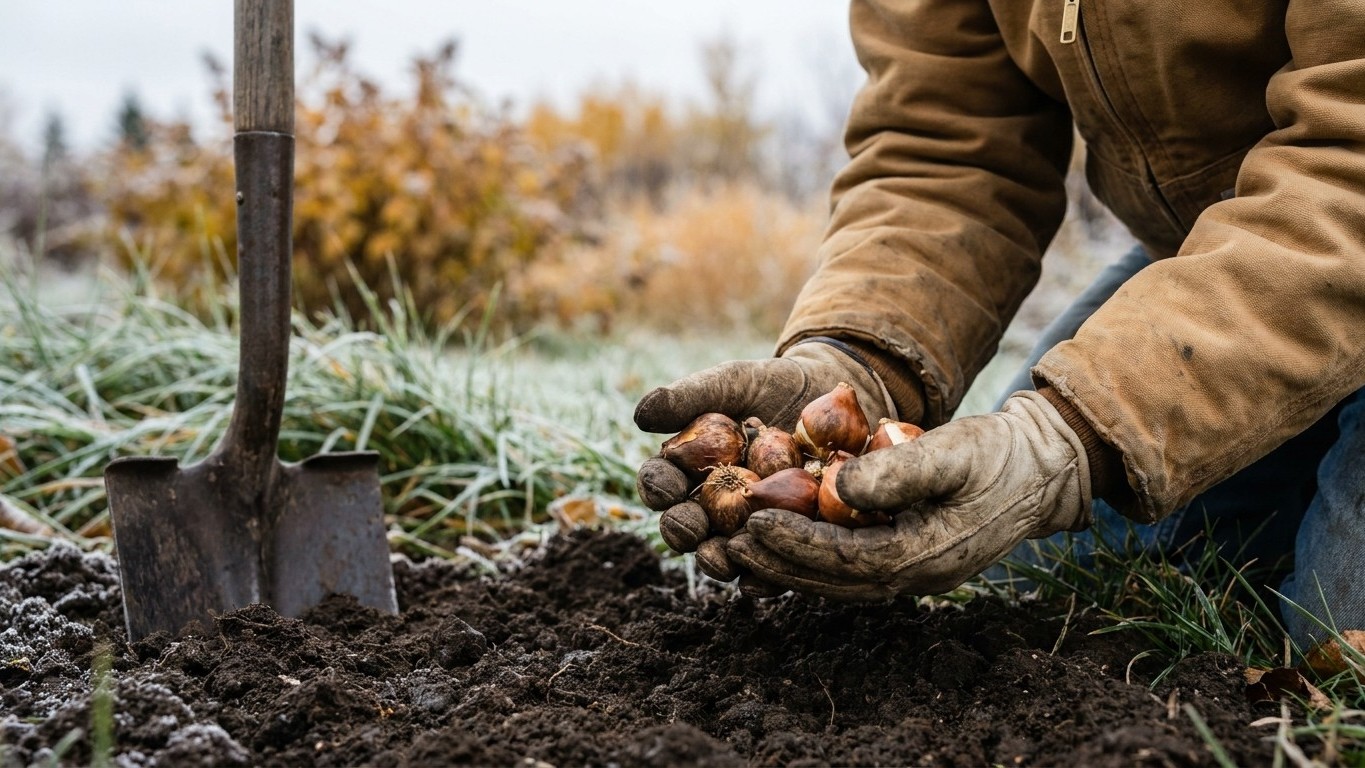

Bulbs go into Manitoba ground from late September through mid-October, and the province’s brutal winter cold (a coldest-month low averaging -6.6°F) hands most spring bulbs far more chilling than they need to bloom. That surplus means daffodils, crocus, and species tulips do well here. It also means a few catalog favorites, hyacinths and anemones among them, disappoint no matter how the bulb bag is marketed.
When to plant bulbs in Manitoba

Winnipeg’s average first fall frost lands on September 22, according to Environment and Climate Change Canada’s 1981-2010 climate normals for the Richardson International Airport station. That date is the anchor for the planting window, not the planting date itself. Ground doesn’t freeze solid the moment frost first touches the grass; the hard freeze that locks bulbs into place typically follows weeks later, so the real window opens once soil has cooled from that first frost and runs until roughly six weeks before the ground seizes up for winter. In practice, that puts most Manitoba gardeners planting from the last week of September through the back half of October.
Both ends of that window carry a real cost. Plant too early, while soil is still warm from summer, and a bulb reads the warmth as spring: it pushes up a shoot before the cold ever arrives, and that shoot dies the first hard freeze, taking a chunk of the bulb’s stored energy with it. Plant too late, after the ground has already started locking up, and roots never get established before freeze-up. A bulb that goes in without roots either comes up stunted the following spring or doesn’t come up at all, having sat in cold, un-rooted soil all winter.
The frost date is an average, not a guarantee
September 22 is a mean drawn from three decades of records, which means it splits the years roughly down the middle. In about half of all years, the first hard frost arrives later than that date, sometimes by two weeks or more. Treat September 22 as the midpoint of a window, not a line you can plant right up against. Gardeners who wait for a calendar date instead of watching actual soil conditions are gambling on the wrong half of that split.
Whether your winter is cold enough
Here’s the test every spring bulb has to pass before it will flower: a stretch of roughly twelve to fourteen weeks with soil temperatures below about 45°F. Skip that requirement, and a bulb typically puts up leaves with no flower at all, or a bloom stalk so short it never clears the foliage. This is the number to hold onto whenever a bulb catalog, a garden center display, or a neighbor’s advice tells you something will “grow fine” without saying anything about cold. If the source doesn’t mention weeks of chilling, it hasn’t actually answered the question that decides whether you get flowers. For gardeners who want blooms before spring even arrives outdoors, that same chilling requirement is also the basis for Forcing Spring Bulbs Indoors in Manitoba.
Manitoba doesn’t come close to falling short on this front. The coldest month here averages a nightly low of -6.6°F, and that kind of cold settles in early and holds on late, keeping soil well below 45°F for a stretch that dwarfs anything a bulb requires. Where warmer regions worry about whether their winter delivers enough chill, and sometimes need to pre-chill bulbs in a refrigerator for twelve weeks (kept well away from ripening fruit, since the ethylene gas fruit gives off kills the flower bud forming inside the bulb), that whole workaround is irrelevant here. The ground does the job on its own, for free, every single year.
The margin buys Manitoba gardeners a long list of workable bulbs and zero fuss over chilling schedules. It does not, on its own, protect a bulb that simply isn’t built to survive this kind of cold in the ground at all, which is a separate problem covered in the next section.
Chill requirement by species
| Bulb | Weeks of cold needed | What Manitoba delivers | Verdict |
|---|---|---|---|
| Tulips (hardy species types) | 14-16 weeks below 45°F | Far more, for a longer stretch | Chill requirement met with room to spare |
| Daffodils | 12-16 weeks | Far more | Met easily |
| Crocus | 8-15 weeks | Far more | Met easily |
| Hyacinths | 12-15 weeks | Met, but not the issue here | Cold requirement fine; overall hardiness is the weak point |
| Alliums | 8-10 weeks | Far more | Met easily |
| Ranunculus | Not a cold-chill flowering bulb; a tender corm | Winter cold kills the corm outright | Fails; must be lifted or grown as an annual |
Which bulbs suit Manitoba
Bulb catalogs still print USDA hardiness ranges on their tags even for bulbs sold north of the border, since that’s the industry-standard scale in the trade. Manitoba’s own official rating, from Natural Resources Canada’s Plant Hardiness Site, is zone 3b in the Canadian system, a seven-variable scale that doesn’t convert one-for-one to the single-variable USDA numbers on a bulb bag, so the two shouldn’t be stacked on the same ruler. What lines up directly is temperature: the coldest month here averages a nightly low of -6.6°F, and any bulb whose stated range doesn’t promise survival at that kind of cold is one that won’t make it through a Manitoba January, whatever zone number is printed on the package.
Bulbs whose published hardiness range covers this kind of cold, and that also clear the chill requirement above, do well here:
- Daffodils (Narcissus) — USDA zones 3-8
- Siberian squill (Scilla siberica) — USDA zones 2-8
- Snowdrops (Galanthus) — USDA zones 3-7
- Crocus — USDA zones 3-8
- Grape hyacinth (Muscari) — USDA zones 3-8
- Alliums — USDA zones 3-8, depending on species
- Species tulips (e.g., Tulipa tarda) — USDA zones 3-8
A few bulbs sold right alongside those will let a Manitoba gardener down, and it’s worth knowing how before spending the money. Hyacinths (USDA zones 4-8) sit at the ragged edge of what this cold allows; the bulb often survives but the flower stalk comes up shortened and frost-nipped, a pale copy of the display on the packaging. Hybrid tulips bred for garden-center color, as opposed to species types, frequently rot in Manitoba’s wet spring thaw or peter out to leaves-only after the first year, since heavy prairie clay holds meltwater right against the bulb. Anemone blanda (USDA zones 5-9) and ranunculus (USDA zones 8-10) simply freeze solid and die; neither is built to overwinter in ground this cold. None of these ranges are a hard line. A hyacinth tucked against a south-facing foundation wall, sheltered from wind, sometimes outperforms the same bulb planted in an open bed. Microclimate moves the boundary; it doesn’t erase it.
What digs them up here
Squirrels and voles are choosy for a chemical reason, not a random one. Daffodils and every bulb in the onion family contain compounds that make them bitter or mildly toxic to rodents, so they’re left alone almost every time. Tulips and crocus contain no such defense and rank among the first bulbs cleaned out of a freshly dug bed, sometimes within hours of planting.
- Usually left alone: daffodils, alliums, snowdrops, grape hyacinth
- Frequently dug up: tulips, crocus
The one method that consistently works is physical: lay galvanized wire mesh flat over the planting bed, pinned down at the edges, and leave it in place until the ground freezes hard. By the time the ground thaws in spring, the shoots come up through the mesh gaps while the mesh itself has done its job protecting the bulbs through the vulnerable fall and early winter window. Repellent sprays and granules, by contrast, wash off with the first good rain or snowmelt and need constant reapplication to do anything at all, which makes them a poor match for a fall planting that then sits untouched for months.
Where to check for your own county
Manitoba stretches across a wide range of latitude, from farmland near the U.S. border to communities hundreds of miles north toward Hudson Bay, and the figures on this page describe conditions at the Winnipeg reference station used by Environment and Climate Change Canada and Natural Resources Canada. A planting calendar built around that one city can run three weeks or more off the mark at either edge of the province: a garden near Brandon or in the Interlake region can see frost land earlier than Winnipeg’s average, while a sheltered spot along the Red River Valley sometimes runs a touch milder.
For conditions specific to your own municipality, Manitoba Agriculture maintains the extension resources and regional contacts that track local frost patterns and soil conditions more closely than a province-wide average ever can. A quick call or visit to their regional office is worth more than any generic planting calendar, especially for anyone gardening outside the Winnipeg area where these numbers were measured.