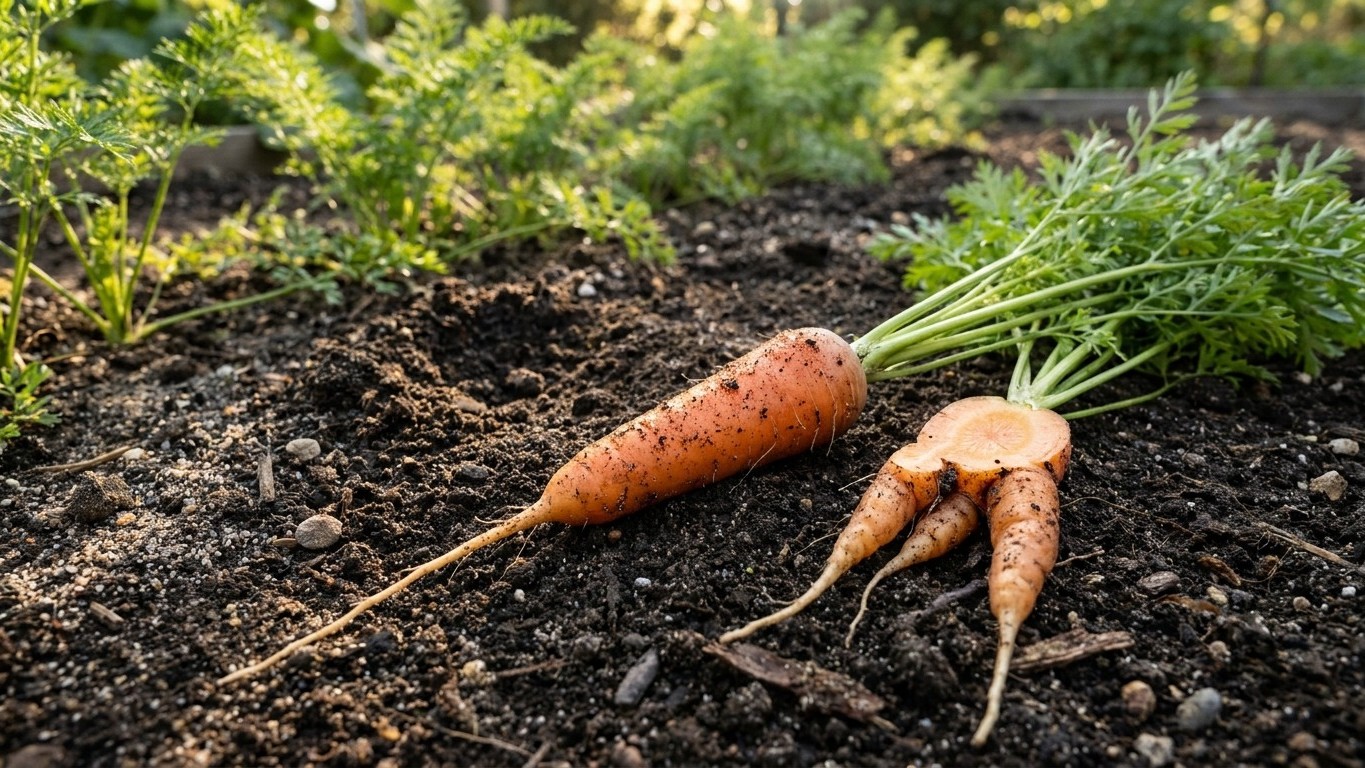

The short, honest answer: the verified data behind this page does not include a documented list of insect species feeding on carrots specifically in Manitoba. What the sourced figures do cover is the soil the province mostly grows carrots in, and the storage window once they’re pulled. That matters more than it sounds, because much of what gardeners blame on bugs is actually the ground working against the root.
Which pests attack carrot in Manitoba
There’s no province-specific insect list in the sourced facts for this page. That’s a real gap, not an oversight to paper over with a guess, and it means this section won’t name species it can’t back up. What it can do is explain why the gap matters and point to what the actual soil data says about root stress, which often gets mistaken for insect feeding.
Manitoba’s mapped agricultural soils are most commonly Chernozem, the dark, organic-rich prairie soil that covers 41 percent of the mapped surface, with Gleysolic soils as the next most common type. The median surface texture runs 45 percent sand, 24 percent clay, and 31 percent silt, a loam-to-silt mix, with organic matter around 5.5 percent and a median pH near 7.6, on the alkaline side. Drainage across these mapped soils is described as imperfect.
None of that tells you what’s chewing on a leaf. But it tells you something a lot of gardeners overlook: a root that forks, stalls, or looks stressed in clay-heavy or poorly drained ground can look exactly like pest damage without an insect anywhere near it. Carrots want deep, sandy, well-drained soil loaded with organic matter, according to Utah State University Extension, and heavy or rocky soil makes the root fork on its own. In a province where Gleysolic (poorly drained) soils sit right behind Chernozem in frequency, that’s not a rare edge case.
This is also why the province’s own extension service matters more than a general list would. Insect pressure varies field to field and even bed to bed, and a documented species list, when one exists, belongs to the agency that tracks it locally, not to a generic page. Until that source is confirmed, the responsible move is to name none, rather than dress up a guess as a fact.
When each one shows up, and what it does first
Without a confirmed species list for Manitoba, there’s no verified insect calendar to lay out here either, and no frost-free window figure in the sourced data to anchor one against. What can be laid out, reliably, is the carrot’s own timeline, because that’s what tells a grower when to actually look closely.
Carrots are sown directly in the ground. There’s no transplant date to count from, no seedling tray stage to watch, just the seed going into soil and staying there. Utah State University Extension puts full maturity at 70 to 100 days from seeding, and Clemson Cooperative Extension notes that harvest can start around 65 to 75 days after planting, depending on how the roots are sizing up. That’s the frame to hang any symptom against, not a calendar month.
Early on, while the root is still thin and the plant is putting energy into leaf growth, stress shows up as wilting or yellowing that can come from uneven watering just as easily as from anything feeding underground. As the root starts to bulk up, forking becomes visible, and in Manitoba’s imperfectly drained, clay-carrying ground, that timing lines up with when compacted or waterlogged soil does the most damage to a swelling taproot. Near the 65 to 75 day mark, when roots are sizeable enough to pull and check, surface scarring or tunneling, if present, becomes easiest to actually see and photograph for an extension agent.
The practical habit worth building is checking a few roots at each of those stages rather than waiting for harvest day to find out what happened underground. Pulling one test carrot around day 60 costs nothing and tells you more than staring at the foliage ever will.
Telling the damage apart from everything else
A forked, stunted, or oddly colored carrot doesn’t announce its own cause, and treating it as pest damage by default is one of the most common missteps in a home garden. The soil is the first suspect to rule out, before an insect is ever assumed.
Heavy or rocky ground forces roots to split around obstructions or dense clay, producing a fork that has nothing to do with feeding. Uneven watering produces cracking or stunted growth that can mimic early stress from underground pests. Manitoba’s median soil texture, with clay running to 24 percent and drainage described as imperfect, is exactly the profile that produces this kind of forking on its own.
| What you see | Likely cause | What tells them apart |
|---|---|---|
| Forked or split root | Heavy, compacted, or rocky soil | No feeding marks or tunnels; shape distortion, not surface damage |
| Wilting foliage, no root growth | Uneven watering or poor drainage | Soil around the root is waterlogged or bone-dry, not just the plant |
| Surface tunnels or holes | Insect feeding | Visible entry points or channels in the root itself |
| Stunted, pale foliage | Nutrient deficiency or crowding | Whole rows affected evenly, not isolated plants |
The line that actually settles it, most of the time, is whether the damage is on the root’s surface (feeding, usually) or in its shape (soil and water, usually). A gardener can go a long way just by pulling one suspect carrot, rinsing it off, and looking at whether the problem is a hole or a shape. Beyond that point, a confirmed diagnosis belongs to a provincial or extension agent who can look at the actual sample, not a general description of symptoms on a webpage.
What actually works here, and what is a waste of time
On ground that runs to clay and drains imperfectly, as much of Manitoba’s mapped soil does, the highest-value move isn’t a treatment at all. It’s fixing the soil the root has to grow through. Working in compost and loosening the bed to a full spade’s depth before seeding does more for a straight, undamaged carrot than anything applied after the fact. Utah State University Extension specifically recommends double digging heavy soil and adding plenty of organic matter, precisely because that’s what prevents the forking in the first place, rather than trying to fix it once roots are already split.
A physical barrier, laid down before the crop is up, beats almost anything sprayed on afterward, mainly because a short growing season leaves little room for a treatment to catch up once damage is already visible. Timing the check-ins to the 60-to-75-day root development window, rather than waiting for a full harvest to size up the crop, catches problems while there’s still time to respond.
What’s a waste of time: guessing at a pest and reaching for a general-purpose product without a confirmed identification. This page names no product, no active ingredient, and no rate, because that call belongs to whichever pesticide is actually registered for use in Manitoba, and that’s a provincial matter, not a website’s. Applying something without knowing what’s actually causing the damage risks treating a soil problem with an insecticide, which fixes nothing and wastes both money and a growing season that’s already short.
At harvest, the highest-payoff habit is one storage step: cut the tops off before storing. Clemson Cooperative Extension notes that bunched carrots with tops still on keep only 10 to 14 days, because the leaves keep pulling moisture out of the root, while trimmed roots stored at 33°F with high humidity hold for months. That’s barely above freezing, not a root cellar guess, and it’s the difference between carrots that make it to late season and ones that go soft in two weeks.
Where to check this for your own county
Manitoba doesn’t divide into counties the way U.S. states do; its local government units are rural municipalities, and that’s the level at which insect pressure actually varies. A pest documented somewhere in the province tells a reader almost nothing about whether it’s present in their own bed, because the sourced soil data on this page already shows how much variation exists within a single province, from Chernozem to Gleysolic, from well-drained to imperfectly drained, all mapped in the same territory.
Manitoba’s provincial agriculture department functions the way a state extension service does in the U.S., though it isn’t part of the verified figures used to build this page. It’s the right outlet to check for a locally documented insect list, since what’s confirmed here covers soil texture, pH, and storage, not species identification. A soil test, run through that same channel, is the one step that turns the province’s median numbers into an actual answer for a specific garden, rather than a starting assumption.
The next move for a home grower isn’t to keep researching pest names online. It’s to pull a sample root showing the damage, take it (or a clear photo of the cut surface) to the nearest provincial agriculture office, and ask what’s confirmed locally this season. That’s the only way a symptom on a real plant turns into a real answer.
Common questions
Does Manitoba’s soil actually cause carrot problems that look like pests?
Yes, often. With clay running to 24 percent and drainage described as imperfect across the province’s mapped soils, forked or stunted roots are common without any insect involved, especially where organic matter hasn’t been worked in.
How long can carrots sit in the ground before I check for damage?
Utah State University Extension puts full maturity at 70 to 100 days from seeding, with Clemson Cooperative Extension noting harvest can begin around 65 to 75 days. Checking a test root partway through that window, rather than waiting for full harvest, catches problems earlier.
Should I add lime or sulfur to change my soil pH for carrots?
The province’s median surface pH runs around 7.6, alkaline, but that’s a province-wide median, not a reading for any specific garden. A soil test through the provincial agriculture department settles what a given bed actually needs, rather than guessing from a regional average.
Why do my stored carrots go soft so fast?
Almost always because the tops weren’t trimmed. Clemson Cooperative Extension found bunched carrots with tops on keep just 10 to 14 days, while roots stored at 33°F with the tops cut off and high humidity maintained last for months.