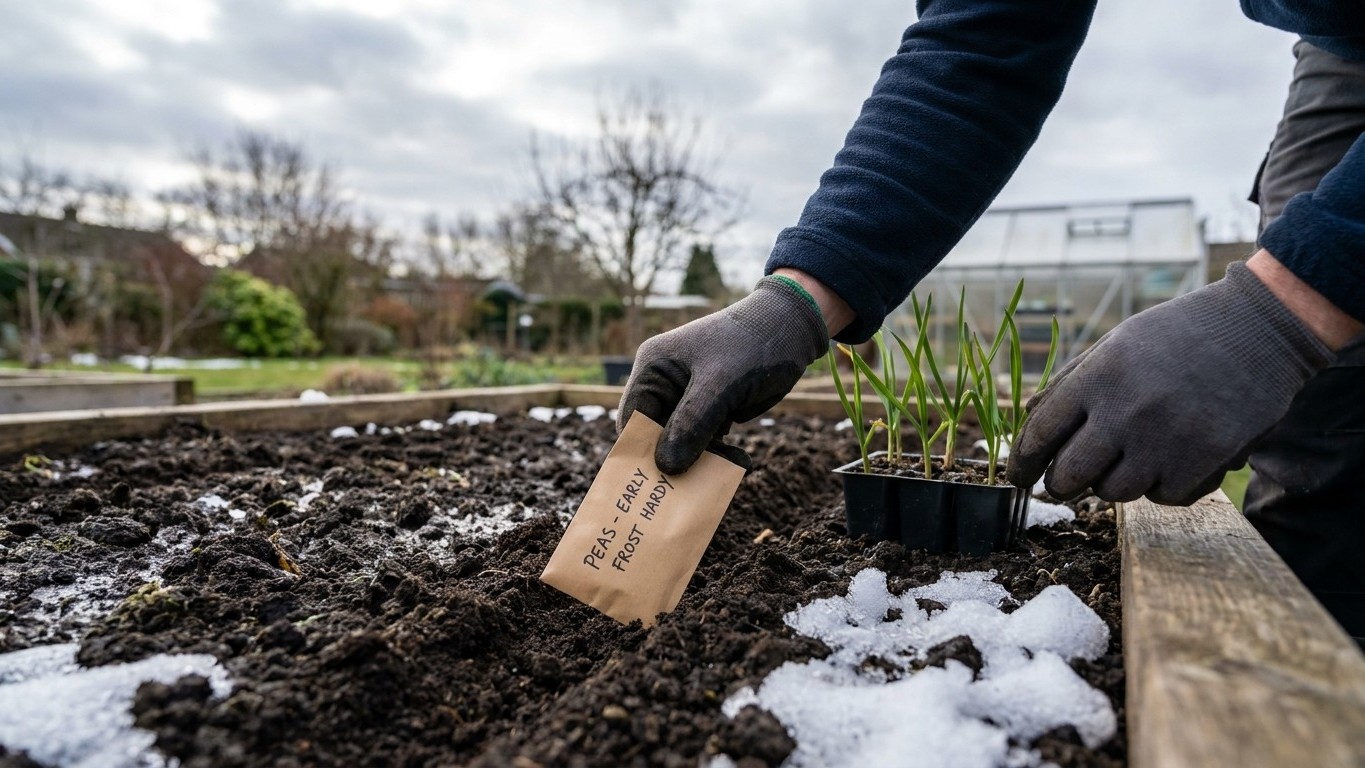

April in Manitoba sits about a month before the average last frost, so outdoor planting stays limited to the hardiest crops and the earliest soil-working window. Garlic, peas, and cold-tolerant greens can go in once ground thaws and dries; tomatoes, peppers, and squash still belong indoors under lights, not in the garden bed.
What goes in the ground in April

The decision here isn’t the calendar, it’s the soil. Cold-hardy seeds and dormant plants go out once the ground can actually be worked, not once the air feels like spring. In Manitoba that threshold moves around a lot, because the province’s average last spring frost lands on May 23, based on Environment and Climate Change Canada’s 1981-2010 climate normals for the Winnipeg Richardson International Airport station. That’s a mean date, not a safe one: in one year out of two, frost arrives later than May 23. April, then, is a full month ahead of that midpoint, and often more in the north.
Manitoba’s plant hardiness zone (Canadian system, not the USDA scale used elsewhere) sits at 3b for the reference city near that station, per Natural Resources Canada’s 1991-2020 mapping. The Canadian and USDA systems don’t convert cleanly, so treat this zone number as its own reference point, not as a stand-in for a USDA figure you might see on a seed packet.
What that means for April: nothing tender goes outside. No tomatoes, peppers, squash, cucumbers, beans, or corn direct-sown or transplanted. What does work, once frost has left the top few inches and the ground has dried enough not to clump in your hand:
- Garlic and shallots, if fall planting didn’t happen and the ground is workable
- Peas and fava beans, direct-sown as soon as soil can be dug
- Hardy greens (spinach, arugula, mustard) under a cold frame or cloche
- Onion sets and asparagus crowns, later in the month in the south if soil has dried
- Bare-root fruit trees, shrubs, and cane fruit, while still dormant
Anything on that list is a bet on drainage and timing, not a guarantee. If the ground is still frozen a few inches down or standing in meltwater, wait.
What to start under cover
Work backward from May 23, the mean last frost. Crops that need six to eight weeks of indoor growth before transplanting, such as broccoli, cabbage, and lettuce, should have started in mid-to-late March to be ready right around that date. Sowing them in April still works, it just pushes the transplant date a couple of weeks later, which is fine for cold-tolerant transplants that can handle a light frost anyway.
Tender, slow crops are a different story. Peppers and eggplant typically need eight to ten weeks indoors before they’re ready to go out, and they don’t go out until well after the frost-free window opens, ideally with a buffer past May 23 rather than right on it. Sown in early April, they land close to transplant-ready by early-to-mid June, which is a reasonable target in a zone 3b growing season. Tomatoes need less lead time, six to eight weeks, so an early April sowing puts a transplant-ready plant in front of you by late May, right around when the risk of frost has genuinely dropped.
Two ways this goes wrong. Start too early, and seedlings sit indoors for weeks past their prime, turning leggy and rootbound in trays too small for them. Start too late, especially with long-season crops, and the plant never catches up before the first fall frost, which averages September 22 at the same station, again a mean date rather than a guaranteed one. In a season this compressed, a couple of lost weeks at either end matters more than it would farther south.
What is ready to pick
Outdoors, April in Manitoba produces little to nothing fresh. That’s not a gap in planning, it’s the season. What still feeds the table comes from what was stored or protected months ago. Overwintered kale or leeks, if they were mulched heavily and survived under snow cover, can come out as soon as the ground around them thaws, and the cold exposure usually sweetens their flavor rather than ruining it.
A cold frame running spinach, mâche, or hardy kale through the winter may already be at picking size, since even weak April sun inside a frame warms the soil faster than the open garden. Indoors, sprouts and microgreens on a windowsill are the fastest fresh food available this month, ready in one to two weeks from seed with no soil-temperature gamble at all.
Rhubarb is worth a specific mention: forcing a crown indoors in the dark, or covering an outdoor crown with an upturned bucket or barrel, pulls stalks weeks ahead of the unforced plant. Meanwhile, stored crops need a check-in. Potatoes, winter squash, and onions held since fall are waking up as sheds and root cellars warm slightly with the season. Look for soft spots, sprouting eyes, or a sweetish smell that signals rot starting, and pull those out before they spread to the rest of the bin.
The jobs that matter this month
Dormant pruning of fruit trees and cane fruit is on a real deadline here, not a flexible one. Apple and plum trees, along with raspberry canes, should be cut back before buds swell and break, because pruning after growth resumes wastes energy the plant just spent pushing new wood. This is close to the last clean window for it.
Seed ordering belongs on this month’s list too, and it’s easy to underrate. Short-season varieties bred for a compressed zone 3b growing window sell out earlier than gardeners expect, and a favorite variety missing from the shelf in May is a problem that could have been solved in April.
Soil testing pays off now while beds are bare and easy to sample. A basic pH and nutrient test tells you what to amend before planting starts in earnest, rather than guessing after problems show up in the leaves. Compost piles need turning as they thaw, and spring cleanup debris (last year’s dead stalks, fallen branches) gives them fresh material to work with.
Tools deserve an hour of attention before the rush: sharpen pruners and hoes, clean rust off spades, oil handles that dried out over winter. Beds, cold frames, and fencing often need repair after frost heave and snow load, and finding a sagging trellis or a cracked cold-frame panel now beats discovering it mid-planting. Keep checking stored crops for rot on a rotating basis rather than a one-time look, since spoilage tends to accelerate as storage areas warm.
What not to do in April
The most common mistake is planting by air temperature instead of soil temperature. A stretch of warm, sunny days can push the air into the 60s while the soil underneath stays cold and wet several inches down. Seeds and transplants for tender crops sitting in that cold, damp ground don’t get a head start, they stall or rot outright. Wait for the soil itself to warm, not just the afternoon.
A close second: stripping off winter mulch, row cover, or cold-frame protection entirely after one mild week. Manitoba springs see-saw, and a stretch of warm days is often followed by a late snow or a hard overnight freeze. Pull protection back in stages, and keep a spare layer on hand to throw back over beds if the forecast turns.
Fertilizing too early is another trap. Nitrogen applied to dormant beds or perennials that haven’t truly broken dormancy pushes soft, leafy growth right when a frost can still take it down. Wait until you see confirmed active growth before feeding.
Finally, resist tilling wet soil. Manitoba’s heavy clay-loam compacts badly when worked while damp, and that compaction can cost you drainage and root growth for the rest of the season. Squeeze a handful of soil first; if it forms a slick ball instead of crumbling, it’s too early to till.
Checking this against your own county
A province-wide planting month is a starting point, not an instruction specific to your yard. Elevation, the moderating effect of Lake Winnipeg and Lake Manitoba, and the straightforward north-south gradient across the province shift these windows by weeks in either direction. The Red River Valley in the south typically sees workable soil well before the Interlake region or the northern parts of the province catch up. For local guidance that reflects your district, Manitoba Agriculture‘s website is the place to check.
Common questions
When is the last frost date in Manitoba?
The average last spring frost at the Winnipeg Richardson International Airport station is May 23, based on Environment and Climate Change Canada’s 1981-2010 climate normals. That’s a mean date: in about half of all years, frost occurs later than that, so it should guide planning rather than set a fixed planting date.
Can I plant tomatoes in April in Manitoba?
Not outdoors. Tomatoes go outside only after the frost risk has genuinely passed, well after the May 23 average. April is the month to start tomato seeds indoors, roughly six to eight weeks before that transplant window.
What is Manitoba’s hardiness zone?
The reference city tracked by Natural Resources Canada sits in zone 3b under the Canadian hardiness system, using 1991-2020 data. This is not a USDA zone and doesn’t convert directly to one, since the two systems are built on different climate variables.
What vegetables can I direct sow in April in Manitoba?
Peas, fava beans, and garlic (if not planted in fall) are the safest direct-sown options once soil can be worked. Hardy greens like spinach and arugula can go under a cold frame or cloche for extra protection during the same window.