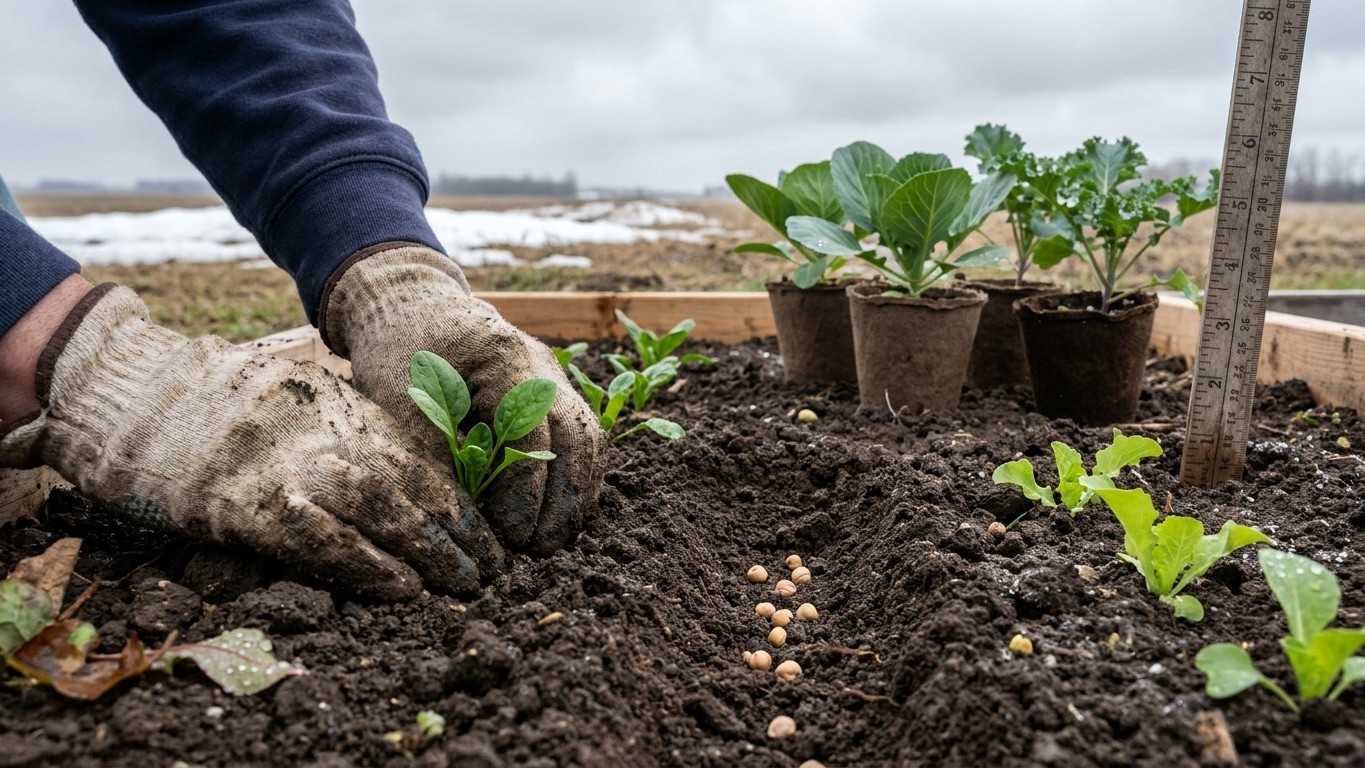

May is a transition month in Manitoba, not a green light. The average last spring frost lands on May 23, which means hardy crops and cold-tolerant transplants can go in early, while tomatoes, peppers, and other warm-season plants should wait until the back half of the month at the earliest, and even then with a backup plan for frost.
What goes in the ground in May

The decision here has nothing to do with the calendar page and everything to do with two numbers: soil temperature and how close the calendar sits to that May 23 average last frost. That date is a mean from Environment and Climate Change Canada’s 1981-2010 climate normals for the Winnipeg Richardson International Airport station, and a mean is not a guarantee. In roughly half of all years, frost arrives after May 23, sometimes well after. Treat the date as the midpoint of a window, not a finish line.
Early in the month, soil across most of Manitoba is still cold and often wet from snowmelt. Working it too soon compacts the structure and sets root crops back before they even sprout. Once the ground is dry enough to crumble in your hand rather than clump, hardy crops can go in: peas, spinach, lettuce, radish, and onion sets tolerate the cool nights and even a light frost. Potatoes are usually planted from mid to late May, once the risk of a hard, prolonged freeze has eased. Cabbage, broccoli, and kale transplants that have been hardened off outdoors for a week can also go out in this stretch, since they shrug off temperatures that would kill a tomato seedling outright.
Warm-season crops are the ones that turn May into a gamble. Tomatoes, peppers, cucumbers, squash, melons, and beans should stay indoors or under cover until the calendar is past that average frost date, and even then, keep row cover or an old sheet within reach for the first couple of weeks outside.
| Crop group | When to plant in May | Frost risk |
|---|---|---|
| Peas, spinach, lettuce, radish | As soon as soil is workable | Tolerates light frost |
| Onion sets, potatoes | Mid to late May | Tolerates light frost once sprouted |
| Cabbage, broccoli, kale transplants | Early to mid May, after hardening off | Tolerates light frost |
| Tomatoes, peppers, cucumbers, squash | Late May at the earliest, with cover ready | Killed by frost |
What to start under cover
Rather than picking a fixed date, count backward from the average last frost of May 23. Tomatoes and peppers generally need six to eight weeks indoors before they’re ready to transplant, which puts their start date in mid to late March for most Manitoba gardeners, well before this month begins. If those seedlings were started on schedule, May’s job is hardening them off outdoors in a sheltered spot for increasing stretches each day, not sowing them fresh.
What does make sense to start under cover in May is the second wave: squash, cucumbers, and melons, which only need three to four weeks before transplanting and would get leggy if started any earlier. Sowing them indoors now times their move outside for early June, safely past the frost window. Fast brassicas and lettuce can also be started under cover in small batches through the month to keep a steady supply coming once the garden bed is free of earlier crops.
Two mistakes show up every spring. Starting warm-season seedlings too early leaves you with rootbound, stretched plants sitting in cups on a windowsill for weeks longer than they should, and they rarely recover their vigor once transplanted. Starting too late is the quieter failure: with an average first fall frost of September 22, Manitoba’s frost-free season runs close to four months, and a squash or melon started weeks behind schedule may not finish before the cold returns. Both mistakes trace back to the same fix, which is working from the frost window instead of a habit or a date remembered from a past season.
What is ready to pick
Outdoor harvests in May are modest, but they’re real. Asparagus from an established bed is one of the true rewards of the month, with spears pushing up through the soil as it warms and ready to snap off once they reach six to eight inches. Rhubarb follows the same pattern, sending up thick stalks that can be harvested once they’re a solid foot or more in length, though the first-year stalks on a young plant should be left alone to build the root system.
Perennial herbs like chives and sorrel often green up early and can be snipped as soon as there’s enough growth to spare. Anything sown directly in a cold frame or under a low tunnel in April, such as spinach or leaf lettuce, may be ready for a first cutting by mid-May, giving a household its first fresh greens of the season well ahead of the open garden.
The rest of the month’s food comes from storage. Potatoes, onions, and winter squash held over from the previous fall should be checked regularly now, since rising temperatures in a root cellar or basement speed up sprouting and rot. Sort through the bins, pull anything soft or sprouting heavily, and use it first rather than letting it spoil next to sound stock.
The jobs that matter this month
Soil preparation is the single most consequential task of May, and it’s also the easiest to rush. Working ground that’s still saturated from snowmelt crushes its structure for the whole season, so wait for the “crumble test” before tilling or turning beds by hand. Once it passes, mixing in finished compost now feeds the season’s first plantings directly.
Hardening off and staking ahead of growth
Any seedling started indoors needs a hardening-off period of seven to ten days, moved outside for a few hours at a time and brought back in if a cold snap threatens. Skipping this step is one of the fastest ways to lose an entire tray of tomatoes to sunscald or wind stress. It’s also worth setting stakes, cages, and trellis frames in place before plants sprawl, since driving a stake through an established root ball later in the season does real damage.
Scouting and mulching
Flea beetles emerge early on brassicas in Manitoba, and their pinhole damage on young cabbage and broccoli leaves is easiest to control if caught in the first week or two rather than after a full-blown infestation. A floating row cover over new transplants keeps them off entirely. Once the soil has warmed, a layer of mulch around perennial beds and any hardy transplants conserves the moisture that April’s snowmelt leaves behind, before dry spells in June draw it back out. Finishing dormant pruning on fruit trees and berry canes before leaf-out fully opens, cleaning and sharpening tools, and mending any fencing or bed edges damaged by winter frost heave round out a productive May.
What not to do in May
The classic mistake is planting tomatoes, peppers, or squash into the ground because a warm afternoon made it feel like summer had arrived. Air temperature says nothing about soil temperature, and cold soil stunts warm-season roots even if the plant survives the air itself. Wait for the ground, not the thermometer on the porch.
A close second is pulling mulch or row cover off perennial beds too early after a mild stretch, only to have a late frost hit exposed new growth. Since the May 23 average is a midpoint and not a safety line, keeping protective covers within reach through the entire month, not just the first half, is the safer habit.
Fertilizer timing trips people up too. Heavy nitrogen applied early in May pushes soft, lush top growth on transplants that are still adjusting to outdoor conditions, and that tender growth is exactly what a late frost damages worst. Hold off on nitrogen-heavy feeding until plants are established and actively growing, and lean on compost worked into the soil ahead of planting instead.
Checking this against your own county
A province-wide date is a starting point, not an instruction. The May 23 average last frost comes from a single station at Winnipeg’s airport, and Manitoba’s climate is anything but uniform: northern communities, areas near Lake Winnipeg, and higher-elevation pockets can run weeks behind that figure, while some southern districts trend a little earlier. The Canadian hardiness zone of 3b cited here also applies to that reference location specifically, using Natural Resources Canada’s seven-variable system, and it does not translate to a USDA zone number. For local frost records and planting guidance tailored to your district, check Manitoba Agriculture’s extension service.
Common questions
Is it safe to plant tomatoes in Manitoba in early May?
No. The average last frost is May 23, and that’s a mean date, meaning frost arrives later in roughly half of all years. Tomatoes and other warm-season crops should wait until the back half of the month or later, with frost cover on standby.
Can peas and onions handle a light May frost?
Yes. Peas, onion sets, spinach, lettuce, and radish tolerate light frost and are typically planted as soon as the soil is dry enough to work, well ahead of the average last frost date.
What Canadian hardiness zone is used for Manitoba planting guidance?
The reference figure here is Canadian zone 3b, based on Natural Resources Canada’s system, which factors in seven climate variables. It is not a USDA zone and should not be compared directly to USDA numbers used elsewhere.
How long is Manitoba’s frost-free growing season?
Based on the average last spring frost of May 23 and average first fall frost of September 22, the frost-free window runs close to four months, though both dates are means and can shift earlier or later in any given year.