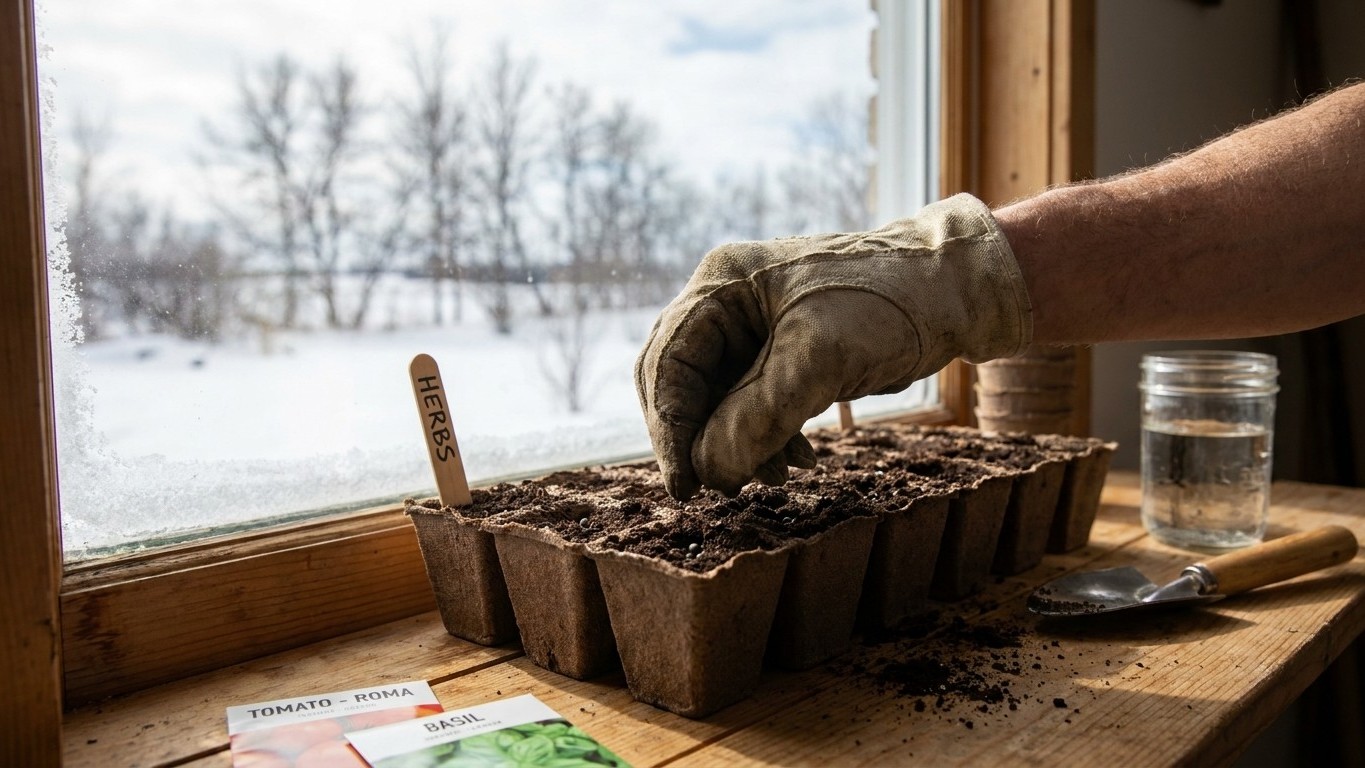

March in Manitoba is not a planting month. The province’s average last spring frost sits near May 23, and Winnipeg still carries a Canadian hardiness rating of zone 3b, which means frozen or snow-covered ground is the normal state of things through most of the month. Nothing goes into open soil yet. What happens instead: seed starting indoors, dormant pruning, chitting potatoes, and forcing rhubarb or chicory for an early taste of the season.
What goes in the ground in March

The decision about what can go outdoors never rests on the calendar. It rests on soil temperature and how far the date sits from the last frost window. Manitoba’s average last spring frost, drawn from the Winnipeg Richardson International Airport station, falls near May 23. That figure is a mean, not a guarantee: in one year out of two, the actual last frost lands later than that date. March sits roughly eight to eleven weeks ahead of that average, and for most of the province the ground itself is still frozen solid or blanketed in snow through the bulk of the month.
That reality rules out direct sowing entirely. Even crops that tolerate a hard frost, like spinach, peas or garlic cloves, need workable, thawed soil to go into, and Manitoba soil rarely reaches that point before the tail end of March at the earliest, and often not until April even in the milder southern districts near Winnipeg. Garlic and shallots, which in warmer regions might still go into the ground this month, have to wait here for the thaw.
What can move forward now happens off the garden bed:
- Chitting seed potatoes indoors in a cool, bright spot so they have visible sprouts by planting time
- Forcing rhubarb crowns in a dark, warm space for an early stalk harvest weeks ahead of the outdoor crop
- Forcing witloof chicory roots in a covered container for pale, tender chicons
- Ordering bare-root fruit trees, canes and asparagus crowns now for delivery once the ground opens
- Building or repairing cold frames so they’re ready the moment the snow retreats
None of this touches open soil, but all of it shortens the wait once the thaw finally arrives.
What to start under cover
Seed starting works backward from the frost window, not forward from a fixed date on a calendar. With an average last frost near May 23, and remembering that half of all years run later than that, gardeners in Manitoba are usually counting on transplanting warm-season crops out sometime between late May and mid-June, and hardier ones a couple of weeks earlier than that.
Counting backward from that window is what tells you when to start indoors. Onions and leeks need the longest runway, often ten to twelve weeks before they go outside, which lands the start date squarely in early to mid-March. Peppers need something close to eight to ten weeks, also pointing to March. Tomatoes need less, generally six to eight weeks, which allows a start in late March or into April depending on the variety.
| Crop | Weeks before transplant outdoors | Typical indoor start |
|---|---|---|
| Onions and leeks | 10 to 12 weeks | Early to mid-March |
| Peppers | 8 to 10 weeks | Mid to late March |
| Tomatoes | 6 to 8 weeks | Late March to early April |
| Cole crops (broccoli, cabbage) | 6 to 8 weeks | Late March |
Two mistakes show up every year at this point. Starting too early leaves transplants sitting in small pots far past their prime, rootbound and leggy long before the ground is warm enough to take them, since the average frost date doesn’t move to accommodate an eager seed tray. Starting too late, in a growing season already shortened by zone 3b conditions, means fruiting crops run out of warm weeks before they finish producing. The backward count from May 23 is the only reliable check against either error.
What is ready to pick
Outdoors, the honest answer is nothing. Manitoba gardens in March are still under snow or thawing mud in most years, and nothing planted the prior season is coming out of that ground. The harvest this month happens indoors and in storage, not in the garden.
Indoor microgreens and sprouts fill the gap well, ready in a week or two from seed and needing nothing more than a sunny sill or a grow light. Rhubarb and chicory forced earlier in the month, or started in late winter, may be reaching a pickable size by the back half of March, giving an early stalk harvest or a batch of pale chicons well ahead of the outdoor season.
The other job this month is going through the root cellar or storage shelves. Squash, potatoes and onions put up in fall are now five or six months into storage, and this is the point where the weak ones start to show it. Squash with a soft spot near the stem, potatoes going soft or sprouting heavily, and onions with a papery neck that’s gone damp all need to come out and get used before they take the rest of the batch with them. A quick check every couple of weeks through the tail end of winter is worth far more than a single inspection in fall.
The jobs that matter this month
March in Manitoba is a working month even though the garden itself is asleep. Dormant pruning of fruit trees, currants and raspberry canes belongs here, done while the plants are still leafless and before sap starts moving, so cuts heal clean and the plant’s energy goes into the buds left behind rather than into wounds made too late in the season.
Seed ordering has a real deadline attached to it. Popular varieties, especially short-season tomatoes and cold-hardy greens bred for zone 3b conditions, sell out at suppliers well before the ground thaws, and waiting until April to order often means settling for whatever’s left rather than what was planned.
- Test and amend soil where samples can be pulled, or send them out for lab analysis ahead of the spring rush
- Turn compost piles that have thawed enough to work, keeping the pile active rather than frozen solid
- Clean and sharpen pruners, loppers and shovels before the season’s first real use
- Repair raised beds, trellises and fencing while nothing is growing in the way
- Draft the season’s crop rotation plan so beds aren’t repeating the same family in the same spot
None of this is filler work invented to keep gardeners busy. A pruning cut made three weeks late, a seed order placed after the good varieties are gone, or a rotation plan skipped entirely all show up later as smaller harvests, more disease pressure, or scrambling in April to fix what March could have settled.
What not to do in March
The most common mistake in a Manitoba March is trusting a warm afternoon. A stretch of unusually mild air, even several days in a row, does not mean the soil underneath has thawed or warmed to a safe planting temperature, and pushing seed or transplants into ground that only looks ready wastes both the seed and the head start.
A second mistake follows close behind: pulling back winter mulch from perennial beds the moment the snow melts. With an average last frost near May 23, and half of all years running later than that, a mild stretch in March or even April is routinely followed by a hard freeze that damages crowns and buds newly exposed by an impatient cleanup.
- Don’t direct sow anything outdoors based on air temperature alone; soil needs to be workable, not just snow-free
- Don’t strip winter mulch off perennials at the first thaw; wait for a more settled stretch closer to the frost window
- Don’t start tomatoes and peppers too early indoors, since the season’s short window still runs from the same May frost date regardless of when the seed went into the tray
- Don’t apply nitrogen fertilizer to dormant beds or trees; growth hasn’t started, so the feed either leaches away or pushes tender growth too soon
The fix in each case is the same discipline: let the frost window and the soil, not the thermometer on a good day, decide the timing.
Checking this against your own county
A provincial average is a starting point, not an instruction for a specific yard. The May 23 average last frost comes from one station, Winnipeg Richardson International Airport, and Manitoba is not one climate. Districts north of Winnipeg, higher ground, and areas away from the moderating effect of Lake Winnipeg and Lake Manitoba can run weeks behind that figure, while some sheltered spots in the south may see soil workable slightly earlier.
For a planting calendar built around local conditions, Manitoba Agriculture is the reliable next stop: https://www.gov.mb.ca/agriculture/.
Common questions
Can I plant peas outdoors in Manitoba in March?
Not usually. Peas tolerate cold and light frost well, but they still need thawed, workable soil to go into, and most of Manitoba is still frozen or snow-covered through March. Peas are typically among the earliest direct-sown crops once the ground opens, but that point rarely arrives before April.
When should I start tomato seeds indoors for a Manitoba garden?
Counting back six to eight weeks from an average last frost near May 23 points to a start in late March or early April. Starting earlier than that risks leggy, rootbound plants sitting in pots long before the ground and air are warm enough to take them outside.
Is it too early to prune fruit trees in Manitoba in March?
No, this is close to the ideal window. Pruning while trees are still fully dormant and before sap starts moving lets cuts heal cleanly and directs the tree’s energy into the buds left behind rather than into fresh wounds.
Why does this page say the last frost date isn’t safe to plant by?
Because it’s a long-term average from Environment and Climate Change Canada, and averages have years on both sides of them. In roughly half of all years, the last frost at the Winnipeg station falls later than May 23, so treating that date as a firm green light rather than the midpoint of a range is how transplants end up damaged by a late cold snap.