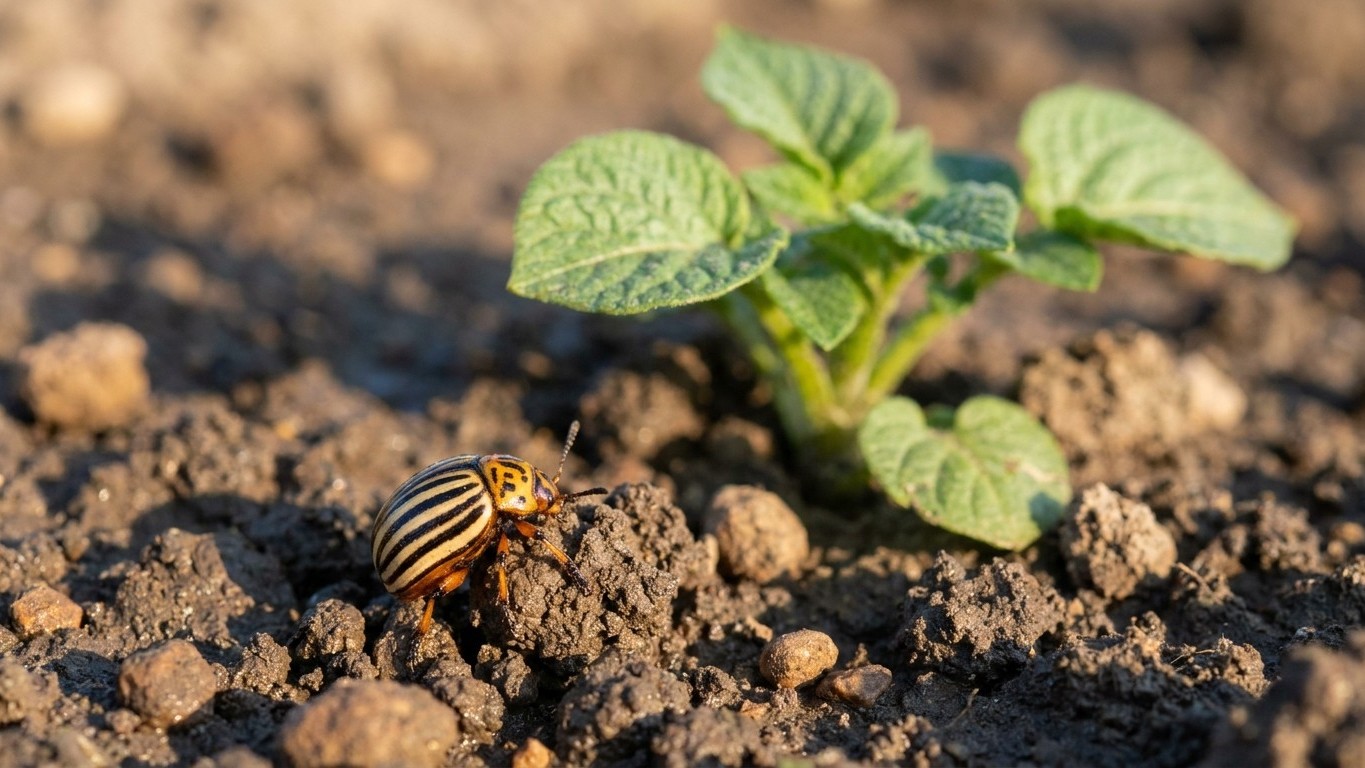

Adult Colorado potato beetles crawl out of Manitoba soil each spring once ground temperatures climb into the high 40s to low 50s Fahrenheit, usually somewhere between mid-May and the first weeks of June depending on how fast the season warms. That timing lines up almost exactly with potato emergence, which is no accident: the beetle has spent thousands of years synchronizing its life cycle with the plant family it depends on. Stopping it comes down to three things working together: catching that spring emergence early, breaking the beetle’s path between overwintering sites and new plantings, and rotating control tactics so the insect never gets comfortable with one method.
When Colorado Potato Beetles Emerge in Manitoba

Manitoba sits at the northern edge of this pest’s established range in Canada, but the province’s potato belt around Portage la Prairie and Carberry gives it plenty of habitat. The beetle overwinters as an adult, burrowed 4 to 6 inches into the soil at field edges, shelterbelts, and ditch banks near last year’s potato ground. It doesn’t fly south or die off with frost the way some pests do. It simply waits underground through a Manitoba winter that can drop well below zero, protected by soil depth and snow cover.
Spring emergence isn’t tied to a calendar date so much as accumulated warmth. Once soil temperatures at the 4-inch depth stay consistently above 50°F for several days, adults dig out and start walking. Because they’re not strong fliers early in the season, they move short distances on foot first, which is exactly why field edges and the margins closest to last year’s potato crop see the heaviest early pressure. A field planted in the same spot as the previous year’s potatoes, or right next to it, gets hit hardest and fastest.
The Life Cycle That Makes This Pest Hard to Beat
Once beetles find host plants, usually potatoes but also tomatoes, eggplant, and various nightshade weeds, females start laying eggs almost immediately. A single female can produce several hundred eggs over her lifetime, laid in clusters of a couple dozen on the undersides of leaves. Those clusters hatch within a week to ten days in warm weather.
The larvae are the real damage engine. They go through four growth stages, and the last stage does the majority of the feeding before dropping to the soil to pupate. In a typical Manitoba season, this whole cycle from egg to new adult takes roughly 30 to 45 days, which means a single generation can strip a plant of leaves in a matter of weeks if left unchecked. Depending on how warm the summer runs, the province can see one full generation and the start of a partial second generation before fall, though Manitoba’s shorter season generally limits it compared to warmer potato-growing regions farther south.
New adults from that first generation feed for a few weeks in late summer before searching out overwintering sites, restarting the whole cycle. This overlap of stages, eggs, larvae, and adults all present on the same plants at once, is part of why timing a single spray application rarely wipes out a population completely.
What Actually Stops Colorado Potato Beetles in Manitoba Fields and Gardens
No single tactic handles this pest on its own. Growers and home gardeners who get results combine physical barriers, timing, and targeted treatment rather than leaning on one approach.
Cultural and Physical Controls
Crop rotation remains the single most effective non-chemical tool. Because overwintering adults walk rather than fly toward the nearest host plants, moving potatoes at least a quarter mile from the previous year’s field forces beetles to cross more ground before finding food, and many simply won’t make it or will arrive too weak or late to reproduce well. Home gardeners with small plots can’t always rotate that far, but even moving potatoes to the opposite side of a yard from last year helps.
Straw mulch applied heavily around young plants has shown a real reduction in beetle colonization in university trials, likely because it interferes with the beetles’ ability to locate host plants by sight and scent, and it also supports ground beetles and other predators that eat eggs and small larvae. Trench barriers lined with plastic sheeting around field perimeters have been tested as a way to intercept walking adults before they reach the crop, catching them in the trench where they can be collected or die from exposure.
Handpicking adults and squashing egg clusters works surprisingly well in home gardens precisely because early-season populations start small and localized. Checking the undersides of leaves every few days from the moment plants emerge through early June catches most of the egg-laying activity before it snowballs.
Biological and Chemical Options
Several natural predators, including ground beetles, lady beetles, and spined soldier bugs, feed on Colorado potato beetle eggs and young larvae, and preserving habitat like uncultivated field margins helps keep those predator populations around. Bacillus thuringiensis subspecies tenebrionis (Bt-t) targets young larvae specifically and breaks down within days, making it a reasonable option for home gardens or organic operations because it spares most beneficial insects.
For larger plantings where beetle pressure is heavy, insecticides remain part of the toolkit, but this is where Manitoba’s potato industry runs into a well-documented problem: resistance.
Resistance Management in a Province Built on Potatoes
Colorado potato beetle holds the distinction of being one of the most insecticide-resistant agricultural pests in North America, having developed resistance to nearly every major class of chemical control used against it at some point since the mid-20th century, according to research tracked by the EPA’s insect resistance management guidance. Manitoba’s commercial potato growers, concentrated in the Portage la Prairie, Carberry, and Winkler areas, have had to adapt their spray programs specifically because of this history, rotating between different chemical classes by mode of action rather than repeating the same product season after season.
Home gardeners face a smaller-scale version of the same issue. Reaching for the same off-the-shelf insecticide every year, even at the correct rate, gives surviving beetles a chance to pass resistance genes to the next generation. Alternating between different active ingredients, or leaning more heavily on Bt-t and physical removal in years with lighter pressure, keeps chemical options viable longer.
Scouting timing matters as much as product choice. Because larvae are far easier to kill than adults, and young larvae easier than mature ones, checking plants weekly starting right at emergence and treating at the first sign of small larval clusters, rather than waiting until defoliation is obvious, produces far better control with less product overall. Manitoba Agriculture’s field crop reports have consistently flagged early-season scouting as the difference between a manageable infestation and one that requires repeated rescue treatments later in the season.
One detail that surprises a lot of gardeners: the beetle’s bright yellow-and-black striped adults are actually the easiest stage to see but among the hardest to kill with contact insecticides, since their hard shell resists penetration. The soft, humpbacked reddish-orange larvae, especially in their first two growth stages, are the vulnerable window most control programs are built around.
Related guides
- Colorado potato beetle in Saskatchewan: When It Shows Up and What Stops It
- Colorado potato beetle in Ontario: When It Shows Up and What Stops It
- Colorado potato beetle in Maryland: When It Shows Up and What Stops It
- Colorado potato beetle in Massachusetts: When It Shows Up and What Stops It
- Colorado potato beetle in British Columbia: When It Shows Up and What Stops It
- Colorado potato beetle in South Dakota: When It Shows Up and What Stops It