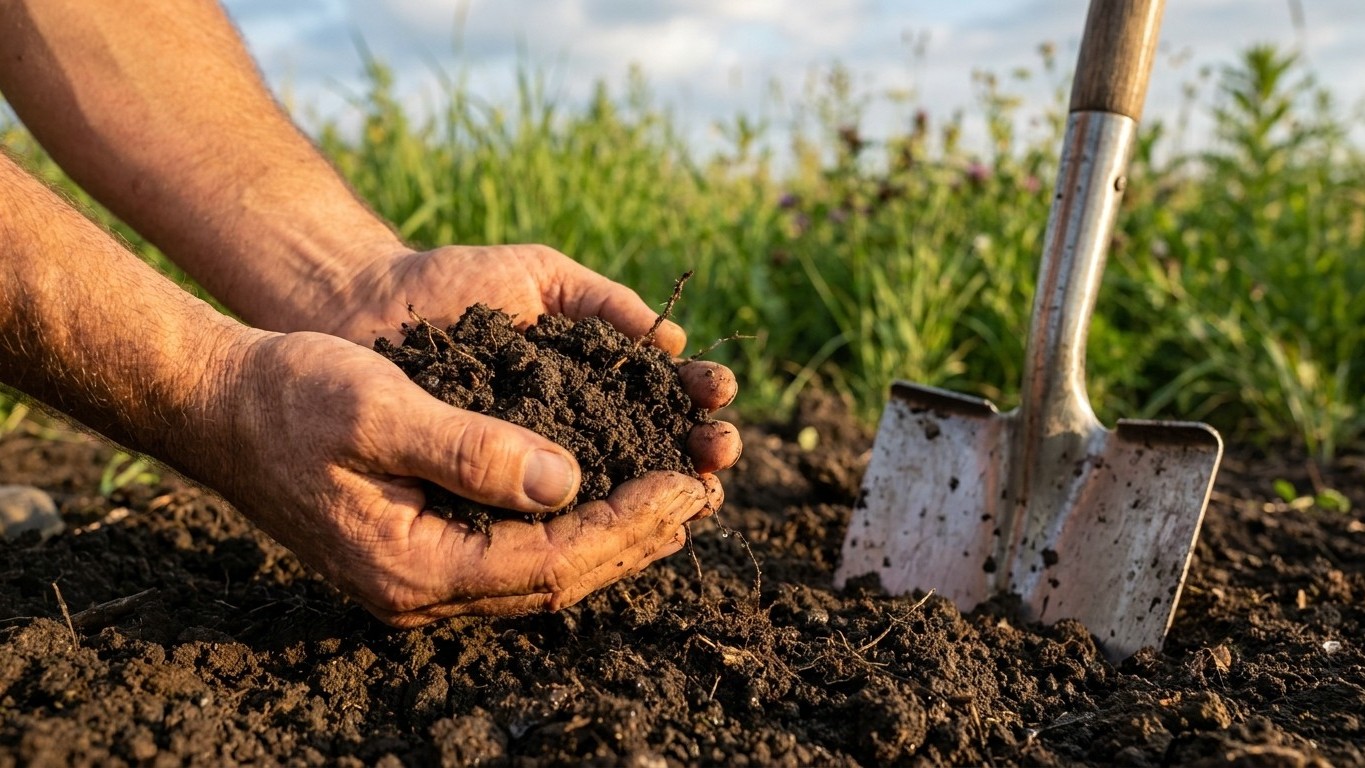

Dig a spade into most cultivated ground in Manitoba and you’re standing on a Chernozem, the dark prairie soil that built the province’s grain belt. It runs alkaline, holds decent organic matter, and drains slower than you’d like after a hard rain. Here’s what that means for your raised bed or backyard plot, and how to work with it instead of against it.
What is under your garden

Agriculture and Agri-Food Canada’s mapped soil data puts Chernozem as the most common soil order across Manitoba’s agricultural region, covering 41 percent of the mapped surface. Gleysolic soils, the wetter, poorly drained cousins found in low spots and old wetland margins, come in second. Chernozem is the classic grassland soil: centuries of prairie grass roots died back every year and built up a thick, dark, organic-rich topsoil. It’s the reason this province grows wheat and canola by the section, not the acre.
The numbers from the mapped surface horizons are specific. Median surface pH sits at about 7.6, meaning the ground leans alkaline rather than acidic. Texture comes in around 45 percent sand, 24 percent clay, and 31 percent silt, which lands in loam territory, not heavy clay, not pure sand. Organic matter runs about 5.5 percent, which is respectable and helps explain why this soil holds nutrients and moisture better than a lot of soils farther south. Drainage is classed as imperfectly drained, so water moves through slowly rather than freely.
This is a median, not your yard
That data set covers 2,535 mapped soil components across the province’s farmed regions, and it’s a median, not a promise. Your actual garden could sit on a river-bottom soil that floods every spring, on thin ground scraped down to subsoil by a builder’s excavator, or on fill trucked in from somewhere else entirely. The far north of the province, which isn’t farmland, isn’t in this data set at all. Treat the Chernozem profile as a starting expectation for what the region’s ground tends to do, not as a substitute for looking at your own dirt.
Read your own soil in five minutes
Grab a handful of moist soil from six inches down and squeeze it between your thumb and forefinger, pushing it upward into a ribbon. A ribbon that holds together for two inches or more before breaking tells you clay is dominant. One that won’t ribbon at all and just crumbles is sandy. Something in between, holding an inch or so, is loam, which lines up with what the mapped data suggests for much of the province.
Back that up with a jar test. Fill a clear quart jar about a third full of soil, top it with water, shake hard, and let it sit overnight undisturbed. Sand settles first and sits at the bottom by morning, silt layers above it, and clay stays suspended longest, often leaving cloudy water for a day or two before settling as the finest top layer. Measure the bands and you’ve got a rough percentage breakdown of your own ground, no lab required.
Testing before you amend
Dumping lime, sulphur, or fertilizer on a hunch is how people waste a season and money on top of it. A soil test tells you the actual pH, the actual nutrient levels, and often the organic matter percentage for the specific patch you’re planting, none of which you can reliably judge by eye or by how the leaves look this week.
How to pull a sample that means something
One scoop from one spot isn’t a sample, it’s a guess. Pull six to eight cores from across the bed or plot, each going down to the depth where roots actually live, roughly six inches for vegetables and shallower for lawns. Mix those cores together in a clean bucket, remove rocks and roots, and send in about a pint of the blended soil. That composite gives you a number that represents the whole area instead of one lucky or unlucky spot.
What the results actually tell you
The lab report will hand back pH, phosphorus, potassium, and usually an organic matter estimate, sometimes with recommendations attached. Given that the region’s mapped median pH runs around 7.6, alkaline, it’s reasonable to expect your own result will land somewhere in that neighborhood too. But expecting isn’t knowing. Soils shift block to block depending on old construction fill, decades of lawn fertilizer, or a low spot that collects runoff, and the only way to know your number is to test it.
Amending it
With a median surface pH around 7.6, Manitoba’s mapped agricultural soil sits solidly on the alkaline side, and that changes what belongs in your amendment bucket. Lime raises pH. On ground that’s already at 7.6, adding lime pushes it further into territory where nutrients start locking up. Skip it entirely on this soil unless a test comes back showing an unusually acidic pocket, which does happen in isolated spots but isn’t the regional pattern.
The honest, slow route down is elemental sulphur worked into the topsoil, combined with steady additions of organic matter like compost or aged manure. Sulphur needs soil bacteria to convert it to sulfuric acid, and that process takes a full season or more to show up in a retest, not weeks. Compost does double duty, buffering pH slightly over time while feeding the biology that makes the conversion happen faster. At pH 7.6, iron becomes chemically locked up and unavailable to roots even when there’s plenty in the ground, which is exactly why alkaline soil gardeners see yellow leaves with dark green veins on blueberries, azaleas, and other acid-lovers. That’s iron chlorosis, and no amount of iron fertilizer fixes it permanently until the pH itself comes down.
Working with the texture you’ve got
The mapped texture, 45 percent sand, 24 percent clay, 31 percent silt, is a loam, which is about as forgiving as garden soil gets. But plenty of individual yards run heavier or sandier than that median, especially where builders graded a lot or where a low spot collects fine clay particles over the years.
| Condition | What it needs | What to avoid | Timeline |
|---|---|---|---|
| Heavy clay pockets | Compost and other organic matter worked in yearly | Adding sand to clay; working it wet | Three seasons or more for real change |
| Sandy pockets | Organic matter plus shorter, more frequent watering | Deep infrequent watering that drains straight through | Noticeable improvement within one season |
| Alkaline pH (7.3+) | Elemental sulphur, organic matter, acid-forming mulches | Lime, wood ash | One season minimum, often two |
Working wet clay compacts it into something closer to brick, so wait until it crumbles rather than smears before turning it. Sandy pockets fix faster because organic matter starts holding moisture and nutrients almost immediately, while clay and pH shifts take longer because they’re chemical and structural changes, not just an addition.
Drainage and compaction
Imperfectly drained is the drainage class attached to Manitoba’s mapped agricultural soil, and it’s a fair warning label. Water moves through this ground slower than a well-drained sandy loam, which means standing puddles after a heavy rain aren’t a fluke, they’re the soil doing exactly what its texture and structure predict.
Test your own drainage before you plant
Dig a hole about a foot deep and a foot wide, fill it with water, and let it drain completely once to saturate the surrounding soil. Fill it a second time and time how long it takes to drop. Anywhere from one to three inches per hour is considered good drainage for most vegetables and perennials. Under an inch an hour means water is sitting around roots longer than most plants tolerate, and anything faster than four inches an hour means the opposite problem, water running through before roots can use it.
Compaction and when a raised bed beats amendment
Foot traffic, wheelbarrows, and especially heavy equipment compress soil particles together and squeeze out the air pockets roots need. Double digging, the old practice of turning soil two shovel-depths deep to break up compaction, has fallen out of favor because it disrupts soil biology and structure that took years to build, often making drainage worse in the following season rather than better. On ground that tests slow to drain and shows real compaction, spending three years amending in place is a real cost in time and effort. A raised bed filled with a purchased blend sidesteps the underlying drainage class entirely and gets roots into workable soil the same season. On imperfectly drained Chernozem, that’s often the more honest answer than waiting out a slow fix.
Local help
Manitoba Agriculture runs soil testing services for growers and home gardeners across the province, and county-level staff will walk through what a test result means for your specific plot rather than leaving you to interpret numbers alone. Contact the Manitoba Agriculture office to find current sampling instructions and lab options before you buy a bag of anything.
Common questions
Is Manitoba soil good for gardening?
Most of the province’s agricultural ground is Chernozem, a naturally fertile, organic-rich soil that supports strong plant growth. Its alkaline pH and imperfect drainage do call for some adjustment depending on what you’re growing.
Why does my soil test more acidic than the provincial average?
The 7.6 median comes from mapped agricultural regions province-wide. Individual yards near old construction fill, wooded lots, or low-lying wet areas can run noticeably different, which is exactly why a direct test matters more than the regional figure.
Can I fix alkaline soil permanently?
Elemental sulphur and ongoing organic matter additions lower pH over time, but the effect isn’t permanent in soil that’s naturally alkaline underneath. Expect to reapply sulphur every few years to hold the lower pH where you want it.
Do I need a soil test if my plants look healthy?
Healthy-looking plants can mask marginal nutrient levels, especially with perennials that tolerate stress for a season or two before decline shows. A test catches problems like phosphorus deficiency or rising pH before they show up as yellowing leaves or stunted growth.
Related guides
- Saskatchewan Soil: What You Are Digging Into, and How to Improve It
- Ontario Soil: What You Are Digging Into, and How to Improve It
- New Brunswick Soil: What You Are Digging Into, and How to Improve It
- Growing Spring Bulbs in Containers in Manitoba
- What to Plant in Manitoba in May
- What to Plant in Manitoba in March
- British Columbia Soil: What You Are Digging Into, and How to Improve It
- Prince Edward Island Soil: What You Are Digging Into, and How to Improve It