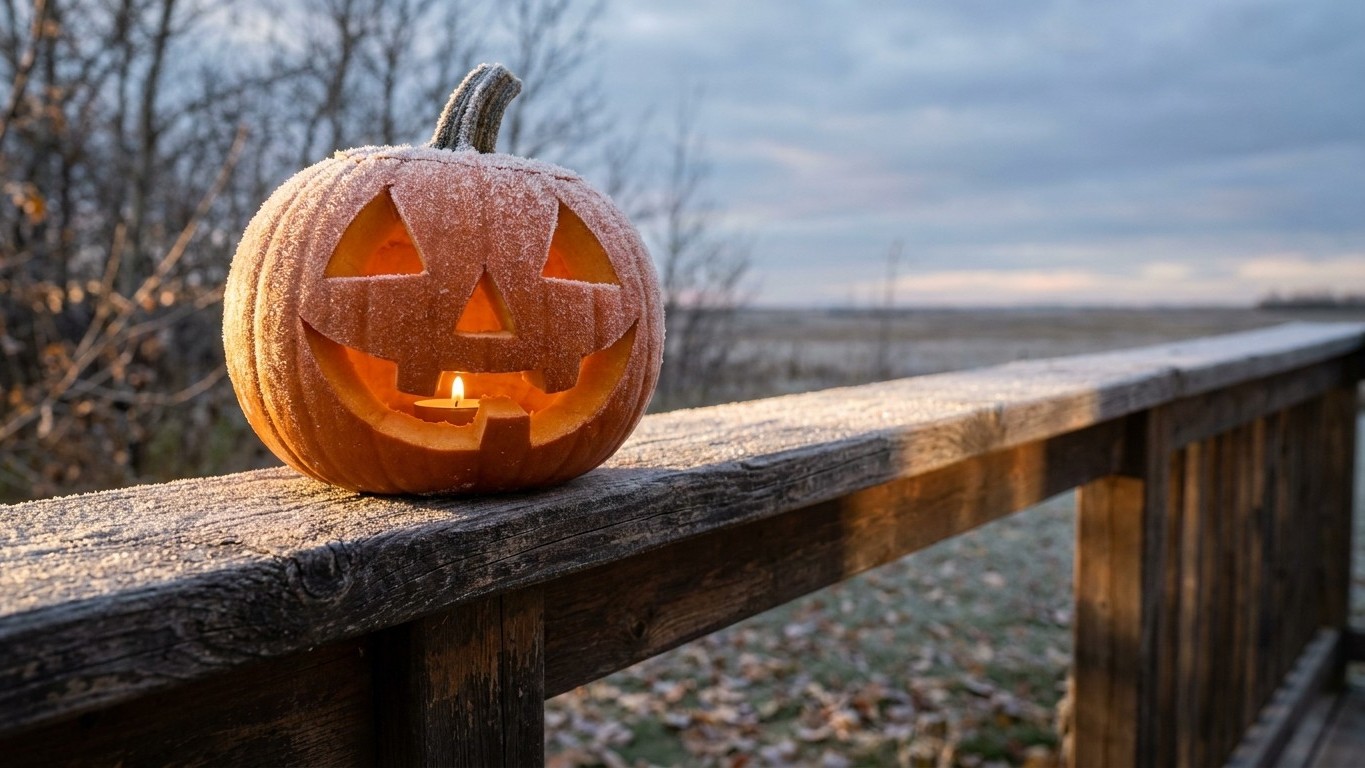

Manitoba’s mean first fall frost lands around September 22, more than five weeks before Halloween. That gap changes the calculus for anyone counting on a porch pumpkin to look sharp on October 31. Here’s how to read that frost date, what actually threatens a carved pumpkin in this province, and where to park it until carving day.
The short answer

Environment and Climate Change Canada’s 1981-2010 climate normals put the mean first fall frost for the Winnipeg area at around September 22, drawn from the Winnipeg Richardson Int’l A station. That’s a mean, not a schedule. In roughly half of all years, frost shows up later than that date, sometimes by a couple of weeks. Treat September 22 as the midpoint of a window, not a line you can plan a Halloween display around with any certainty.
Do the math against Halloween and the picture is stark: September 22 falls about 39 days, or roughly five and a half weeks, before October 31. In a typical year, the first frost of the season has already come and gone well before trick-or-treaters show up. That’s very different from states where the mean frost date lines up close to Halloween itself, and it means Manitoba carvers are working against cold, not against a race to beat the season.
What that means in practice: there’s no benefit to carving early to “get ahead” of frost, because frost risk is already baked into the calendar by the time most people start thinking about pumpkins at all. The smarter move is the opposite. Keep the pumpkin whole for as long as you can, since a whole pumpkin stores for three to six months in the right conditions, and carve close to the day you actually plan to display it. A carved pumpkin has exposed flesh, and exposed flesh is what a cold snap and the freeze-thaw cycle common on the prairies in late October will damage first.
So the window to carve in isn’t really about outrunning frost, since that risk arrives on its own schedule well ahead of Halloween most years. It’s about minimizing the number of days the cut surface sits outside before the display date. A reasonable target for most households is carving somewhere in the two to four days before Halloween, after the pumpkin has spent the bulk of its life whole and stored properly. That keeps the exposed interior in the open air for the shortest stretch possible, while still leaving time to enjoy the finished jack-o’-lantern.
Frost or heat: which one gets it here
The cold end
Cold is the dominant threat to a Manitoba pumpkin, not heat. The coldest month here runs to a mean daily minimum of -6.6°F, which tells you how far below freezing nighttime lows regularly go once winter sets in. Late October sits well ahead of that deep cold, but the trend is already pointed in that direction. Whole pumpkins are best kept between 45 and 50°F, and by late October, unprotected outdoor nights in Manitoba are frequently well below the bottom of that range, often below freezing altogether. A pumpkin left uncovered on an exterior step through several late-October nights is at real risk of chilling injury or outright freezing, long before Halloween arrives.
This is the reason the mean frost date matters so much here: it signals that the season has already tipped into a cold-dominant pattern by the time most carving decisions get made. A pumpkin that freezes and thaws even once tends to soften and break down fast, whole or carved. In Manitoba, that risk is the one to plan around.
The warm end
Heat, by contrast, is close to a non-issue here in the weeks before Halloween. The 45-50°F storage band has an upper limit too, and in southern states where the mean frost date arrives much later in the fall (or barely arrives at all before Halloween), warm autumn afternoons can push storage spots above that upper bound, encouraging mold and premature softening. Manitoba doesn’t have that problem. Once the calendar turns to mid-to-late October here, afternoon highs are rarely warm enough, for long enough, to threaten a pumpkin from the heat side of the range. The entire risk profile in this province sits on the cold end of the scale, which is why storage advice for Manitoba should focus on keeping things from freezing, not from overheating.
Where to keep it until you carve
Given how firmly Manitoba sits on the cold side of the risk, the goal is a spot that stays close to 45-50°F and stays dark, without ever dipping to freezing. A few practical options, in rough order of usefulness for most homes in this province:
- An unheated but insulated entryway, mudroom, or enclosed porch. These spaces often track close to the target range in fall, staying cooler than the living areas of the house but insulated enough to avoid the hard freezes hitting the exterior steps.
- A basement away from the furnace or any heat duct. Basements in Manitoba homes tend to run cool and stable, which suits a whole pumpkin well, provided it isn’t sitting near a heat source that pushes the spot above 50°F.
- An attached, unheated garage, if it doesn’t freeze. This works fine early in the season, but check it regularly as temperatures drop; once overnight lows in the garage start flirting with freezing, move the pumpkin somewhere more insulated.
- Anywhere away from ripening fruit and vegetables. Apples, potatoes, and tomatoes give off a gas that ages a pumpkin faster, so keep it well clear of the produce bowl or the root cellar shelf where those items sit.
- Out of direct sun and away from exterior doors that let in drafts of cold air each time they open, which can chill a pumpkin sitting just inside faster than expected.
Whichever spot you choose, check the stem before you settle on a pumpkin at the patch or the stand. Look for one to two inches of stem still attached. The stem isn’t a handle, and a pumpkin should never be carried or lifted by it; it functions as a seal, and once it snaps off, that exposed patch becomes the first place spoilage sets in.
Checking this against your own county
The September 22 mean frost date comes from a single reference station in Winnipeg, and Manitoba is a big province with a lot of climate variation across it. Northern communities and higher-elevation districts routinely run behind that date by a couple of weeks or more, which shifts the whole calculation earlier for those areas. Before locking in a carving date, check conditions specific to where you live rather than relying on a provincial average.
Manitoba Agriculture is the place to start. Their office tracks regional frost patterns and growing-season data across the province, and can point you toward the nearest weather station and local advisories relevant to your area. Pair that with your own observation of overnight lows in your yard during the last two weeks of October, and you’ll have a far better read on your actual carving window than any single provincial figure can offer.
Common questions
How long does a carved pumpkin last in Manitoba?
No extension service, including University of Illinois Extension or Utah State University Extension, publishes a lifespan figure for a carved pumpkin, and there’s no verified preservation method (bleach dips, petroleum jelly, and similar tricks aren’t backed by research). What is established: choose a firm pumpkin with an intact stem, keep it whole as long as possible in cool, dark conditions, and carve it close to the day you plan to display it.
Does an early September frost ruin a pumpkin still on the vine?
A light frost can damage exposed vines and foliage, but the mean frost date reported here describes air Temperature at a weather station, not a guarantee about every pumpkin patch. Growers watch their own fields closely once frost risk starts in September, since a hard freeze is a different, more damaging event than a light frost.
Should I bring a whole pumpkin inside once nights start dropping toward freezing?
Yes. Once overnight lows in your area start approaching 32°F, an uncovered pumpkin outside is at risk. Moving it to an unheated but insulated space, like an entryway or basement, keeps it closer to the 45-50°F range it needs.
Is there a downside to carving too far ahead of Halloween in this climate?
Yes. The exposed flesh of a carved pumpkin is far more vulnerable to Manitoba’s cold nights than a whole one is. Carving several weeks out means more nights of exposure to freeze-thaw swings, which speeds up softening and collapse. Carving closer to the display date limits that exposure.